Ksar Saïd Palace: A Beylical Palace in Tunisia
Site at a Glance
- Rating
- 4.2
- Popularity
- Low
- Country
- Tunisia
- Primary era
- Modern
- External website
- Open
- Eras represented
- Modern
- Civilizations
- Unclassified
- Site type
- Domestic
- Remains
- Palace
On this page9 sections
History
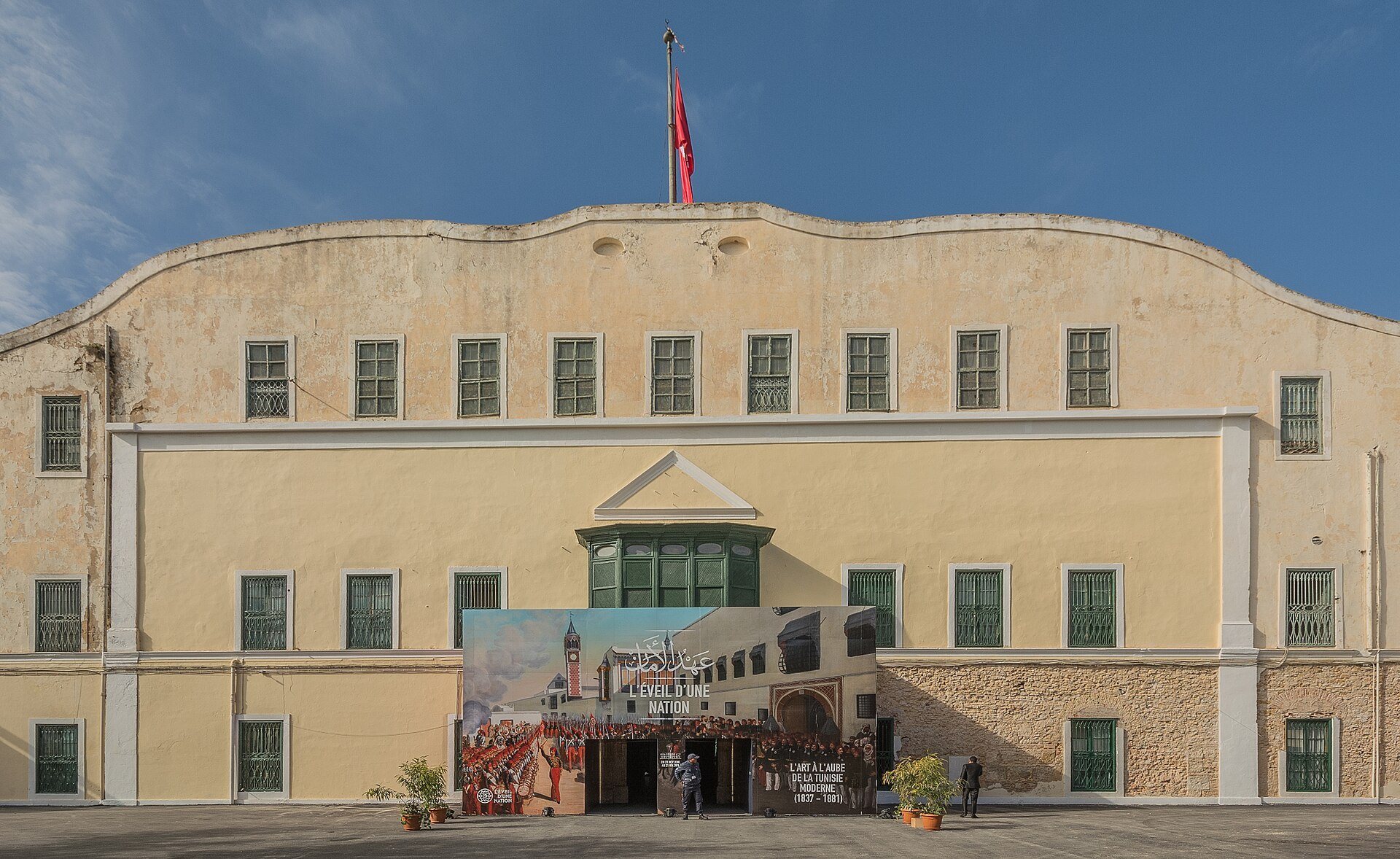
Ksar Saïd Palace is a former beylical palace in Le Bardo, Tunisia, completed in 1845 within the nineteenth-century tradition of Tunisian palace architecture. A bey was the hereditary ruler of Tunisia during the Husainid dynasty, which governed the country from 1705 to 1957. The palace later became the setting for the signing of the Treaty of Bardo, the 1881 agreement that placed Tunisia under French control while formally retaining the bey as ruler.
Residence of Ismaïl Es-Sounni
The palace was first the preferred residence of Ismaïl Es-Sounni, a high dignitary of the Husainid dynasty and brother-in-law of Muhammad Bey and Muhammad III Sadiq Bey. In 1867, Ismaïl Es-Sounni was accused of plotting against Muhammad III Sadiq Bey and was executed. Sadiq Bey then took possession of the residence, renamed it Ksar Saïd, meaning “Blessed Palace,” and moved there in 1869 after major alterations.
The Treaty of Bardo
On 12 May 1881, Muhammad III Sadiq Bey signed the Treaty of Bardo at the palace under compulsion. The agreement established the French protectorate in Tunisia, beginning a period in which France controlled the country while the bey remained its formal ruler. Sadiq Bey died in 1882, and his successor, Ali III Bey, abandoned Ksar Saïd in favor of a residence at La Marsa.
At the beginning of the twentieth century, the palace again served as a beylical residence under Muhammad IV al-Hadi Bey. He was the only ruler to inhabit Ksar Saïd after Sadiq Bey. In the years following the establishment of the protectorate, the French geophysicist Charles Lallemand described the palace as being in fairly good condition, with several well-maintained apartments, extensive gardens, and an orangery.
Hospital, exhibition venue, and cultural institution
In 1951, Lamine Bey, Tunisia’s last bey, converted the palace into the headquarters of a hospital named after him. The institution was renamed Aboulkacem-Chabbi Hospital in 1957, and additions and alterations were made during this period. An attempt to establish a museum of modern and contemporary Tunisian history at Ksar Saïd began in 1981, but the museum was never inaugurated.
After the 2011 Tunisian Revolution, a museum devoted to the Muradid and Husainid beys was proposed for the palace. The Muradid dynasty had ruled Tunisia before the Husainids, from 1613 to 1702. Ksar Saïd later hosted The Awakening of a Nation in 2016 and 2017, an exhibition concerned with Tunisia’s reform period from 1830 to 1881.
Following restoration work, the palace was inaugurated by Prime Minister Youssef Chahed in March 2019 and officially renamed Ksar Saïd, Palace of Letters and Arts. Since then, it has housed the Tunis Institute of Philosophy, the Tunis School of History and Anthropology, and the Tunis School of Thought, which organize conferences and academic meetings. On 15 March 2022, the palace was classified and protected as a historical monument in Tunisia.
Remains
Palace plan and interior decoration
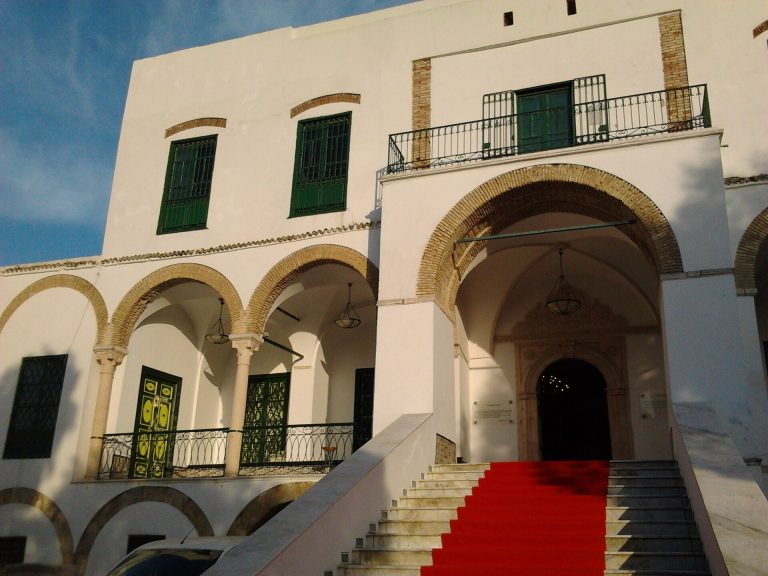
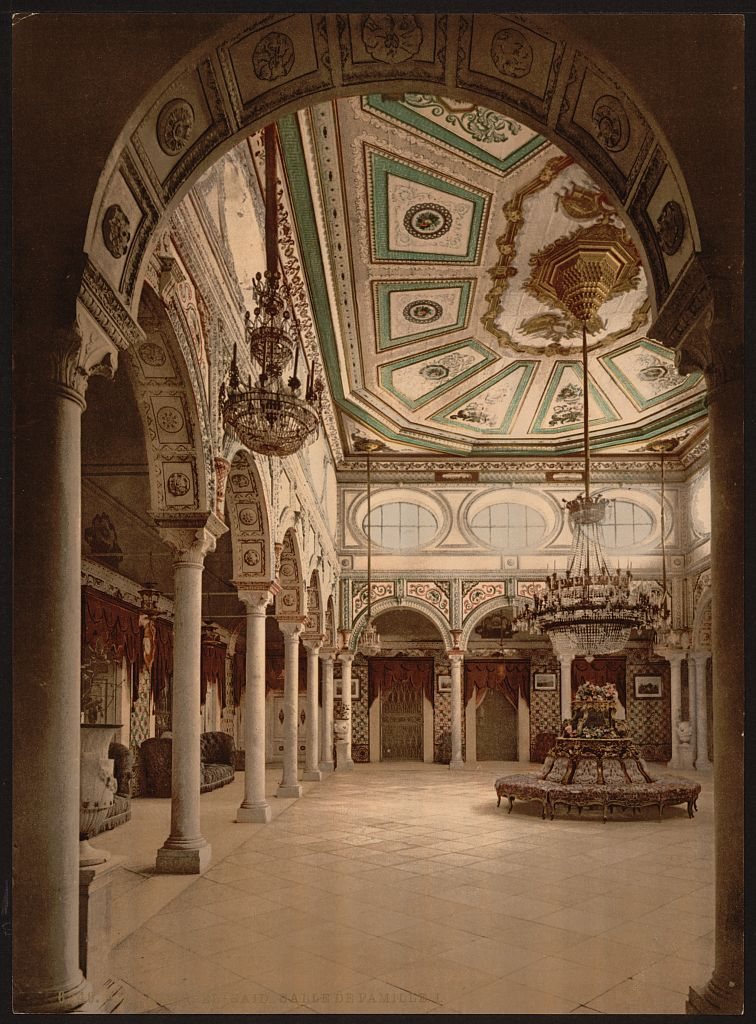
Ksar Saïd combines European architectural and decorative influence with Tunisian and Arab-Islamic traditions. Its first floor was treated as the principal or noble level and contains both ceremonial salons and the bey’s private apartments overlooking a central courtyard. A marble staircase leads to this upper floor, with Italian-style ceramics on its walls and ceiling.
Two ceremonial salons display different forms of local palace decoration. The salon on the right has a T-shaped plan with alcoves. The salon on the left has a barrel-vaulted ceiling covered with plaster sculpture and rosette motifs made using nakch hdida, a Tunisian technique for carving incised plaster decoration. Another chamber contains a semicircular alcove whose arch is filled with carved and gilded ornament.
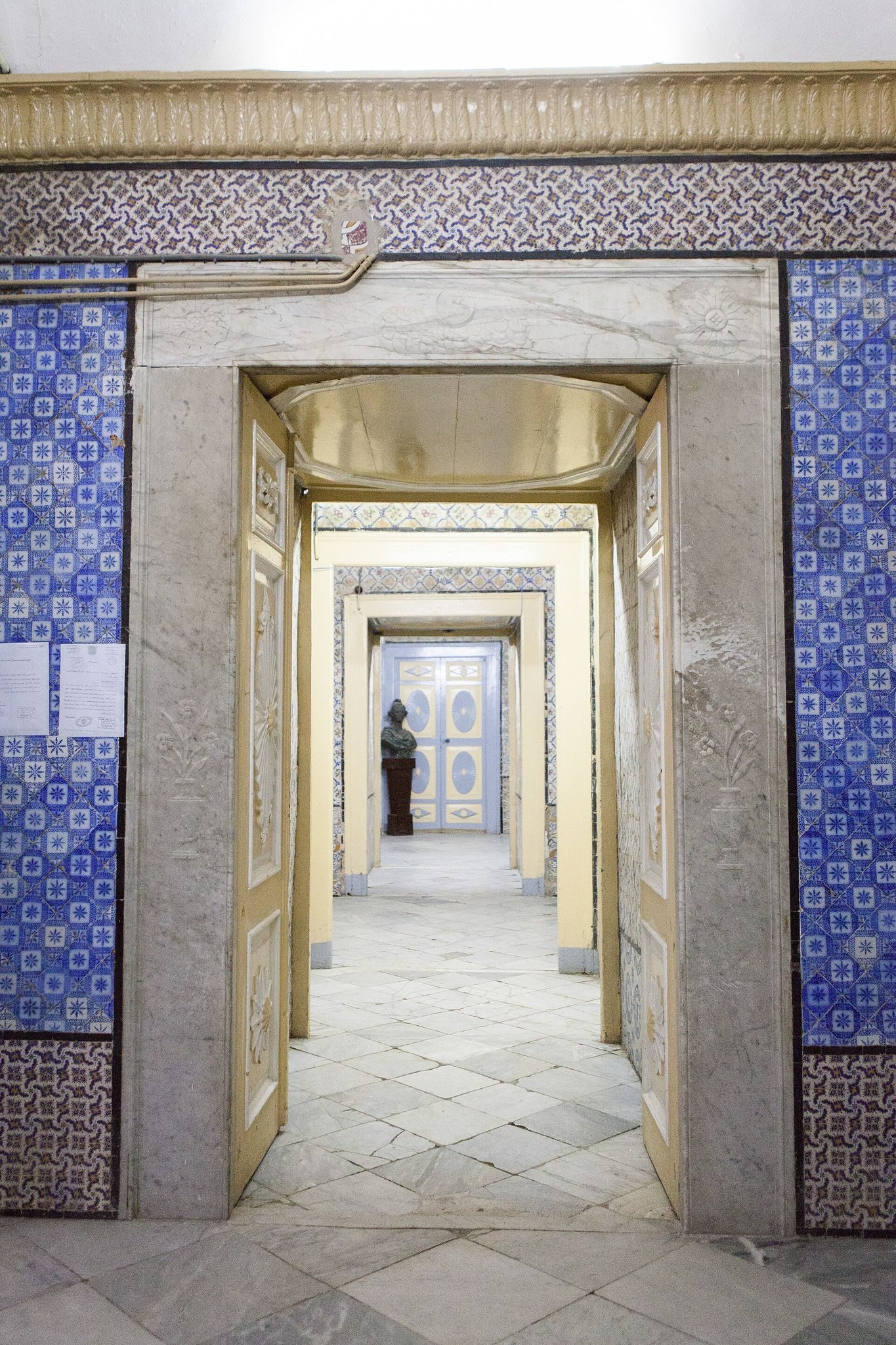
Ceramic tiles cover much of the interior and were imported mainly from Italy. White Carrara marble appears in the columns, capitals, door frames, pavements, and other architectural elements. Ceiling paintings, furniture, hangings, and additional furnishings are Italian in workmanship or origin, while several rooms retain references to Tunisian architectural and decorative traditions.
Gardens and orangery
The palace was historically surrounded by extensive gardens. Charles Lallemand described an orangery extending across several hectares and containing thousands of golden apple trees. This cultivated area formed part of the palace setting during the period when Ksar Saïd functioned as a beylical residence.
Historical paintings
The palace houses approximately sixty large historical paintings showing Tunisian and foreign statesmen as well as important events in Tunisian history. Among the subjects are Ahmad I Bey in European dress, Muhammad III Sadiq Bey with his hand on the 1861 Constitution, Hayreddin Pasha as a brigadier general, the young grand vizier Mustapha Khaznadar, Victor Emmanuel II, and Ludwig II of Bavaria.
Other paintings portray the return of the Tunisian army from the Crimean War in 1856, the meeting of Sadiq Bey and Napoleon III in Algiers in 1860, and King Leopold I of Belgium receiving Hayreddin Pasha in Brussels while he served as the bey’s special envoy. Works in the collection bear the signatures of Charles Gleyre, Auguste Moynier, Alexandre Debelle, Charles-Philippe Larivière, Feodor Dietz, and other European artists.
Furniture, political objects, and decorations
The palace preserves locally made and imported historical furniture, including mid-nineteenth-century beylical thrones decorated with gold leaf. A table dated to 1881 is associated with two major political acts. The Treaty of Bardo was signed on it that year, and exactly 83 years later, on 12 May 1964, Habib Bourguiba signed documents nationalizing agricultural land held by colonists on the same table. Bourguiba later became Tunisia’s first president.
The collections also include Husainid decorations and medals from the nineteenth and twentieth centuries. Among them is the Nichan Iftikhar, a Husainid order and decoration made of silver and enamel in the dynasty’s red and green colors.