Burg Rolandseck: A Ruined Hilltop Castle in Germany


Site at a Glance
- Rating
- 4.8
- Popularity
- Very Low
- Country
- Germany
- Primary era
- Medieval
- External website
- Open
- Eras represented
- Medieval, Modern
- Civilizations
- Holy Roman Empire
- Site type
- Military
- Remains
- Castle
On this page14 sections
History
Foundation and medieval fortification
Burg Rolandseck is a ruined hilltop castle in Germany, in the Rolandswerth district of Remagen. Archbishop Friedrich I of Cologne built it in 1122 together with the women’s monastery of Nonnenwerth. The castle followed an earlier mention of the site as Rulcheseck in 1040, and a predecessor structure may already have existed then. Its medieval buildings belonged broadly to the Romanesque tradition, which flourished in western Europe during the eleventh and twelfth centuries.
During the twelfth century, Burg Rolandseck joined Drachenfels and Wolkenburg in securing the southern frontier of the coherent territory ruled by the Archdiocese of Cologne. The older name gradually developed into Rolandseck during the fourteenth century.
Destruction and collapse
The castle was destroyed during the Burgundian War in 1475 and subsequently rebuilt. Swedish forces severely damaged it around 1632 during the Thirty Years’ War, the major European conflict fought from 1618 to 1648. The castle then fell into ruin. On 19 February 1673, an earthquake caused the remaining structure to collapse almost entirely, leaving one castle window that later became known as the Rolandsbogen, or “Roland’s Arch.”
Legend and Rhine Romanticism
A Middle High German version of the local Roland legend connects the site with Roland, the legendary paladin associated with Charlemagne in medieval tradition. In the story, Roland left the grieving Hildegunde at Drachenfels, after which she entered Nonnenwerth monastery. Hildegunde is a legendary figure rather than a securely documented historical person, and the tale conflicts with the chronology of the historical Roland tradition. Roland is associated with Charlemagne in the eighth century, about three centuries before the castle and monastery were built.
The hill and castle arch passed to the Grand Duchy of Hesse-Darmstadt in 1836. The surviving arch became a landmark of Rhine Romanticism in the Bonn region, a nineteenth-century cultural movement that found historical and artistic meaning in the Rhine valley’s castles, ruins, scenery, and legends. When the Rolandsbogen collapsed on 28 December 1839, the poet Ferdinand Freiligrath appealed for donations in the Kölnische Zeitung. The arch was rebuilt in 1840 according to plans supplied by Ernst Friedrich Zwirner, the Cologne cathedral architect.
Nineteenth- and twentieth-century additions
Johann Jakob vom Rath, a Cologne sugar manufacturer who also commissioned architectural and landscape projects, ordered the Tempelchen in 1845 and the Rath Tower, later called the Humboldt Tower, on the Rodderberg in 1848. He intended the associated project to create an attraction that would surpass the Rolandsbogen, which he had been unable to acquire. A refreshment kiosk stood on the plateau by 1894. A larger restaurant followed in 1928–1929 with funds from Ernst Ludwig, Grand Duke of Hesse and by Rhine. Designed by the Mehlemer architect Peter Wald, it was inaugurated on 6 May and opened on 8 May 1929.
Recent conservation
A fire destroyed the restaurant in December 2001. After restaurant income proved insufficient to finance care of the ruin, an investor acquired the hill and castle ruin in early 2008. The restaurant underwent major renovation in 2009. A long-term program for the ruin and its surroundings was then developed with Remagen, the Ahrweiler district, monument-protection authorities, and support associations.
The Freiligrath monument on the historic ascent was renovated in 2011, and the Rolandsbogen was comprehensively repaired in 2010–2011. In September 2012, the upper staircase to the viewing terrace and the forecourt were renewed, while parts of the Romanesque castle wall were exposed and conserved in the Freiligrath Hall. The arch entered the federal program for nationally valuable cultural monuments in July 2013. Access from the former moat was renewed in 2014, and repairs to the southern outer-bailey walls began in 2015.
On 29 January 2015, part of the southern outer-bailey wall and a landing supporting the staircase to the plateau collapsed. Access to the Rolandsbogen was restored in March 2016 with a new concrete retaining wall faced with rubble stone, and the historic castle path reopened. The ruin lies within a landscape-protection area, which limited the periods available for conservation work.
Remains
Castle rock and surviving medieval fabric
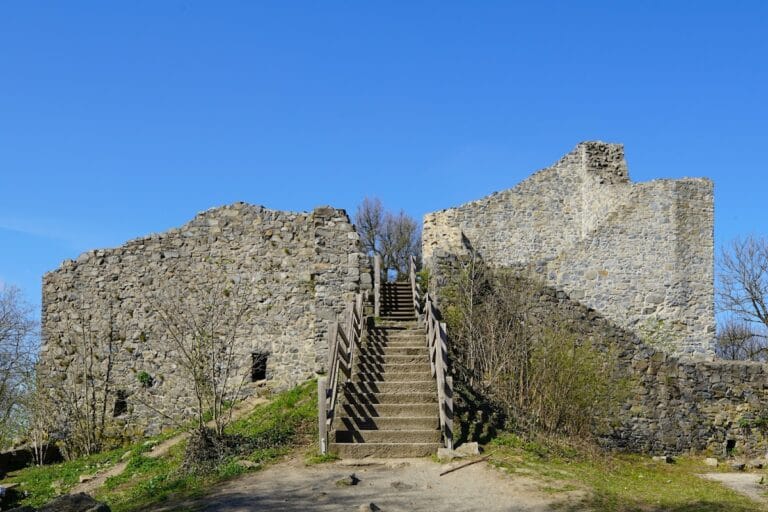
Burg Rolandseck stands on a basalt rock below the Rodderberg at 155.2 metres above sea level, above the Middle Rhine Valley. The site occupies the final left-bank constriction of the Rhine before the valley gradually opens into the Lower Rhine Bay. A staircase leads to the plateau and viewing terrace. From the former castle moat, a renewed route reaches the arch, while the historic southeastern castle path runs below the main walls.
Rolandsbogen
The Rolandsbogen is the last surviving castle window from Burg Rolandseck. Before its conservation in 2010–2011, ivy covered and endangered the arch, and removing the growth changed its external appearance. The route to the arch and the landing beside the staircase were restored after the 2015 collapse. The surviving opening now forms the principal remnant of the castle’s upper structure.
Southern outer bailey
The southern walls of the former outer bailey rise as high as 12 metres. They include dry-stone construction, in which stones are arranged without regular mortar joints and rely on their weight and placement for stability. Some of these walls are estimated to be about 900 years old. Parts of the original upper castle, probably including twelfth-century wall fabric, were exposed and conserved in the Freiligrath Hall.
Romantic landscape features
Tempelchen
The seven-sided Tempelchen stands on a rocky projection below the Rolandsbogen. Built in 1845 as a viewing pavilion, it followed plans by Ernst Friedrich Zwirner. Its polygonal form was influenced by Masonic symbolism. The pavilion was dismantled in 1931 because it endangered the railway tracks, and proposals to rebuild it have not been implemented.
Rath Tower
The Rath Tower, later known as the Humboldt Tower, was erected on the Rodderberg in 1848 as part of Johann Jakob vom Rath’s associated landscape project. Its construction formed part of the nineteenth-century setting created around the castle arch.
Freiligrath monument
The Freiligrath monument stands beside the historic footpath leading from the Rhine Valley to the Rolandsbogen. It commemorates Ferdinand Freiligrath’s role in initiating the arch’s reconstruction in 1840. The monument was renovated in 2011.
Nearby sites