Palazzo Campana: A Noble Residence and Educational Institution in Osimo


Site at a Glance
- Rating
- 4.4
- Popularity
- Very Low
- Country
- Italy
- Primary era
- Early Modern
- External website
- Open
- Eras represented
- Early Modern, Modern
- Civilizations
- Papal States
- Site type
- Domestic
- Remains
- Elite Residence
On this page10 sections
History
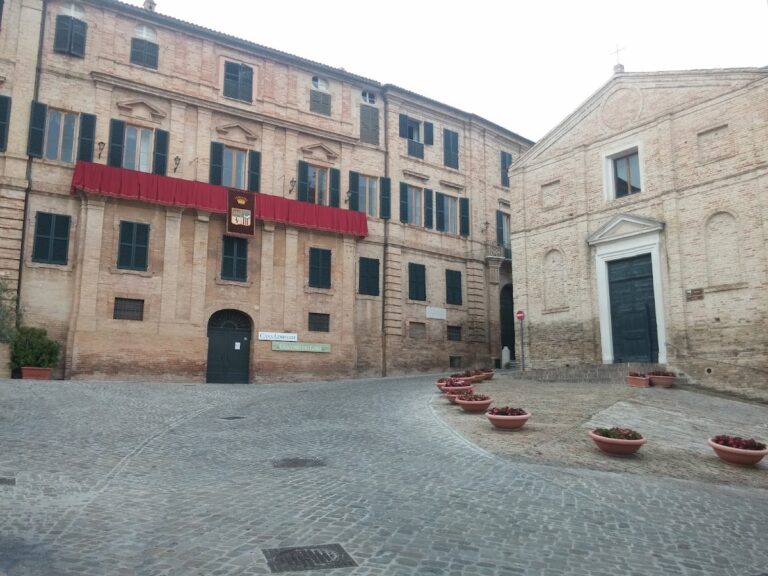
Palazzo Campana is a historic noble residence and former educational institution in Osimo, Italy, whose construction and enlargement took place broadly during the seventeenth and eighteenth centuries. Built for the Campana marquises, it later became the seat of a residential college and episcopal seminary, institutions that helped make Osimo a centre of education and culture.
The Campana family and its inheritance
The palace began as the residence of the Campana marquises of Osimo. The earliest identified ancestor of the family was Ugocinus Feltronini de Campaneschis, who served as Osimo’s gonfalonier in 1457. A gonfalonier was a civic officeholder associated with the city standard who could also exercise important governmental or military responsibilities.
Federico Campana held military and administrative positions within the Papal States. He was commissioner of the Pontifical Cavalry for the Legations of Romagna, papal territories administered through the Papal States, and vice-castellan of Ancona fortress, meaning deputy administrator or commander of that fortified place. In his will, he directed that if the direct male line of the family became extinct, its property should pass to Osimo’s Company of Death to finance a monastery for Capuchin nuns, members of the Capuchin branch of the Franciscan tradition.
Federico’s wishes became contentious after Scipione Campana, the last member of the family, died without descendants. The resulting legal dispute continued until 1710, when Apostolic Visitor Ferdinando d’Adda approved the testamentary arrangement. An Apostolic Visitor was a papal representative appointed to inspect ecclesiastical institutions or settle particular church matters. During the dispute, Benedetta Wan Herten Viganega of Genoa also sought to establish a women’s monastery in Osimo and place the Campana property at public disposal.
The college and episcopal seminary
A rescript issued on 20 September 1715 by the Sacred Congregation of Bishops and Regulars designated Palazzo Campana as the seat of a male residential college and the episcopal seminary. This Roman Curia office dealt with matters concerning bishops and religious orders. The decision was supported by Orazio Filippo Spada, bishop of Osimo. The city’s seminary had already existed since 1564, while the new arrangement joined its work to the college established in the palace.
The college and seminary expanded over time and drew students from an increasingly broad geographical area. Their teachers included Giuseppe Santini and Giuseppe Ignazio Montanari, alongside scholars of literature, oratory, philosophy, and mathematics. The students included Aurelio Saffi, an Italian politician and intellectual associated with republicanism and the Risorgimento, as well as the future popes Leo XII and Pius VIII.
The college operated for approximately 250 years before ceasing activity after a lengthy separation from the seminary. From 1984, the institution functioned under a new statute, revised in 2015, and adopted the name Istituto Campana per l’Istruzione Permanente. It continues the educational and cultural function associated with Palazzo Campana through exhibitions, book presentations, conferences, and other major events.
Library, archives, and present institutions
The college possessed a substantial library from its foundation for the use of resident students and seminarians. Its holdings grew through bequests from the bishops Pompeo Compagnoni and Guido Calcagnini, followed later by the bequest of the Carmelite Agostino Maria Molin. In 1851, Giovanni Soglia Ceroni, then bishop of Osimo, approved the transfer of the library to a room on the palace’s principal floor.
The Casati Law of 1859 and the Valerio Decree of 1861 required the episcopal seminary to leave the palace. The library was consequently divided between the new seminary and the college. It was later reunited, including through Osimo’s donation of books that had belonged to Giuseppe Ignazio Montanari. The collection now comprises about 16,000 volumes, including 155 manuscripts dating from the fourteenth to the twentieth centuries, several with illuminated decoration, and 20 incunabula, books printed in Europe before 1501. It also includes Gerardus Mercator’s geographical atlases of 1613 and atlases by Joan Blaeu.
The Campana Historical Archive occupies the palace’s principal floor. Its holdings bring together the records of the Campana family, the Nobil Collegio and episcopal seminary founded in 1715, and the institution’s agricultural enterprise. The records span the period from 1483 to 1967.
Palazzo Campana currently houses the Istituto Campana per l’Istruzione Permanente, the Consortium for Advanced Training and Development of Scientific Research in Administrative Law, the Francesco Cini Municipal Library, the Luigi Egidi Municipal Historical Archive, the Civic Museum, and the Archaeological Museum.
Remains
Palazzo Campana survives as a noble residence and former college shaped by construction and enlargement during the seventeenth and eighteenth centuries. Several architects contributed to its development, including Andrea Vici, an eighteenth-century Italian architect and engineer. Within the building, historic rooms, the library, an art collection, and the principal-floor archives preserve different aspects of its aristocratic and educational past. Two underground galleries connect the palace with Osimo’s extensive subterranean system.
Rooms, library, and paintings
Library room
A library room on the principal floor retains its original wooden shelving. Its ceiling is decorated with grotesques, ornamental designs combining foliage, figures, animals, and fantastic motifs in intricate arrangements. The room forms part of the palace’s surviving library environment, whose collections developed for the college and seminary.
Campana art collection
The oldest rooms contain an art collection associated with Federico Campana’s testamentary bequest of 1646 to his nephew Muzio Campana, who died in 1687. Among the seventeenth-century paintings connected with Guercino and his workshop are The Tiburtine Sibyl, The Madonna and Child, Queen Sophonisba, and Samson and Delilah. Guercino was the established name of the Baroque painter Giovanni Francesco Barbieri.
The collection also includes Saint Francis in Prayer. Initially associated with Guercino and his workshop, the painting was definitively attributed to Guercino after its restoration in 2014. Three fresco fragments attributed to the fourteenth-century painter Andrea da Bologna depict The Coronation of the Virgin, Christ Judge, and Music-Making Angels. Other works include The Beheading of Saint Denis by Giacinto Brandi, The Sorrowful Virgin with Angels and Symbols of the Passion by Odoardo Vicinelli, and a Saint Nicholas and Holy Monk possibly by Claudio Ridolfi.
Underground galleries
Sandstone reliefs
Two underground galleries beneath Palazzo Campana form part of Osimo’s wider subterranean system. Their walls contain numerous figures carved in sandstone. The reliefs have received several interpretations. Some identify pagan deities such as Venus, Bacchus, and Mercury, while others see personifications including Death, Perseverance, and Will, or representations of territories such as Africa and America.
Another interpretation associates the figures with the categories of vices, virtues, and arts described in Cesare Ripa’s Della novissima iconologia. One underground vault also contains reliefs recognizable as heraldic coats of arms belonging to Osimo families. The circumstances of their creation remain unclear, and the figures may date from the eighteenth or nineteenth century.