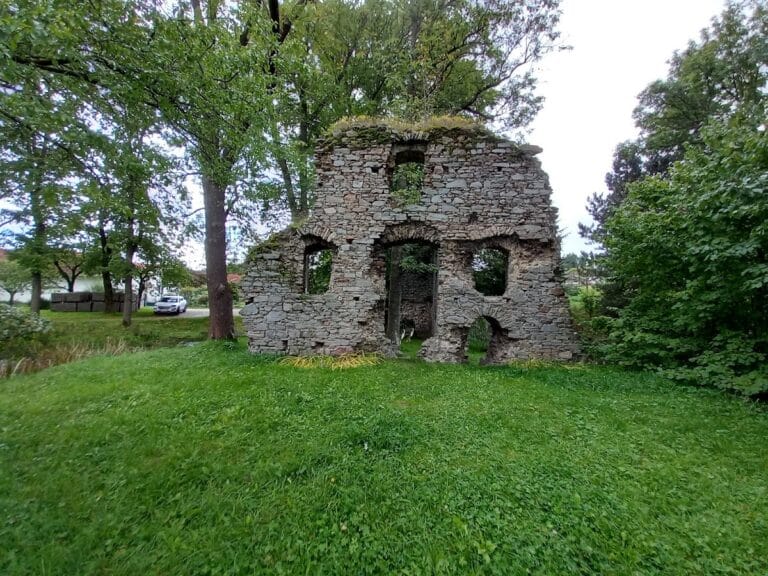
Vysoký Chlumec Castle: A Medieval Noble Seat in Czechia


Site at a Glance
- Rating
- 4.4
- Popularity
- Very Low
- Country
- Czechia
- Primary era
- Medieval
- External website
- Open
- Eras represented
- Medieval, Early Modern
- Civilizations
- Holy Roman Empire, Kingdom of Bohemia
- Site type
- Military
- Remains
- Castle
On this page10 sections
History
Vysoký Chlumec Castle is a medieval noble castle in Czechia, originating toward the end of the reign of Charles IV in the fourteenth century. Charles IV was the king of Bohemia and Holy Roman Emperor during a period of major political and architectural development in the Bohemian lands. The castle was first mentioned in 1382 in connection with Zbyněk, its burgrave, or castle governor.
Royal Grant and the Janovice Lords
In 1385, King Wenceslaus IV granted Chlumec Castle and the associated settlements of Chlumec and Víska hereditarily to his favorite, Purkart Strnad of Janovice. The estate later became connected with Peter of Janovice, a Bohemian nobleman who signed the protest by Bohemian nobles against the burning of Jan Hus at the Council of Constance in 1405. Hus was a Bohemian religious reformer whose execution in 1415 became a major issue in Bohemian religious and political history. Peter also fought for the moderate coalition at the Battle of Lipany in 1434, a decisive conflict in the Hussite Wars. Emperor Sigismund subsequently pledged several villages around Chlumec to him. These villages had formerly belonged to St. George’s Convent at Prague Castle.
By the middle of the fifteenth century, the Chlumec estate included two estates, 16 hereditary villages, and several forests. Jan Burkart Jenec of Janovice and Petersburg sold the Chlumec lordship to Bedřich Ojíř of Očedělice in 1469. Ojíř then sold the castle, the small town of Sedlec, and associated villages to Anna, the widow of Johann Popel of Lobkowicz, in 1474.
The Lobkowicz Lordship
Děpolt Popel of Lobkowicz held the lordship from 1476 and secured hereditary possession of the villages that had belonged to the former convent. He also acquired the estates of Sedlčany and Křepenice from the Rosenbergs as pledged property, although those estates were later redeemed. A division of the family possessions in 1490 assigned Sedlčany and Miličín, together with half of Chlumec, to his brothers Václav and Ladislav. After acquiring the North Bohemian lordship of Bílina in 1502, Děpolt moved his seat there. When Ladislav died in 1505, Václav Popel of Lobkowicz became sole owner of Chlumec.
After Václav’s death, his nephew Ladislav Popel of Lobkowicz inherited Chlumec in 1532. Ladislav held important offices as court marshal, president of the Court of Appeals, and chief chamberlain. He also enlarged his possessions with the lordships of Jistebnice and Krásná Hora nad Vltavou. His son, Zdeněk Vojtěch Popel of Lobkowicz, received Chlumec in 1595.
Zdeněk Vojtěch acquired the Křepenice lordship and the town of Sedlčany in 1604 after the death of Jakob Krčín of Jelčany. His wife, Polyxena, acquired the Počepice estate in 1609, and it was incorporated into the Chlumec lordship. During the Bohemian Estates’ revolt, Zdeněk Vojtěch became the secular leader of the Bohemian Catholics and fled Bohemia in 1619. His property was confiscated, but he recovered it after the Battle of White Mountain in 1621. That battle defeated the revolt and led to the restoration of his estates. In 1623, he acquired several additional properties that had been confiscated from Protestants.
Expansion and Estate Administration
Polyxena inherited the lordship in 1628. She made Roudnice nad Labem Castle, inherited from her first husband Wilhelm of Rosenberg, her principal residence, while administration of her estates passed to her only son, Wenceslaus Eusebius. By 1637, the Chlumec lordship and its acquired estates included the town of Sedlčany, the small towns of Chlumec, Sedlec, Krásná Hora nad Vltavou, and Kamýk nad Vltavou, as well as 90 villages. The holdings also contained two breweries, four sheep farms, six mills, a brickworks, a sawmill, 54 fishponds, and 829 properties.
In 1640, Wenceslaus Eusebius established the lordship as a family fideicommissum, an inheritable estate arrangement intended to keep property together rather than divide it among heirs. His son Ferdinand August of Lobkowicz inherited it in 1677. Later owners included Philipp of Lobkowicz, who held it from 1715 to 1734, and Ferdinand Philipp Joseph of Lobkowicz, who held it from 1739. Ferdinand Philipp Joseph lived largely outside Bohemia and left administration to his officials. Their abuses contributed to a peasant revolt in Sedlčany and nearby villages, after which the emperor appointed August of Lobkowicz administrator of his uncle’s estates. The lordship belonged to Joseph Franz of Lobkowicz from 1784 to 1816 and to Ferdinand Joseph of Lobkowicz from 1816.
Domain in the Nineteenth and Twentieth Centuries
In 1845, the fideicommiss lordship of Hoch-Chlumetz, together with the allodial estates of Skregssow, Hoysin, and Přičow, covered 31,874 yokes and 1,447 square klafter. A yoke and a square klafter were historical Central European units of land area whose exact values varied by region and period. The Chlumec lordship accounted for 29,950 yokes and 243 square klafter. Skreyschow and Hoyschin covered 1,453 yokes and 1,440 square klafter, while Přičowé Luhy covered 470 yokes and 1,364 square klafter.
The domain contained 167 fishponds, including 114 belonging to the lordship, as well as 14 sheep farms and 25 manorial farms, 11 of them leased. Agriculture was its principal economic activity. The domain’s population numbered 17,591 people, including 56 Israelite families.
During the German occupation, the castle and brewery belonging to Max Lobkowicz were confiscated, and an authority of the Protectorate of Bohemia and Moravia was installed in the castle. Max Lobkowicz recovered the property after the Second World War, but the Communist authorities confiscated it again in 1948. Because of its art-historical importance, the castle was then placed under the administration of the state heritage service. It first served as a repository for protected furnishings from other nationalized castles and palaces. After renovation, it opened with an exhibition on regional history.
The Lobkowicz family recovered the castle through restitution in 1992. It was sold in 1998 to Riprand, Count of Arco-Zinneberg, who has since resided there.
Remains
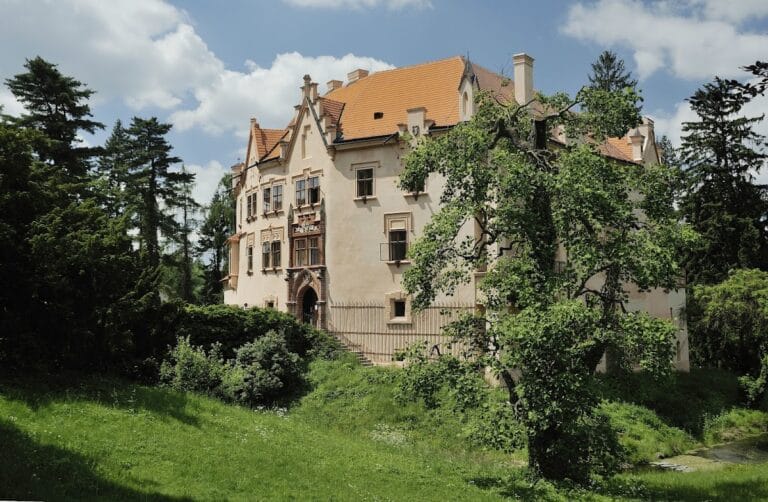
The castle stands east of the small town of Vysoký Chlumec on Chlumec, a granite hill rising to approximately 526 metres above sea level between the valleys of the Libíňský and Chlumecký streams in the Central Bohemian Hill Country. Vápenice lies to the east, the settlement of Pod Zámkem to the southeast, the Vysoký Chlumec brewery to the south, and the Vysoký Chlumec open-air museum to the northwest. The surviving complex retains a medieval character, with two courtyards, a tall residential building, and a tower.
Medieval Core and Courtyards
Original Castle
The original castle had an irregular quadrangular plan surrounding a small inner courtyard. Two residential wings occupied its western and eastern sides. The first entrance crossed a drawbridge and led through what is now the West Gate. In the second half of the fifteenth century, the Popel family of Lobkowicz remodelled and enlarged the complex by adding a new southern courtyard and a second entrance with its own drawbridge.
West Gate
The West Gate preserves the line of the original approach into the castle. In 1678, Antonio della Porta, a seventeenth-century master builder associated with aristocratic construction projects in Central Europe, made limited alterations to the gate. He replaced its drawbridge with a stone arch bridge.
Unbuilt Palace Project
After 1668, Wenceslaus Eusebius of Lobkowicz commissioned della Porta to replace the medieval castle with a large palace. The project was not carried out after Wenceslaus Eusebius died. From the eighteenth century onward, no major alterations transformed the complex, allowing its medieval arrangement and principal surviving buildings to remain substantially intact.
Nearby sites