Forte Lisser: An Italian First World War Border Fort in Italy


Site at a Glance
- Rating
- 5
- Popularity
- Very Low
- Country
- Italy
- Primary era
- Modern
- Eras represented
- Modern
- Civilizations
- Italian
- Site type
- Military
- Remains
- Fort
On this page13 sections
History
Forte Lisser is a former Italian military fort in Italy, built on Monte Lisser during the early twentieth century as part of the Brenta–Cismon barrage. Standing at 1,633 metres above sea level near the former Austro-Hungarian–Italian border, it was intended to block enemy movement from the Marcesina and Val Brenta areas toward the eastern Valsugana.
Planning and construction
Initial plans for a defensive work on Monte Lisser were submitted in 1909. The first proposal called for a small auxiliary fort armed with four 120 mm guns beneath armored protection. It was to be linked with a planned main fort on Cima Echar and would have connected the Cismon–Brenta and Assa–Astico defensive groups.
In 1910, the design was changed to a larger armored fort with four 149A guns in armored turrets. Budget restrictions led to further alterations before construction began near the end of 1911. The access road was postponed until the Enego–Primolano road had been completed, while building materials were brought from the Valsugana valley by a specially constructed material cableway.
Excavation ended in November 1912, by which time masonry work had begun. Completion was planned for 1913 but was delayed. When the First World War began in August 1914, the 149 mm guns intended for the armored turrets were still at Enego, and the Schneider armored cupolas manufactured under licence by Ansaldo were waiting to be installed.
The mobilization of the Brenta–Cismon defensive command on 8 August 1914 accelerated the work. Construction was practically complete by the end of that year, and the Lisser defensive position was formally handed over in February 1915. An additional open battery of 149G guns was established outside the fort to protect the Italian deployment area. In autumn 1914, Italian Chief of the General Staff Luigi Cadorna and Roberto Brusati, commander of the First Army, visited the fort and expressed a favorable impression of it.
The opening phase of the war
The Italian army declared the Brenta–Cismon defensive group ready for action on 22 May 1915, one day before Italy presented its declaration of war to Austria-Hungary. The formation was placed on alert on 23 May, and Forte Lisser was occupied on 24 May by the 9th and 15th Companies of the 9th Fortress Artillery Regiment and the 7th Company of the 7th Field Artillery Regiment.
Together with the Coldarco cavern battery, the fort formed the second group of the defensive formation. Three forward artillery-observation posts, with about 30 men, were also subordinate to the group. Forte Lisser itself had a garrison of two officers, 106 other personnel, and 42 machine-gun crew members.
The fort was ordered to support an infantry advance with artillery if necessary. The Austro-Hungarian forces, however, withdrew to positions beyond the range of the fortress guns, so Forte Lisser fired no shots during the opening phase of the war. The first batteries of the defensive group began to be withdrawn on 28 May 1915. The external 149G battery was removed from Monte Lisser in mid-June and transferred closer to the front, while the fort’s guns and ammunition were retained in case of an Austro-Hungarian counteroffensive. After the situation stabilized, Forte Lisser gave up 800 shells and several machine guns in August.
The Austro-Hungarian offensive of 1916
During the Austro-Hungarian spring offensive of 1916, Forte Lisser again became important as a link between the Asiago plateau and the Cismon–Brenta sector. In late May, two batteries equipped with new 120 mm autocannons and four 149A guns were brought to the position. Probably two of the fort’s armored turrets were still armed at this time.
On 2 June 1916, the fort fired on Austro-Hungarian troops attacking the Meletta massif, a mountainous sector of the Asiago plateau that saw heavy fighting during the First World War. The targets included the 27th Imperial and Royal Infantry Regiment and the 2nd Bosnian-Herzegovinian Infantry Regiment. The fire fell short and struck Italian lines. Emilio Lussu later described the incident in his memoir One Year on the High Plateau. Italian wartime correspondents nicknamed Forte Lisser the “Lion of the Plateau” because it continued firing after much of the Italian artillery had been lost.
Several Austro-Hungarian 305 mm shells struck the fort on 8 June 1916. One hit the side of the battery block but failed to explode, and the bombardment caused no major damage. Once the offensive ended and the front moved back, the fort again lay far behind the lines. It was disarmed and evacuated, then assigned to the Italian XX Corps as a command post in late June. The Cismon–Brenta defensive-group command was dissolved in November 1916.
Occupation and postwar history
After the Italian defeat at Caporetto in the Twelfth Battle of the Isonzo in autumn 1917, the Italian General Staff briefly considered whether the former Brenta–Cismon defenses could slow the Austro-Hungarian advance. On the morning of 13 November 1917, during the second Austro-Hungarian attack on the Meletta massif, Forte Lisser was occupied without resistance by the III Battalion of the 81st Austro-Hungarian Infantry Regiment. The Italian rear guard had abandoned it a few hours earlier.
Austro-Hungarian forces retained the fort until the end of the war and used it as an ammunition and storage depot. After the conflict, Forte Lisser was removed from military administration but was never formally registered or sold. It remained in private ownership without cadastral recording until the Municipality of Enego acquired it in the 1990s and arranged its restoration.
Postwar deterioration included the removal of stone for local construction, including the bell tower of Enego. A ski-lift installation was later built on the summit structure. Restoration and redevelopment followed through the “Ecomuseum of the Great War in the Vicentine Prealps” project, and the restored fort opened to visitors in summer 2017. It is now owned by the Municipality of Enego and remains a restored example of an Italian border fortification that later served under both Italian and Austro-Hungarian military control.
Remains
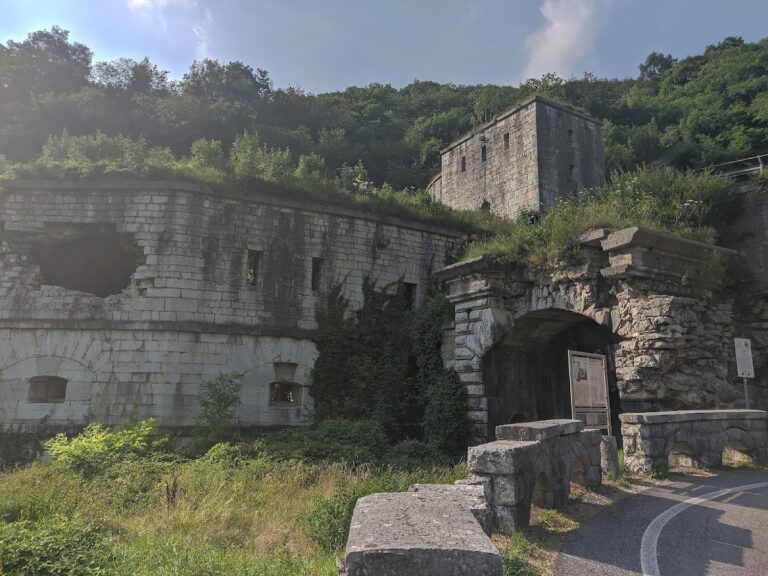
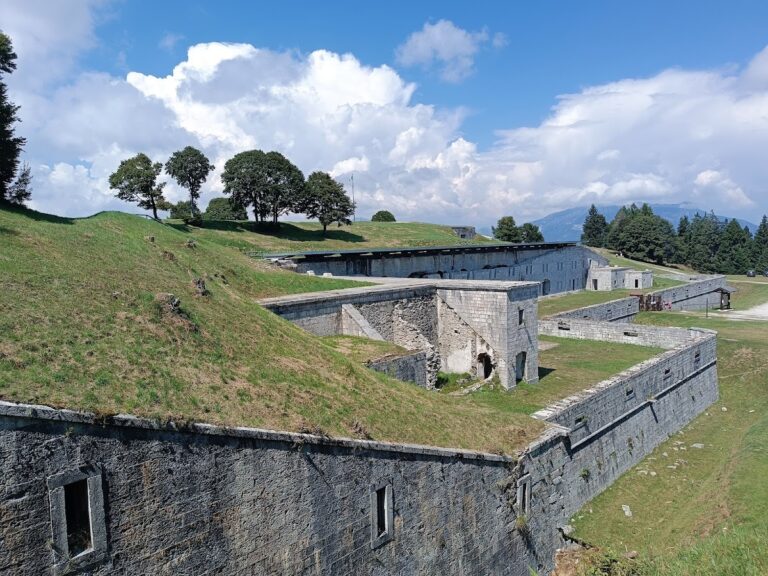
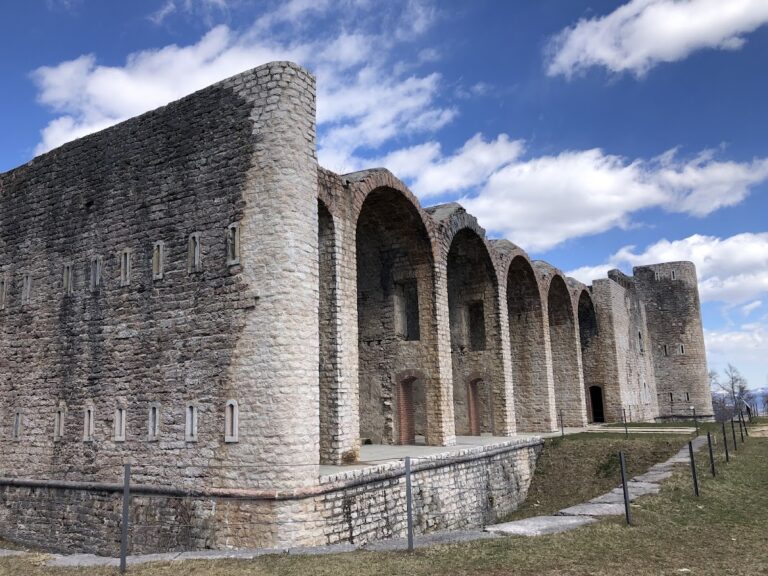
Forte Lisser occupies the summit of Monte Lisser at 1,633 metres. The partly subterranean complex is centered on a two-storey casemate block, a fortified enclosed structure for weapons, personnel, storage, and equipment. The block is approximately 10 metres high, 63 metres long, and 15.5 metres wide, and was built of natural stone reinforced with concrete. It was surrounded by a ditch about 5 metres deep. A two-storey barracks for about 200 men stood at the first bend of the military access road below the fort.
The casemate block
Battery block and armored turrets
The upper storey contains the former battery block, with four armored gun turrets along its front side, a rear battery passage, and several rooms. An armored cupola is a heavily protected rotating housing for a gun. The fort’s main armament consisted of four 149/35 S guns in rotating Schneider armored cupolas protected by 180 mm-thick armor. Access from the first storey was provided by a single staircase at the right edge of the battery block.
An observation cupola and the battery command post stood above the battery area. Other upper-storey rooms served as ammunition stores, while two ammunition lifts were positioned at the opposite end of the battery passage. The armored gun cupolas were reconstructed during the restoration.
Accommodation and power facilities
The ground floor contained accommodation for the 72-man readiness garrison. Separate officers’ quarters, a kitchen, guardroom, sickroom, food and ammunition stores, an armory, latrines, an assembly room for issuing orders, and a generator room formed part of this level.
The diesel-powered generator supplied electricity and compressed air. The compressed air was used to clear smoke from the gun turrets after firing. A staircase from the generator-room area led to the left gorge casemate, a fortified chamber positioned toward the protected rear side of a fort.
Gorge casemates and ammunition movement
One of the fort’s two retractable machine-gun armored turrets stood at the outer left end of the casemate block, and the other stood at the opposite end. A retractable turret could be lowered into the fort’s structure when not in use, reducing its exposure to enemy fire. Forte Lisser is described as the only fort on the plateau with this type of retractable armored turret. The right retractable machine-gun turret was reconstructed during restoration.
The opposite end of the casemate block contained another ammunition lift and two rooms where artillery shells were prepared and assembled. A staircase led from this area to the right gorge casemate and to the powder magazine. Five machine guns were mounted in the gorge casemates, three in the left chamber and two in the right. The fort’s original two Gardner Model 1886 machine guns in retractable turrets were later replaced by Maxim Model 1906 guns.
Magazine and defensive perimeter
Powder magazine and emergency tunnel
The powder magazine lay 12 metres below the casemate block and approximately 30 metres to its side. This separation reduced the likelihood that an accidental explosion would destroy the main fort. Propellant charges were stored in the magazine, and ammunition was carried to the ammunition lift in small carts running on rails.
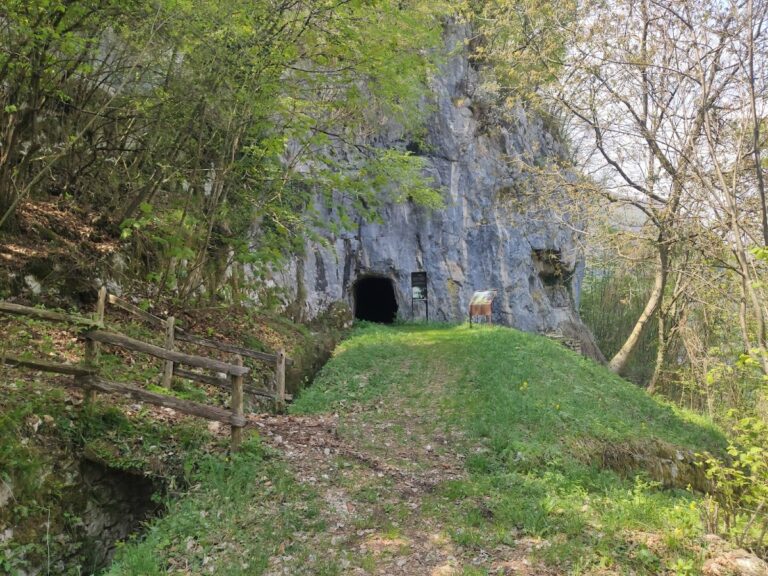
An emergency tunnel approximately 80 metres long ended at the powder magazine. Its position formed part of the fort’s underground circulation and escape arrangements.
Infantry position and external batteries
Two doors on the rear side of the casemate block led to an infantry position surrounding the front of the fort. Several open machine-gun emplacements provided close defense there, supported by four Perino Model 1908 machine guns mounted on tripods.
The nearby artillery positions were separate from the fort itself. The external 149G battery operated on Monte Lisser in 1914 and 1915. During the 1916 offensive, batteries armed with 120 mm autocannons and 149A guns were brought forward to the vicinity. These positions complemented the fort’s artillery without being housed inside its casemate block.