Forte Brusafer: An Austro-Hungarian Battery in the Fortress of Trento


Site at a Glance
- Rating
- 4.1
- Popularity
- Very Low
- Country
- Italy
- Primary era
- Modern
- Eras represented
- Modern
- Civilizations
- Habsburg
- Site type
- Military
- Remains
- Fort
On this page7 sections
History
Forte Brusafer is an Austro-Hungarian battery in Italy, near Trento, built between 1878 and 1880 as part of the Fortress of Trento and the wider Austrian defensive system along the Italian frontier. It occupied the southern slope of Mount Marzola above Valsorda and was designed to block an approach to Trento through Vigolo Vattaro.
Construction and Strategic Role
The battery was built at an elevation of 741 metres on the right side of Valsorda. Its twin, Doss Fornas, stood at 755 metres on the opposite side of the valley. Together, the two batteries controlled the route toward both Vigolo Vattaro and Trento. This route linked Trento with Valsugana and Lavarone, giving it particular military importance.
The defensive value of the route had been reinforced by the incursion of Italian soldiers on 25 July 1866, when they reached the vicinity of Valsorda. Brusafer and Doss Fornas were closely associated with the fortified complex at Mattarello, forming part of a coordinated defensive arrangement.
Military Use and Later Status
In accordance with Austro-Hungarian military doctrine, Forte Brusafer was intended to resist an attack independently for several days. It therefore included stores of ammunition and food, its own energy facilities, a water supply, kitchens, dormitories, and mortuary rooms.
After the First World War, the fort passed to the Italian military state property administration. Royal Decree No. 1022 decommissioned it on 7 March 1929. The privately owned fort is currently neglected.
Remains
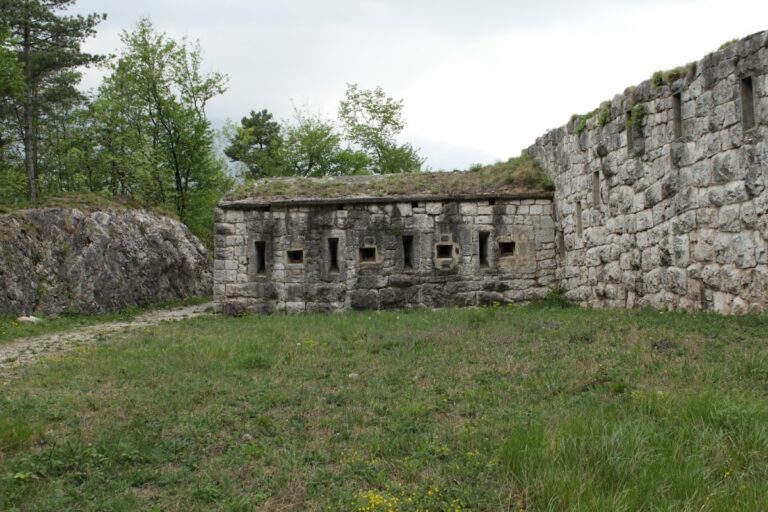
Forte Brusafer occupies a single level and is built in limestone. Concrete covered with earth and grass forms its upper protection. Its plan closely followed that of Doss Fornas, with the two batteries arranged as essentially mirror-image layouts on opposite slopes of the valley. This arrangement allowed them to control a broad sector toward Vigolo Vattaro and the Adige Valley.
Layout and Construction
Fortification Form
The battery has a circular-type form with a barrel vault and multiple loopholes prepared for rifles and machine guns. A quadrangular caponier, a projecting structure for close-range defence of a fort’s approaches, extended toward the valley from the angle between the two principal wings. Internal rooms were arranged to accommodate both light and heavy weapons.
Artillery Positions
The planned armament consisted of four 12-centimetre M61 guns, but the battery received six 12-centimetre M61 K guns mounted in casemates, protected chambers used for artillery operation. Their field of fire covered 36 degrees, with four guns directed toward Vigolo Vattaro and two toward the Adige Valley. Two 9-centimetre M75 F.K. guns were also installed. At a later stage, the fortifications received a rotating turret carrying a 37-millimetre gun, while the loopholes were prepared for several rifles and machine guns.
Nearby sites