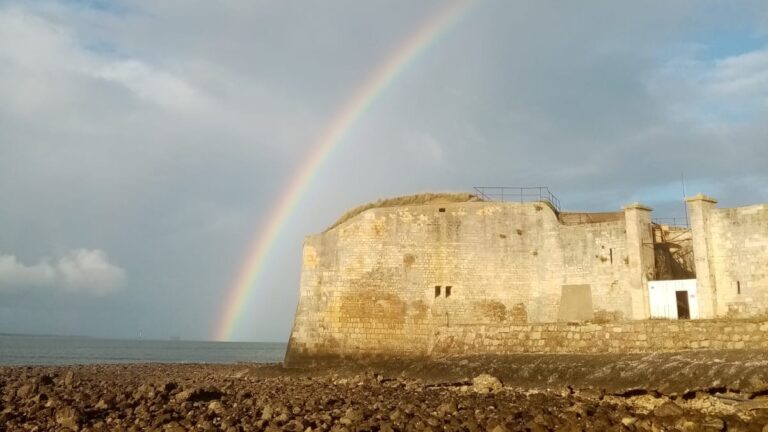
Sablanceau and Redoute of Rivedoux: A Coastal Fortification on Île de Ré


Site at a Glance
- Rating
- 3.6
- Popularity
- Very Low
- Country
- France
- Primary era
- Early Modern
- External website
- Open
- Eras represented
- Early Modern, Modern
- Civilizations
- French, German
- Site type
- Military
- Remains
- Fort
On this page8 sections
History
Sablanceau and Redoute of Rivedoux is a coastal fortification in France, at the eastern end of Île de Ré, built as a seventeenth-century defensive work to protect the island’s exposed approach. The site belongs to the commune of Rivedoux-Plage and became important after an English invasion force landed here in 1627.
The English landing of 1627
Sablanceau, formerly known as Saint-Blanceau, formed the easternmost point of Île de Ré. On 12 July 1627, an English force commanded by the Duke of Buckingham came ashore there. Its objectives were to control the approaches to La Rochelle, encourage the city’s rebellion, and aid the Rochelais, who were then under siege. Toiras, the French commander, opposed the landing from behind the dunes with 1,200 infantry and 200 horsemen. Although his forces inflicted losses of more than 12 officers and 100 men, the English secured a beachhead. The landing was followed several days later by the Siege of Saint-Martin-de-Ré.
Construction and later military use
The vulnerability revealed by the invasion led to plans for a permanent defense at Sablanceau. At the request of Colbert, a leading minister whose policies supported the strengthening of France’s defenses under Louis XIV, Vauban built the Rivedoux redoubt in 1674. Vauban, Louis XIV’s chief military engineer, developed systematic methods for fortification and coastal defense. He regarded Sablanceau as the most exposed position on Île de Ré and in the kingdom, placing it in importance on the island immediately after Saint-Martin-de-Ré. Two further redoubts were built at Les Portes-en-Ré in the north and Martray at Ars-en-Ré in the west.
From 1701, batteries around the redoubt strengthened its defenses. The nearby Batterie de Sablanceaux, at the end of the point and less than 500 metres away, was enlarged and modernized in successive stages until the Second World War. It was disarmed in 1827 and converted into an ammunition depot in 1894. The redoubt itself was rehabilitated in 1862 during the reign of Napoleon III, when its walls received a smoother finish.
War damage, abandonment, and rehabilitation
During the Second World War, German occupation forces incorporated an observation blockhouse into the southern guardhouse as part of the Atlantic Wall, a system of coastal defenses built along occupied European shores. Concealed within the guardhouse, the blockhouse was not visible from outside. A battery was also installed on the southern counterguard, while the Batterie de Sablanceaux received German blockhouses and became the site of a small defensive artillery base.
After the war, the redoubt was abandoned. Its western entrance ditch was filled, and a campsite was established on the glacis, the gently sloping earthwork that exposed attackers to defensive fire. In 2005, the municipality of Rivedoux-Plage acquired the redoubt and adjoining land. Municipal initiatives and volunteer work then began to rehabilitate the site, enabling visits and the organization of exhibitions.
Remains
The redoubt and its defenses
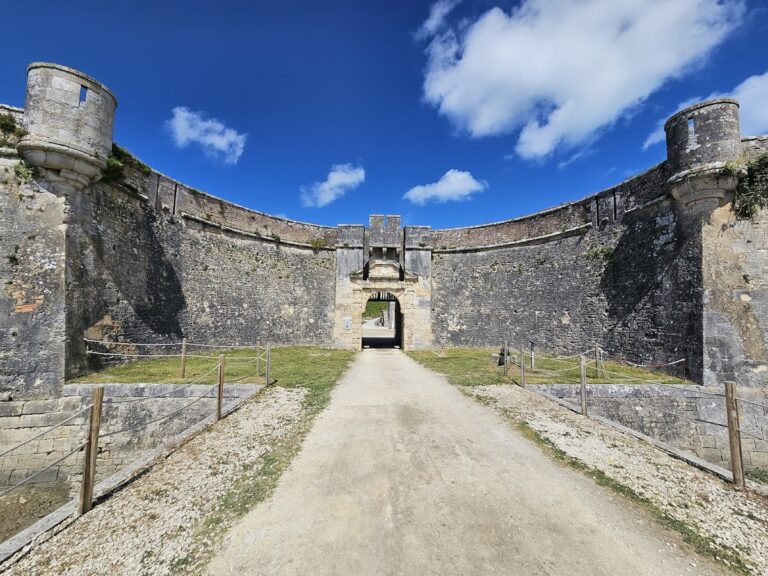
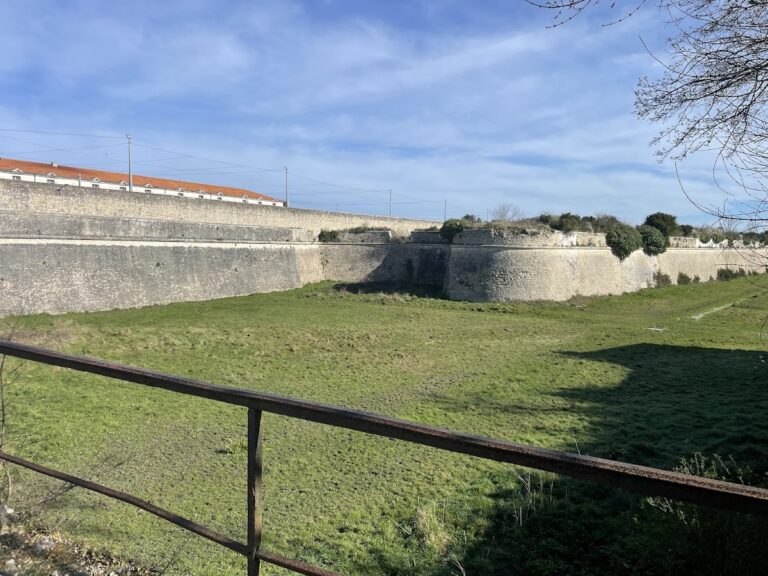
The redoubt is a square fortification measuring 45 metres on each side. Two projecting counterguards, outer works designed to protect the main fortification, flank it and formerly blocked the full width of the Sablanceaux point. A dry ditch surrounds the stronghold. On the eastern side, a covered way, or protected passage along the outer edge of a fortification, and a glacis formed the principal defensive approach. The western entrance was reached by a fixed bridge and a drawbridge, followed by a postern passing through the fortification.
Interior buildings
Two two-level guardhouses stand inside the redoubt, one against the northern wall and the other against the southern wall. The southern building contains the concealed German observation blockhouse, a strongly protected military structure associated with twentieth-century coastal defenses. A powder magazine is built into the northern wall, and a well supplied fresh water during a siege. The small stronghold was planned for a garrison of about 30 men, 12 cannons, and 3 tonnes of gunpowder. Surviving interior fabric includes both seventeenth-century quarters and quarters from the German period.
Sablanceaux battery
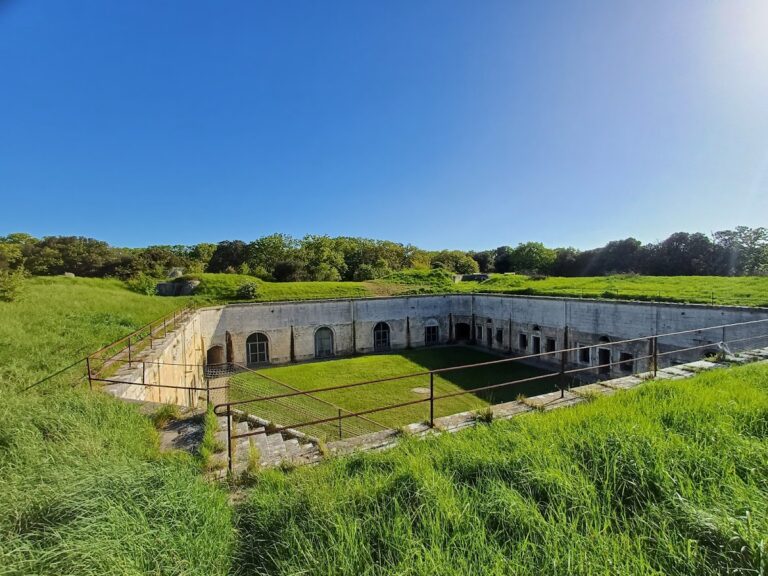
The Batterie de Sablanceaux was a simple grass-covered fortification wall arranged to accommodate 12 cannons. It remains physically extant and retains the German blockhouses added during the Second World War. Together with the redoubt’s counterguards and associated defensive works, the battery formed part of the fortified system protecting the Sablanceaux point.