Fort Liédot: A Napoleonic Coastal Fortress on Aix Island


Site at a Glance
- Rating
- 4
- Popularity
- Low
- Country
- France
- Primary era
- Modern
- External website
- Open
- Eras represented
- Modern
- Civilizations
- French
- Site type
- Military
- Remains
- Fort
On this page7 sections
History
Fort Liédot is a French coastal fortress on Aix Island, built under Napoleon I between 1810 and 1834 to prevent an enemy landing. It occupies the island’s highest ground and is the only completed example of the Model Redoubt No. 1 design.
Napoleonic origins and construction
During an inspection of Aix Island on 5 August 1808, Napoleon I decided that a fortress should be built on the eastern side. He chose the island’s highest point and prepared the first sketches himself. The project was initially known as Fort de la Sommité.
Construction began in 1810 under the direction of the engineer Thuillier and continued for 24 years. The original design called for a square fort with four corner bastions, projecting sections that allowed defensive fire along the walls. During construction, the planned Model Tower No. 1 was changed to a Model Redoubt No. 1, a smaller, self-contained fortified work. The completed redoubt gave Fort Liédot its distinctive place in French military architecture. In 1812, the fortress received its present name in memory of Colonel Liédot, a senior officer who had died during the Russian campaign.
Military use and imprisonment
Fort Liédot was built primarily for defence, but it later served several other military purposes. It was used as a detention site, as a target for army firing exercises, and as a military holiday camp. French army training fire struck the fort in 1863, but it experienced no other attack.
After the Paris Commune, the revolutionary government that controlled Paris in 1871, defeated Communards were held at the fort. In 1917, leaders of a mutiny by Russian soldiers at La Courtine were sent to Aix Island. Eighty-one leaders were among those transferred, and 249 Russian soldiers reached the fort on 21 September 1917. Three escaped in an unseaworthy boat and drowned. During the Spanish influenza epidemic, nine prisoners died at the Naval Hospital in Rochefort. Five others were buried in the small cemetery on Aix Island: Jean Voevodine, Ilia Theuktistoff, Nicolas Godoff, Alexis Krevenko, and Ligor Mathorin, all of whom died in October 1918. The mutiny leaders included Afanasie Globa, Baltaïs, Saraïkine, and Kediaïev.
From March 1959 to May 1961, Ahmed Ben Bella was imprisoned at Fort Liédot with Mohamed Boudiaf, Hocine Aït Ahmed, Mohamed Khider, and Mostefa Lacheraf. Ben Bella was a leader of the FLN, the National Liberation Front, which fought for Algerian independence from French rule, and later became Algeria’s first president. About 150 gendarmes guarded the prisoners. During this period, the army divided the island into two parts and continuously monitored its coasts.
Military camp and preservation
After the Second World War, the Ministry of the Armies’ social-welfare organization converted the fort into a military holiday camp. Children stayed there from 1948 to 1958 and again from 1962 to 1980. After several years of abandonment and overgrown vegetation, the Conservatoire du littoral, a French public body that protects coastal land, purchased the fort in 1989 and undertook its management and rehabilitation with the commune of Aix Island. Fort Liédot, including its ditches and glacis, a gently sloping defensive area outside the fortification, has been listed as a historic monument since 8 September 1995.
Remains
Fortification and setting
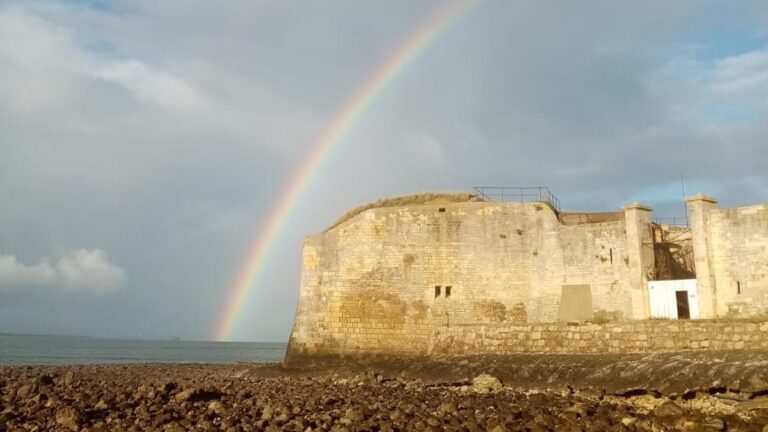
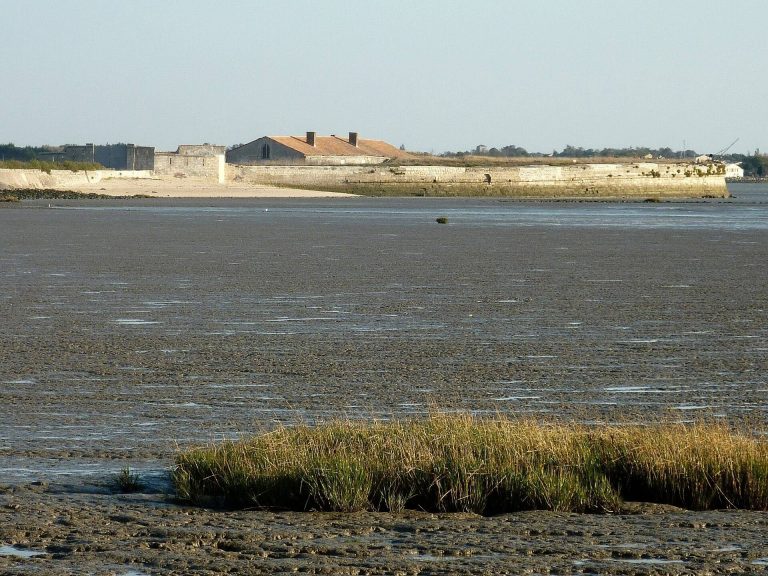
Fort Liédot stands in the northeast of Aix Island on ground approximately 9 metres above sea level. It is a semi-buried square stone fortification, 90 metres long on each side and about 7 metres high. Its partly buried position was intended to reduce exposure to artillery fire. A bastion occupies each corner, while the central courtyard measures 30 metres on each side.
Layout and construction
The surviving complex includes an entrance, an outer defensive enclosure, the interior courtyard, and a façade facing southwest. The stone blocks were transported along the Charente River from the quarries at Crazannes, near Saint-Savinien. The fort’s completed form reflects the change from the planned Model Tower No. 1 to Model Redoubt No. 1, the only example of that type.