Fort de Montrouge: A Nineteenth-Century Fortification of Paris
Site at a Glance
- Rating
- 4.5
- Popularity
- Very Low
- Country
- France
- Primary era
- Modern
- Eras represented
- Modern
- Civilizations
- French
- Site type
- Military
- Remains
- Fort
On this page8 sections
History
Fort de Montrouge is a stone fortification in Arcueil, France, built between 1843 and 1845 in the Haxo style as one of the sixteen detached forts in the first defensive belt around Paris. This belt formed part of the Thiers fortifications, a nineteenth-century system of walls and forts intended to protect the capital.
Construction and territorial history
The fort was built to defend Paris and later served as an artillery depot with a workshop for manufacturing cartridges. Despite its name, it stands in Arcueil, near the boundaries of Montrouge and Bagneux. A law of 5 August 1851 placed the fort within Arcueil, which has retained it since then. When part of Arcueil’s territory was transferred to Montrouge in 1875, the fort and its related budgetary responsibilities remained with Arcueil.
The Franco-Prussian War and the Paris Commune
During the Franco-Prussian War, French artillery units occupied the fort. They included detachments from the 17th and 27th Naval Artillery Batteries, a land-artillery detachment, and a company of naval gunners. Prussian forces began shelling the fort on 5 January 1871 and fired more than 12,000 large-calibre projectiles, damaging its structures.
France capitulated on 28 January 1871. After the Paris Commune, a revolutionary municipal government that controlled Paris from March to May 1871, began its uprising on 18 March, the National Guard Federation maintained a detachment at the fort while fighting the Versailles forces.
Military, judicial, and scientific uses
After the First World War, the fort contained a gendarmerie barracks. Following the Liberation of Paris, it was used for executions from 1944 to 1949. Those executed there included Georges Suarez, Pierre Bonny, Henri Lafont, Alexandre Villaplane, Paul Chack, Robert Brasillach, Paul Ferdonnet, Jean Multon, Fernand de Brinon, Georges Delfanne, Jean Bassompierre, Robert Alesch, Jean Mamy, and Jacques Desoubrie. The execution list also records Jacques Desoubries, identified as “Duverger,” on 23 December 1949.
Philippe Pétain, the marshal who headed the collaborationist Vichy regime during the Second World War, was interned at the fort with his wife for three months. He arrived there after leaving Sigmaringen in Germany and surrendering at the Franco-Swiss border. His internment lasted from his arrest on 27 April 1945 until the opening of his trial on 23 July 1945.
In the postwar period, the Central Armament Laboratory moved into the fort. It commissioned the electronics and automation company SEA to construct the Armament Universal Binary Calculator, known as CUBA, which was installed there and used as the first French computer. A joint Army and CNRS laboratory also operated at the fort, researching automatic translation. The CNRS is France’s national public research organization.
Later institutional development
Several additional buildings were erected inside the fort’s enclosure. The Central Armament Laboratory became the Central Armament Establishment in 1975 and was renamed the Central Technical Armament Establishment in 1977. The fort is now owned by the National Defence authorities and houses units of the National Gendarmerie, France’s military-status police force, including the Overseas Gendarmerie Command and three central judicial-police offices assigned to the gendarmerie. An armament gendarmerie company and services of the Directorate General of Armament, the General Secretariat for Administration, and the Army Commissariat Service also occupy the site.
Remains
Fortification and enclosure
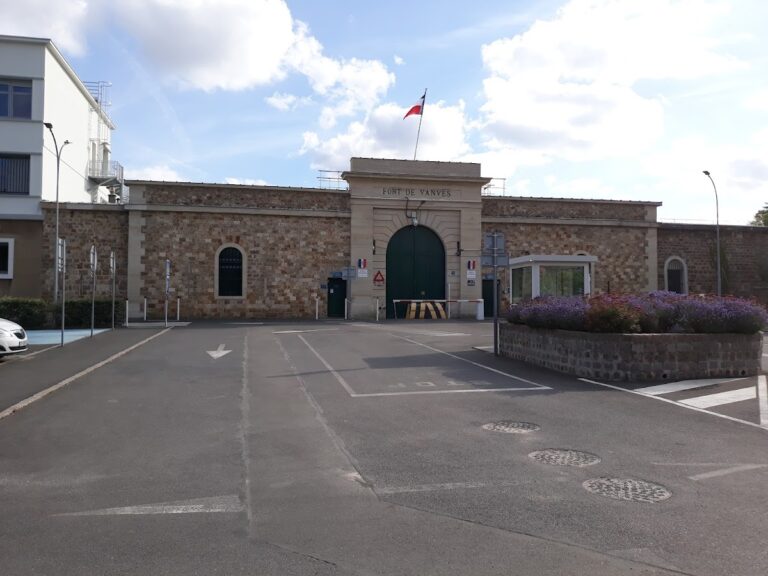
Fort de Montrouge is a stone fort built in the Haxo system of nineteenth-century fortification, which emphasized protected artillery positions and defensive arrangements adapted to modern artillery. The surviving complex includes the fort’s gate, a gendarmerie barracks, and several later buildings within the enclosure. The original structures bear damage from the Prussian bombardment of 1871.
Postwar technical installations
The fort also preserves the site of major postwar technical activity. CUBA, the Armament Universal Binary Calculator built by SEA for the Central Armament Laboratory, was installed there and used as the first French computer. The enclosure additionally contained the joint Army and CNRS machine-translation laboratory.