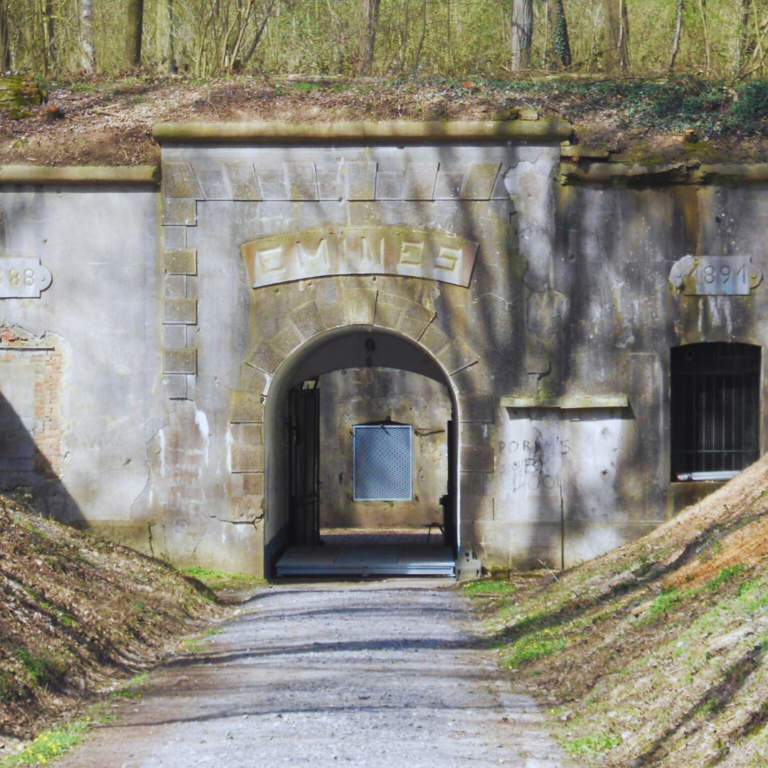
Fort de Marchovelette: A Belgian Fort of the Namur Defensive Ring


Site at a Glance
- Rating
- 3.8
- Popularity
- Very Low
- Country
- Belgium
- Primary era
- Modern
- Eras represented
- Modern
- Civilizations
- Belgian, German
- Site type
- Military
- Remains
- Fort
On this page14 sections
History
Fort de Marchovelette is a late-nineteenth-century Belgian concrete fort near Namur, built between 1888 and 1892 as one of nine forts forming the city’s fortified ring. Designed under the direction of General Henri Alexis Brialmont, a Belgian military engineer, it protected Namur from the north and east and helped guard against another French occupation.
Construction and strategic purpose
The fort stood about 6.8 kilometres northeast of Namur. Its artillery was intended to cover the Meuse crossings or approaches at Marche-les-Dames and Namêche, the railway leading to Huy, and roads toward Tienen and Leuven. Its position worked with the neighbouring Fort Cognelée and Fort Maizeret to protect the approaches to the city. Belgian troops occupied Marchovelette soon after construction was completed.
First World War
When the First World War began, Captain-Commandant Duchâteau commanded a garrison of roughly 400 men, including about 300 artillerymen and 100 infantrymen. The fort opened fire on German positions on 20 August 1914, and the German attack on Namur reached it the next day.
German artillery subjected Marchovelette to sustained bombardment, including fire from weapons reaching 420 millimetres in calibre. On 23 August, a powder charge exploded inside the fort, severely wounding Duchâteau and causing extensive destruction. Damage and worsening air quality soon forced the garrison to surrender. About 20 members of the garrison died during the fighting and bombardment, while captured personnel were transferred to a prisoner-of-war camp in Münster.
German occupation and interwar modernization
During the German occupation, structural and technical defects were addressed. Corrugated steel reinforced the walls, reinforced-concrete rings were added around the gun turrets, ventilation was renewed, and the original steam-powered generator was replaced with a diesel unit.
In the 1930s, Marchovelette was incorporated into the Fortified Position of Namur, an interwar defensive system intended to deter or delay a renewed German invasion. The modernization strengthened the walls, improved ventilation and communications, installed a new ventilation-observation tower, and upgraded electrical generation and sanitary facilities. New observation posts and infantry shelters were also built around the fort.
The artillery was reorganized during this work. The 21 centimetre turret was replaced by a twin 75 millimetre turret, the 15 centimetre turret was replaced by a turret carrying a machine gun and grenade launchers, and the 57 millimetre turrets were replaced by retractable turrets mounting 75 millimetre guns. Machine guns were added for close defense, protection of the entrance, and antiaircraft fire.
Second World War and later use
In 1940, Captain-Commandant de Lombaerdt led a garrison of about 250 soldiers. During the German invasion of Belgium, the fort supported Belgian forces with long-range fire from 11 May. It came under German attack that same day and surrendered on 18 May after three days of resistance. Three members of the garrison were killed.
After the Second World War, the fort remained abandoned and largely untouched while still belonging to the Belgian Ministry of Defence. Since 2007, the Belgian military has used the site for explosives testing, as well as for military and police training. The site is continuously guarded, access requires special permission, and entrances other than the main entrance have been sealed.
Remains
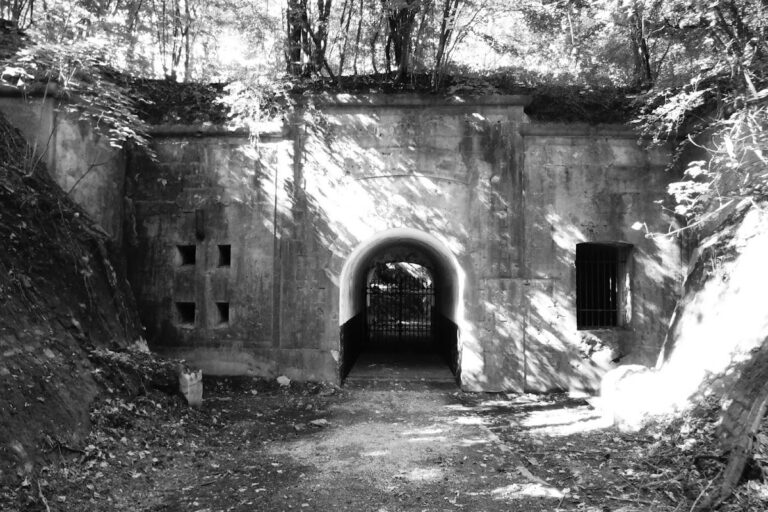
Fort de Marchovelette is a small triangular fort on a hill about 195 metres above sea level, roughly three kilometres from the left bank of the Meuse and between Marchovelette, Champion, and Bonnine. Its principal defensive and artillery installations occupy a solid central concrete massif. Around it lies a ditch about six metres deep and eight metres wide, while the rear barracks side forms a relatively straight line facing the rear ditch in the direction of Namur.
Fortifications and internal installations
Central concrete massif
The central massif contains the fort’s principal protected installations and artillery positions. Its upper surface was built with about four metres of unreinforced concrete, while the less exposed casemate walls were approximately 1.5 metres thick. A casemate, a protected chamber for guns, troops, storage, or other military uses, formed part of this defensive construction. The fort was designed to withstand artillery of roughly 21 centimetres calibre, but heavier bombardment caused severe damage in 1914.
Ditch and counterscarp defenses
The ditch was defended by flanking fire from counterscarp casemates. A counterscarp is the outer wall or slope of a defensive ditch. Five 57 millimetre guns in these protected positions fired along the ditch, while other 57 millimetre guns covered the rear entrance. The counterscarp also contained latrines, showers, a kitchen, and a morgue, placed directly opposite the barracks. These service areas were considered vulnerable during a prolonged bombardment or siege.
Artillery and communication equipment
Original artillery
The original armament included a retractable 21 centimetre howitzer turret, a turret with two 15 centimetre guns, and two turrets mounting one 12 centimetre gun each. Three additional retractable 57 millimetre turrets provided close defense, and five more 57 millimetre guns in casemates defended the ditch and rear entrance. The heavy guns were generally German-made, while turret mechanisms came from manufacturers including Grusonwerke, Schneider-Creusot, and Châtillon-Commentry.
The original 15 centimetre guns had a range of about 8.5 kilometres, and the 12 centimetre guns reached approximately 8 kilometres. The 21 centimetre howitzer had an indirect-fire range of about 6.9 kilometres, while the 57 millimetre guns reached roughly 300 metres. These weapons used black powder rather than smokeless powder. The resulting gases were intended to choke attackers in the ditches, but they could also collect in the enclosed firing rooms and spread through the fort.
Interwar armament
The 1930s defenses included three 75 millimetre howitzer turrets, one 75 millimetre gun turret, and two turrets equipped with machine guns and a mortar. Further machine guns were installed in the caponiers, fortified structures designed to fire along a ditch, at the entrance, and in positions for antiaircraft defense. The turrets could be lowered into the protective concrete structure after firing, reducing their exposure to enemy artillery.
A retractable armored cupola carried a powerful searchlight, and signal lights connected Marchovelette with Fort Cognelée about 5.95 kilometres to the northwest and Fort Maizeret about 5.95 kilometres to the southeast. The new ventilation-observation tower built during the interwar modernization remains visible at the edge of the surrounding woodland.
First World War damage
Destroyed and flooded areas
The 1914 bombardment damaged or destroyed the large armored turrets and the rear barracks. The 21 centimetre howitzer turret was disabled, the 15 centimetre turret and one 57 millimetre turret were destroyed, and the central passage collapsed. Damage to the water cisterns caused flooding in the central massif, while the magazine for the 210 millimetre ammunition was also destroyed. These surviving traces record the limits of the fort’s original unreinforced-concrete defenses against heavier artillery.