Fort de Domgermain: A Séré de Rivières Perimeter Fort in France


Site at a Glance
- Rating
- 4.4
- Popularity
- Very Low
- Country
- France
- Primary era
- Modern
- External website
- Open
- Eras represented
- Modern
- Civilizations
- French
- Site type
- Military
- Remains
- Fort
On this page14 sections
History
Fort de Domgermain is a French perimeter fort built between 1874 and 1879 as part of the fortified place of Toul and the Séré de Rivières system. This network of forts and defensive works was developed mainly after the Franco-Prussian War of 1870–1871. The fort occupied the southern end of the plateau marking the Foug threshold and protected the approaches to Toul.
Construction and original defense
The project was ordered for study on 5 December 1873, approved by the minister on 11 September 1874, and awarded on 24 October that year. The undertaking was declared one of public utility and emergency on 4 December 1874. Work began on 15 November 1874, and completion was recorded on 31 December 1878, although the fort is generally dated to 1874–1879. Its estimated total cost was 1,000,000 euros.
The original fort carried 40 artillery pieces. Its magazines held 83 tonnes of powder and 500,000 cartridges. The garrison accommodation included space for 522 men and a 40-bed infirmary, while two cisterns supplied a combined water capacity of 550 cubic metres.
Modernization and the First World War era
Special concrete was installed in 1894. A comprehensive restructuring followed from 1907 to 1910 under the 1900 programme. The work provided for a 75 mm gun turret, a Bourges casemate, three armored observation posts, and a machine-gun turret. A supplementary programme in 1908 proposed two 155 mm turrets for installation in 1915, but this plan was abandoned.
In 1914, the garrison consisted of half a company of the 169th Infantry Regiment and 148 artillerymen of the 6th Foot Artillery Regiment. The fort then contained 316 protected places in casemates and 240 unprotected places. Its additional weapons included four revolver cannons and four breech-loading 12 cm cannons for defending the fort coffers, protected positions used to fire along the ditches. Four 22 cm mortars and four 15 cm mortars completed this configuration.
Military reuse and municipal ownership
For several years, Fort de Domgermain served as a munitions depot. The depot closed in 1987, after which the 516th Regiment of the Train, the French Army branch responsible for transport and logistics, used the fort for military exercises until the beginning of the 2000s.
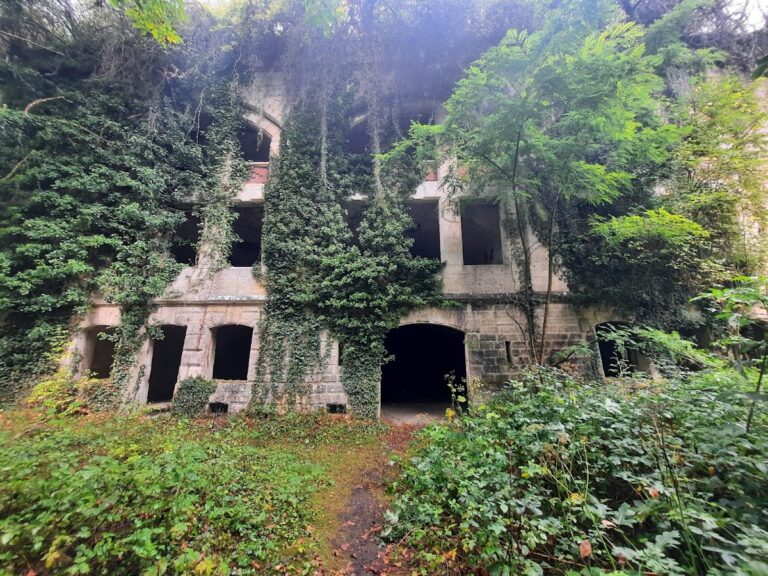
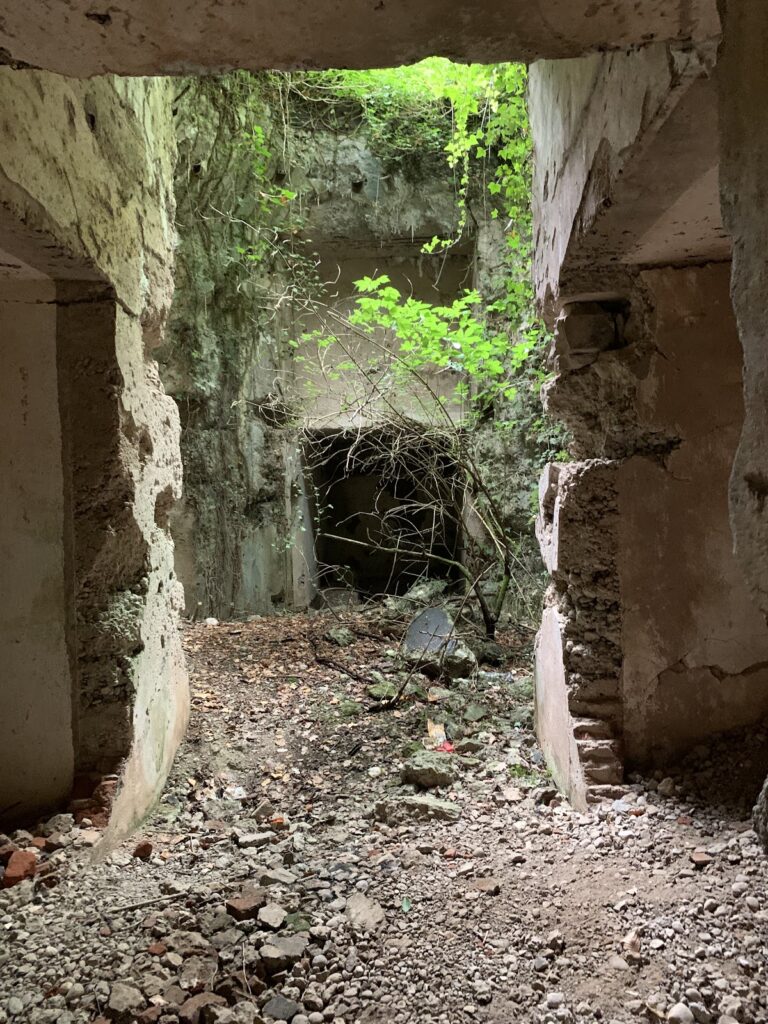
By early 2007, the fort was derelict. Its armored fittings had been left in place, and its machine-gun turret was partly dismantled. The commune of Domgermain acquired the fort in 2007, and a municipal order prohibited entry from 13 September of that year. Ownership remains municipal, while its current use is unspecified.
Remains
Layout and service facilities
Raised artillery platform
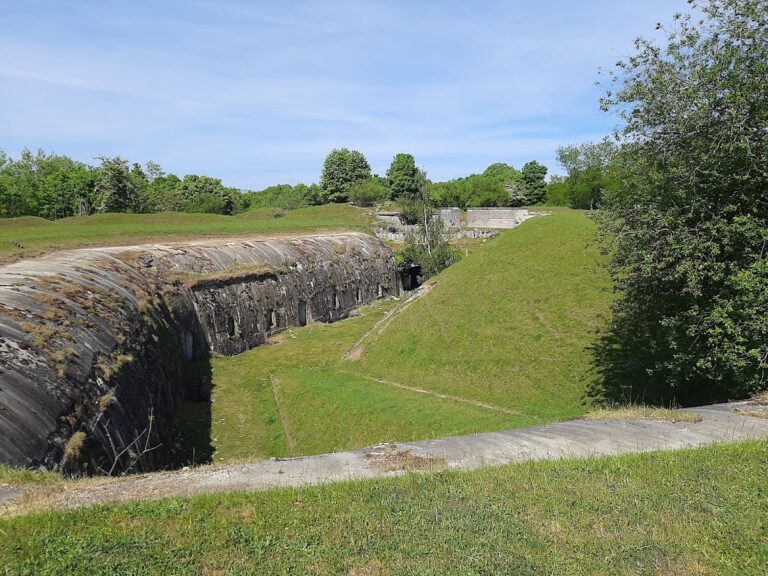
At an elevation of 398 metres, the fort has an irregular pentagonal plan and a raised central artillery platform known as a cavalier. This elevated position allowed artillery to fire over the lower parts of the fort and the surrounding terrain. The work was designed as a perimeter fort of the fortified place of Toul.
Accommodation and storage areas
The surviving complex includes casemates, an infirmary, two water cisterns, powder magazines, and ammunition storage areas. The cisterns had a combined capacity of 550 cubic metres, while the original magazines were intended to hold 83 tonnes of powder and 500,000 cartridges. Ground markings, a danger sign, and fencing preserve physical traces of the later munitions-depot use.
Artillery and observation defenses
Rampart and flanking armament
The fort included 24 rampart artillery pieces and 12 flanking pieces. Its 1914 defensive arrangement also included four revolver cannons and four breech-loading 12 cm cannons for the coffers, together with four 22 cm mortars and four 15 cm mortars.
75 mm gun turret
A 75 mm gun turret formed part of the modernization programme carried out from 1907 to 1910. The turret was installed as a protected artillery position within the reorganized fort.
Bourges casemate
The fort contains a Bourges casemate, a protected artillery chamber designed to fire laterally along a defensive ditch or approach. It was arranged to fire toward the south.
Armored observation posts
Three armored observation posts were provided during the modernization. These protected positions allowed observation and the direction of artillery fire.
Machine-gun turret
A machine-gun turret provided close-range defense from a rotating armored mount. By early 2007, the turret had been half dismantled, while the fort’s other armored fittings remained abandoned.