Fort de Cognelée: A Belgian Fortress in the Namur Defensive Ring


Site at a Glance
- Rating
- 4
- Popularity
- Very Low
- Country
- Belgium
- Primary era
- Modern
- Eras represented
- Modern
- Civilizations
- Belgian, German
- Site type
- Military
- Remains
- Fort
On this page13 sections
History
Fort de Cognelée is a Belgian military fortress near Namur, Belgium, built between 1888 and 1892 as part of the late-nineteenth-century fortified ring around the city. Designed by General Henri Alexis Brialmont, it used unreinforced concrete throughout, an innovative choice for its period. The fort defended Namur from the north and helped protect Belgian neutrality against a possible French or German advance through the Meuse valley.
Construction and defensive purpose
Construction began in 1888 and ended between 1891 and 1892. Fort de Cognelée was one of nine forts forming the Namur ring, built alongside the forts around Liège. Its position was intended to prevent a renewed French occupation of Namur. Together with Fort d’Émines and Fort de Marchovelette, it covered the roads toward Tienen and Leuven, the area before Marche-les-Dames, and the heights around Champion. Belgian troops occupied the fort soon after its completion.
The First World War
At the beginning of the First World War, the garrison comprised 350 artillerymen and 180 infantrymen under Captain-Commander Emmanuel Cambier. The artillery belonged to the 8th Fortress Artillery Battery, while the infantry came from the 3rd Fortress Infantry Regiment.
During the German encirclement of Namur, Fort de Cognelée opened fire on 20 August 1914. Its guns disrupted attacks against the spaces between the forts. On 21 August, the artillery engaged German infantry concentrations at Leuze-Longchamps, the Château de Tiller, the Tronquoi woods, Marchovelette, Ville-en-Waret, and Franc-Waret.
A concentrated bombardment began on 22 August. German forces used Austrian 305 mm mortars and 420 mm guns, including the weapons known as Big Bertha. Their range exceeded that of the fort’s main guns, preventing effective counter-fire. German infantry also tried to break through between Cognelée and Marchovelette after an earlier attack on Cognelée had failed.
The fort initially endured the bombardment with few casualties and helped repel two German night attacks. On 22 August, a shell ignited propellant charges, causing an explosion that burned and injured many gun crews. By the next day, the concrete had been extensively cracked and several galleries had collapsed. The 150 mm turret, both 210 mm howitzer turrets, and a 120 mm turret were disabled or seriously damaged, while fires spread through the powder stores.
After further shelling on 23 August, Cambier ordered the remaining equipment and powder to be destroyed. The fort surrendered at 12:30. German infantry entered and helped uncover defenders who had been buried by the bombardment. The attack had included 59 shells of 305 mm calibre and 748 shells of 210 mm calibre.
German occupation and later military use
In 1915 and 1916, German forces repaired damage to the Namur forts in preparation for a possible French counteroffensive. At Cognelée, they added a metal lining to the gallery leading to the head casemate.
After Namur fell in 1914, the German army built three airship hangars beside the fort. Their position near the Namur to Tirlemont railway supported rail supply, while their proximity to the front provided shelter for airships. The unarmoured hangars had a triangular cross-section and remained until the end of the war. During the later stages of the conflict, they also housed heavy bombers. Two airships based nearby were shot down in 1916.
Fort de Cognelée was one of two Namur forts that were not modernized during the interwar period. Instead, it became an ammunition depot. In 1939 and 1940, two additional bunkers were built to supply local defenders with automatic weapons. When the German army advanced during the Second World War, the fort was lightly occupied and captured with little fighting. German forces again used it as an ammunition depot, then destroyed the entire left-hand section with explosives during their retreat in August 1944.
Postwar condition
The fort was disarmed and cleared of mines before its sale in 1997. It remains privately owned and has not been developed as a museum. The wooded grounds are used as a hunting reserve and have occasionally been used illegally for techno parties.
Remains
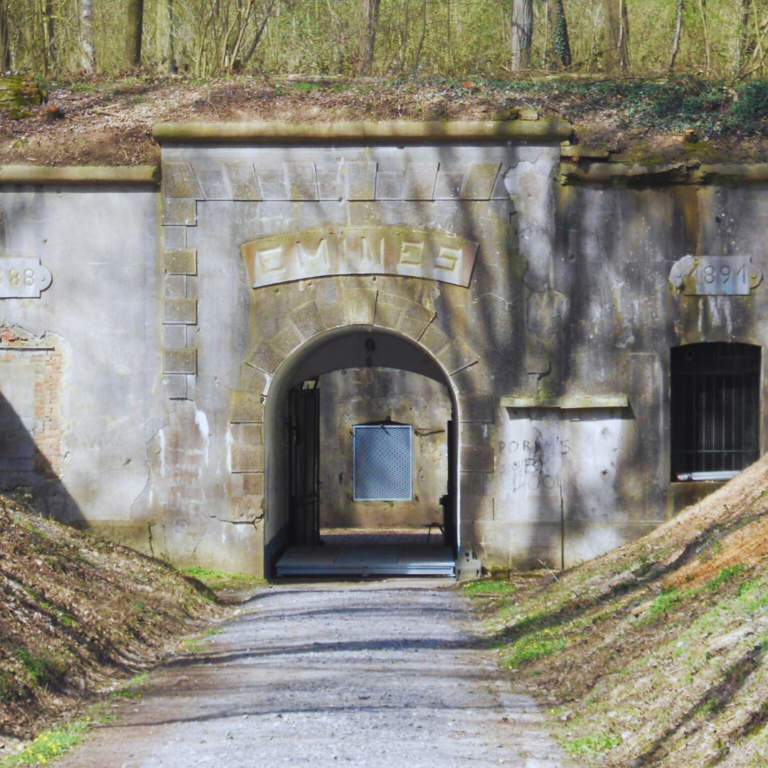
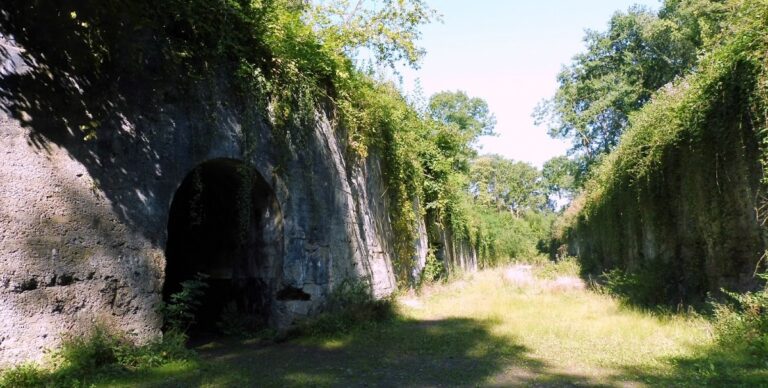
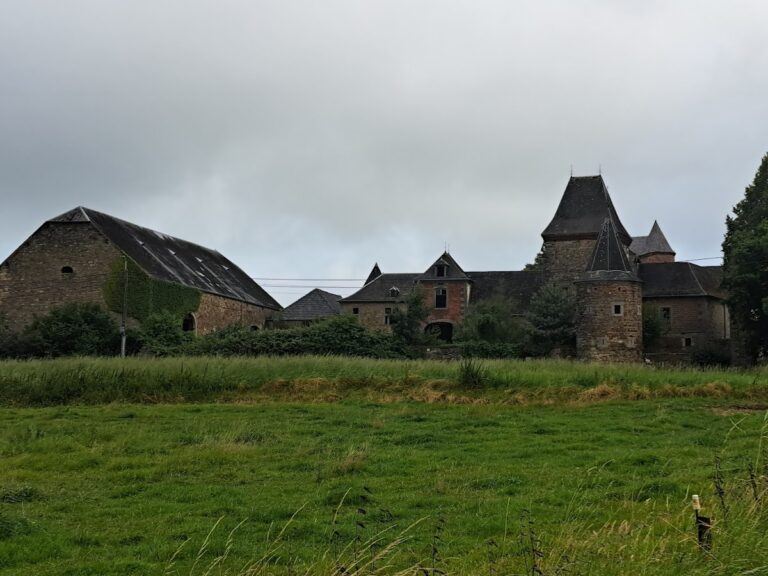
Fort de Cognelée occupies an approximately 200 m-high, gently undulating agricultural plateau in the Daussoulx area, about 7 km north to north-northeast of Namur beside the road to Leuven. It lies between Fort d’Émines and Fort de Marchovelette. The large fort has an approximately isosceles triangular plan with a broad curtain, the defensive section connecting its projecting corners. A ditch about 6 m deep and 8 m wide surrounds it. The ditch has a flattened slope and a steep masonry counterscarp, the outer retaining wall of the ditch. The fort was built entirely of unreinforced concrete, with concrete about 4 m thick in the central block and about 1.5 m thick in the less exposed casemate walls.
Outer defences and entrance
Rear barracks and ditch defences
The rear barracks follow a broken or angled line and form two half-bastions, each a bastion with one flank and one face. Each half-bastion held two 57 mm guns to defend the rear ditch, while another 57 mm gun covered the entrance directly. Four more 57 mm guns for close defence occupied retractable rotating armoured turrets in the central block. Four small retractable turrets, positioned at the fort’s salient corners, held 57 mm M1889 Nordenfeldt guns. These weapons had a range of about 300 m, and eight additional 57 mm guns supplied flanking fire.
Reverse caponier
At the junction of the ditches, opposite the main entrance, a double reverse caponier occupied the counterscarp. This protected structure projected into the ditch from the outer wall and was designed to fire along it. The two-storey structure carried two pairs of 57 mm guns. Six heavy machine guns in counterscarp casemates also covered the ditches and the rear entrance.
Central block and artillery
Protected central mass
The central concrete mass contained the fire-control office, magazines, and main gun turrets. Its roof carried an armoured retractable searchlight cupola capable of transmitting Morse signals to neighbouring forts. Observation personnel used nearby church towers, crossroads, and dominant points, communicating with the fort by telephone. All the gun turrets could be lowered into the protective structure when necessary.
Heavy artillery turrets
The main artillery comprised two turrets with two 120 mm guns each, one turret with two 150 mm guns, and two turrets mounting 210 mm howitzers. The 150 mm Krupp M1886 guns had 3.8 m barrels, an elevation range from -2° to +25°, and a range of about 8.5 km. Their turrets measured 4.8 m across, weighed 224 tonnes, and required crews of about 25 people.
The 120 mm M1889 guns had 3 m barrels, an elevation range from -3° to +25°, and a range of about 8 km. Their 4.8 m turrets weighed 188 tonnes and were operated by crews of approximately 25 people. The 210 mm Krupp M1889 howitzers had 2.5 m barrels, an elevation range from -5° to +35°, and an indirect-fire range of about 6.9 km. Their turrets were 3.6 m in diameter, weighed 100 tonnes, and required crews of about 13 people.
Internal facilities and damage
Daily-service facilities, including latrines, showers, a kitchen, and a mortuary, were placed in the counterscarp. The supply area lay directly opposite the barracks, which opened toward Liège and had relatively little protection. The fort used black powder rather than smokeless powder. Its gases were intended to collect in the ditches and hinder attackers, but they could also spread from the enclosed firing rooms through the fort.
The central mass, artillery positions, casemates, ditches, and galleries were damaged during the First World War. The concrete was heavily cracked, several galleries collapsed, and the left-hand section was demolished by German explosives during the Second World War. The wooded site is privately held and remains abandoned as a military installation.
Nearby sites