Fort d’Andoy: A Belgian Fortress of the Namur Fortifications


Site at a Glance
- Rating
- 3.9
- Popularity
- Very Low
- Country
- Belgium
- Primary era
- Modern
- Eras represented
- Modern
- Civilizations
- Belgian, German
- Site type
- Military
- Remains
- Fort
On this page12 sections
History
Fort d’Andoy is a Belgian military fort near Namur, built by Belgian engineers in the late nineteenth century and completed in 1892. Construction began in 1888, about 6 km southeast of Namur, as part of the nine-fort defensive system protecting the city from the south and east. Designed by General Henri Alexis Brialmont, a Belgian general and military engineer responsible for fort systems around major cities, it was intended partly to prevent a renewed French occupation. Belgian troops occupied the completed fort soon afterward.
Construction and defensive role
Fort d’Andoy differed from contemporary French forts associated with Raymond Adolphe Séré de Rivières because it was built entirely of unreinforced concrete rather than masonry. Its artillery belonged to the second fortress-artillery battery. Together with Fort de Dave to the southwest and Fort de Maizeret to the northeast, it helped defend the approaches toward Jausse, the Luxembourg railway, and the Meuse valleys south and east of Namur.
Communication between the neighboring forts depended on signal lights and, after telephone lines failed during the fighting of 1914, on improvised motorcycle and bicycle couriers. The arrangement reflected the fort’s role within a coordinated defensive network rather than as an isolated position.
First World War
Fort d’Andoy fired its first shots of the First World War on 14 August 1914. During the Battle of Namur, the German army used heavy artillery against the fort instead of attempting the costly infantry assaults made against the Liège forts. Between 21 and 24 August, approximately 450 to 600 shells from 305 mm guns and as many as 1,400 shells from 210 mm guns struck the position.
A direct hit on 21 August damaged the kitchen and magazine, badly weakened the overhead protection, and disabled the 15 cm turret and one 57 mm turret. Damage to the utility plant killed Lieutenant Tasnier and five or six soldiers. The bombardment caused panic among the garrison, but supporting infantry allowed the fort to continue resisting.
On 23 August, Fort d’Andoy fired on German positions, silencing a battery beyond Mont Sainte-Marie and shelling Château de Mozet, where a German headquarters was located. One 21 cm turret was destroyed, killing seven soldiers, while the second 21 cm turret and a 12 cm turret were later put out of action. The utility plant then failed completely, removing both electricity and ventilation. The air became unbreathable and the artillery had to stop, although the garrison restored limited ventilation and lighting and repelled a German infantry attack with its remaining men and functioning 57 mm turrets.
On 24 August, the ceiling of the main assembly hall threatened to collapse. Commandant Nollet gathered the remaining defenders, destroyed or sabotaged the surviving weapons and equipment, and surrendered late in the morning to the 11th Battalion of the German 32nd Infantry. About 215 men remained. The decision was intended partly to spare the garrison and to prevent the magazine from being blown up. German forces occupied Fort d’Andoy until the end of the war.
German alterations and interwar modernization
Beginning in 1915, the German occupiers altered the fort to correct weaknesses exposed by the bombardment. By 1916, the latrines and bakery had been moved to better-protected positions, the postern and main entrance had been reinforced, ventilation had been improved, and the concrete had been strengthened with additional material and metal supports. Belgium recovered the fort after the war.
During the 1930s, Fort d’Andoy was modernized within the Fortified Position of Namur, the interwar defensive system that integrated and upgraded Namur’s older forts against a possible German invasion. The works improved protection, ventilation, sanitary facilities, communications, electrical services, and infantry shelters. Four 57 mm turrets were re-equipped with 75 mm guns, while additional observation positions, machine-gun installations, and anti-aircraft guns were added. The badly damaged 21 cm turrets were not reused.
Second World War
In May 1940, during the Battle of Belgium, the German invasion and campaign in Belgium during the Second World War, Fort d’Andoy was commanded by Commandant Degehet. After the invasion began, the fort fired unsuccessfully at German aircraft before engaging advancing German forces. Armored vehicles and other heavy units reached the area on 14 May, and German artillery later targeted the fort’s observation or ventilation tower. Fighting around the fort and Namur intensified on 15 and 16 May.
Fort d’Andoy supported Fort de Marchovelette with artillery fire on 18 May and fired in support of Forts Saint-Héribert and Malonne on 21 May. All three neighboring forts were eventually overrun or surrendered. On 22 May, German forces began a sustained attack supported by 88 mm guns. Forts Maizeret and Dave returned supporting fire, allowing the first German assault to be repelled and communication between the forts to continue despite severe damage.
On 23 May, Fort d’Andoy and Fort Maizeret came under simultaneous attack while Fort Dave supported both positions. The retractable armored turrets, which could be lowered into the concrete structure for protection, could not descend quickly enough to escape German 37 mm anti-tank fire. As the assault intensified, the turrets and observation cupolas became unsafe to occupy. The fort’s artillery was reduced to one 75 mm gun and a grenade-launcher turret. After neighboring forts had surrendered, the Germans issued an ultimatum threatening aerial bombardment. Degehet sabotaged the remaining weapons and surrendered at about 17:30 with military honors. The garrison was taken prisoner and sent to prisoner-of-war camps in East Prussia.
Four Belgian soldiers were killed at Fort d’Andoy, while more than 300 Germans were killed or wounded in the fighting around it. The fort was never repaired or rehabilitated after the Second World War. It remains privately owned, abandoned, and used for hunting.
Remains
Layout and defensive works
Ditch and rear defenses
Fort d’Andoy stands on a hill about 220 m above sea level and has a right-triangular plan. A ditch approximately 6 m deep and 8 m wide surrounds the entire fort. Its defenses were arranged for enfilade fire, meaning that guns could fire lengthwise along the ditch toward prepared shot traps. The ditch had a flattened slope and a steep masonry counterscarp, the outer wall or slope of a defensive ditch.
On the rear, or gorge, side, a broken line of barracks formed two demi-bastions. Each contained two 57 mm guns covering the rear ditch, while another gun protected the main entrance. At the junction of the ditches opposite the entrance, the counterscarp held a two-level reverse caponier. This fortified position projected into the ditch and carried two pairs of 57 mm guns for fire along its approaches.
Central concrete massif
The barracks and service areas occupied the rear side facing Namur and opened toward the rear ditch. Latrines, showers, the kitchen, and the morgue were placed in the counterscarp, while the service area opposite the barracks had comparatively little protection. These arrangements contributed to the vulnerability of the service spaces during the 1914 bombardment.
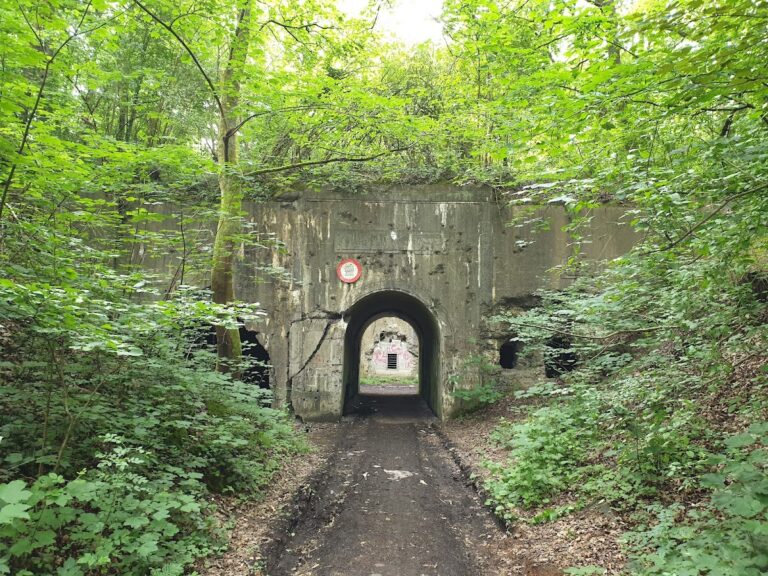
The principal weapons were concentrated in a solid central concrete massif. Its exposed upper protection was about 4 m thick and made of unreinforced concrete, while the less-exposed caserne walls were about 1.5 m thick. The original design was intended to withstand fire from guns up to 21 cm, but the fort could not resist heavier artillery. The postwar remains are abandoned, unrepaired, and heavily overgrown with vegetation.
Turrets and artillery
Original artillery
The original long-range armament consisted of two 21 cm howitzer turrets, one twin 15 cm gun turret, and two twin 12 cm gun turrets. The Krupp 15 cm guns had a range of approximately 8.5 km, the 12 cm guns reached about 8 km, and the 21 cm howitzers had an indirect-fire range of about 6.9 km. Close defense relied on retractable armored turrets carrying 57 mm Nordenfelt guns, supplemented by 57 mm weapons in counterscarp casemates or embrasures.
The fort also had a retractable armored observation turret with a searchlight. Turret mechanisms came from several manufacturers, while the heavier artillery was generally German-made, especially by Krupp. The 15 cm turret was about 4.8 m in diameter, weighed roughly 224 tonnes, and required a crew of about 25. The 12 cm turrets had the same diameter and crew but weighed about 188 tonnes. Each smaller 21 cm turret measured about 3.6 m across, weighed approximately 100 tonnes, and required about 13 men. The 57 mm turrets were about 2.1 m in diameter, weighed around 34 tonnes, and required crews of six.
The guns initially used black powder rather than smokeless powder. Choking gases produced during firing could accumulate in the confined firing spaces and spread through the fort, reducing the garrison’s ability to continue combat. The effects of this problem became acute when the utility plant failed during the German bombardment in August 1914.
Modernized defenses
The 1930s modernization replaced the armament of four 57 mm turrets with 75 mm guns and installed further 75 mm guns in other cupolas. The completed arrangement included four 75 mm howitzer turrets, a turret with two 75 mm guns, two turrets equipped with machine guns and a mortar, and six anti-aircraft guns.
A ventilation and observation tower about 14 m high was connected to the fort by a tunnel approximately 1,200 m long. The tower could also serve as an artillery-observation post. German artillery targeted the tower during the 1940 fighting, while fire against the retractable turrets and observation cupolas eventually made them unsafe to occupy. The surviving fort and its overgrown concrete defenses remain on private property and are not open to the public.