Castle of Pico: The Ducal Fortress of Mirandola, Italy


Site at a Glance
- Rating
- 4
- Popularity
- Very Low
- Country
- Italy
- Primary era
- Early Modern
- Eras represented
- Early Modern, Modern
- Civilizations
- Holy Roman Empire
- Site type
- Military
- Remains
- Castle
On this page12 sections
History
Castle of Pico is a fortress in Mirandola, Italy, whose earliest documented existence dates to 1102. A more primitive settlement probably occupied the site during the Lombard period, around the year 1000. Positioned on the Via Romea Imperiale, the route linking Germany with Rome, the stronghold was gradually enlarged into a large quadrilateral defended by a moat.
The Pico Lordship
The Pico family ruled Mirandola from 1311 to 1711, and the castle’s name reflects this four-century association. During the Renaissance, the family enriched the complex with important works of art and developed it beyond its original military purpose. The Picos obtained the title of duke in 1617, after which the castle became an exceptionally lavish ducal residence and one of the most important residences in the Po Valley.
In 1500, Giovan Francesco II Pico della Mirandola commissioned the massive Torrione, a large fortified tower or keep. Its reputation for being impregnable did not prevent repeated attacks on Mirandola. Papal forces under Julius II besieged the city during the winter of 1510–1511, and the forces of Julius III launched another siege in 1551. The castle also received distinguished visitors, including Julius II, Louis I of Hungary, Emperor Leopold I, the Venetian printer Aldus Manutius, the Ferrarese rulers Borso and Ercole d’Este, Rodolfo Gonzaga, and Francis Stephen of Lorraine.
Este Rule and Destruction
When the Este family took possession of Mirandola in 1711, the city and castle entered a period of decline. During a storm at about 1:30 a.m. on 11 June 1714, lightning struck the Torrione. Its powder magazine, which held 270 barrels of gunpowder, exploded and destroyed much of the castle while severely damaging buildings and churches in the city center. The blast also destroyed almost the entire state archive of the Duchy of Mirandola. A local tradition says that residents later reused Pico family documents as wrapping for food.
In 1783, Ercole III d’Este ordered further demolition of the Ducal Palace, the lowering of Mirandola’s star-shaped walls, and the filling of the moats. Other towers and outer defenses were demolished soon afterward, and additional sections of the walls disappeared during the Napoleonic period. On 24 February 1867, the urban enclosure was formally declared no longer to be a fortification, ending the military restrictions on adjacent land. Between 1876 and 1896, the municipal administration removed the remaining walls and bastions as part of measures intended to combat unemployment, selling the cleared land, medieval remains, and demolition materials.
Theater and Early Cinema
The castle acquired a new cultural use in the late eighteenth century. In 1789, Count Ottavio Greco Corbelli obtained Ercole III d’Este’s permission to establish a modern theater in rooms then occupied by the militia of the Duchy of Modena. Giuseppe Maria Soli adapted two existing halls, and the Teatro Greco Corbelli opened on 29 September 1791. Its auditorium had three tiers of boxes, a horseshoe-shaped seating area, and elaborate stage machinery suited to late eighteenth-century theatrical practice. The theater declined during the final two decades of the nineteenth century and closed in 1894.
A local chronicle records a film projection in the former theater on 31 October 1896. It was carried out by Italo Pacchioni, an inventor and photographer born in the castle in 1872, and is identified as an early landmark in Italian film history, about a year after the first experiments of the Lumière brothers. The former theater later became the Cinema Pico, which closed in the late 1980s.
Twentieth-Century Changes and Restoration
Around the 1930s, an attempt was made to recreate the destroyed Torrione as a monumental neo-Gothic building overlooking Piazza della Costituente. Its swallowtail merlons referred visually to the Ghibellines, a faction associated with support for imperial authority in medieval and early-modern conflicts between the Holy Roman Empire and the papacy.
After the Second World War, 52 families, numbering about 200 people, lived in the castle, whose halls were also used for parties and carnival events. Following many years of abandonment and deterioration, the complex was restored and reopened to the public in 2006. The project included the re-establishment of the Civic Museum and the creation of a cultural center with an auditorium and exhibition spaces. From 2010, the traveling Mobilmed exhibition presented the history of Mirandola’s biomedical district in the castle.
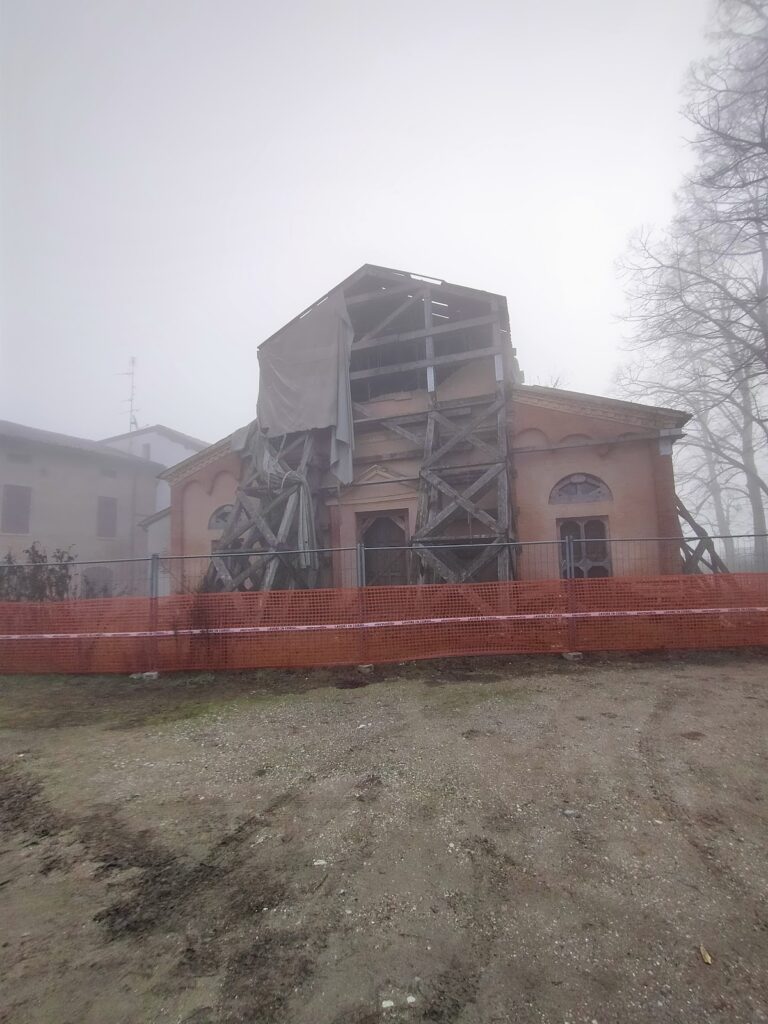
The 2012 earthquake in Emilia severely damaged the castle and made its historic section unusable. The complex closed while urgent safety work was undertaken. The cartographic collection and gold coins were temporarily transferred to the UniCredit vault in Modena, the painting collection moved to the Ducal Palace in Sassuolo, and the biomedical exhibition relocated to Via Focherini. In April 2016, the municipal council approved a first recovery plan financed by the Emilia-Romagna Region, while the castle remained under restoration in the later description. Together with the town hall, the castle continues to be regarded as an icon of Mirandola.
Remains
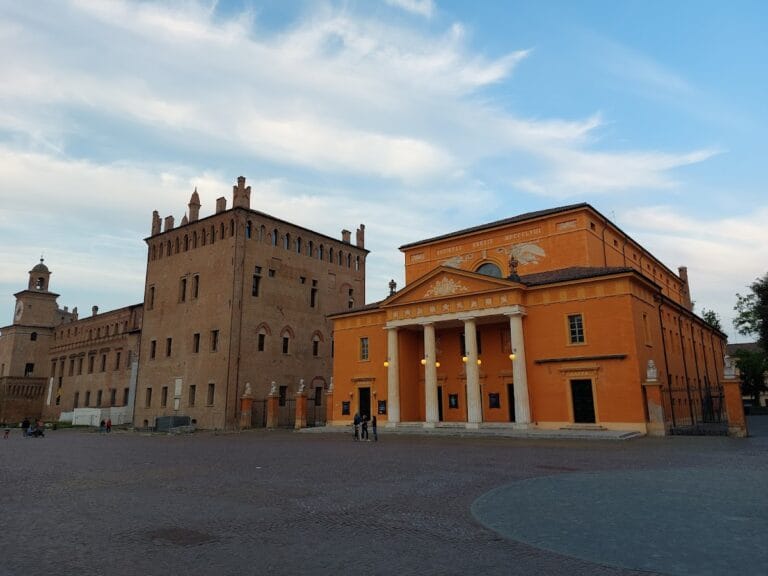
The surviving complex preserves parts of the former quadrilateral fortress beside the tree-lined Circonvallazione and the long Piazza della Costituente. The nineteenth-century city walls that once surrounded it were partly replaced by this road. The principal surviving fabric includes the ruined Ducal Palace on the southern side, the Galleria Nuova at the center, the remains of the Bastione del Castello to the west, prison rooms, and the adapted theater spaces.
Ducal Palace and Western Defenses
The ruined Ducal Palace is the largest surviving original structure. It stands on the southern side of the castle, opposite the Teatro Nuovo, while the adjoining widening of Piazza della Costituente formerly served as a horse market. Its portico rests on ten pink-marble columns commissioned by Alessandro I Pico. A doorway with rusticated arches leads from the portico into the internal courtyard and onward to the Galleria Nuova. On the first floor, the Sala dei Carabini retains ornate seventeenth-century decoration and was used for the Civic Museum.
West of the palace are the remains of the sixteenth-century Bastione del Castello, a fortified projection strengthened by Fulvia da Correggio in 1576. It was connected at eight points to powerful star-shaped walls defending the city. The former prison area is reached by descending several steps from the ground floor. Its thick masonry walls and barrel vault survive, together with graffiti and drawings made by prisoners. An exhibition room was created beside the prisons for temporary displays.
Galleria Nuova
The central building is the Galleria Nuova, whose northern facade was erected in 1668 at the order of Alessandro II Pico della Mirandola. It takes the form of an elegant loggia, an open-sided gallery, enclosed at each side by a building wing with rusticated profiles. Broad tripartite Serlian windows, each formed by a central arch flanked by lower rectangular openings, face the Circonvallazione.
Biagio Falcieri frescoed the gallery for a collection of more than 300 works. The paintings included works by Leonardo da Vinci, Raphael, Caravaggio, Titian, and Paolo Veronese. Alessandro II Pico purchased the collection from the Veronese lawyer Giovan Pietro Curtoni in November 1688 for 15,000 Venetian ducats. Its later history reflects the destruction and dispersal of the castle’s contents. Francesco Maria II Pico sold some paintings in Bologna to support himself in exile, while others were lost in the 1714 explosion. In 1716, many Pico portraits and Sante Peranda’s cycles Age of the World and Story of Psyche were transferred to the Ducal Palace in Mantua. Other works are held by the Galleria Estense in Modena.
The Torrione
The Torrione stood apart from the rest of the castle as an isolated keep designed by Giovanni Marco Canozi of Lendinara, son of Lorenzo Canozi. Built in 1499–1500 for Giovan Francesco II Pico della Mirandola, it had walls 18 feet thick and reached 48 meters in height. Entry was possible only by a drawbridge at the level of the third floor, reinforcing its separate defensive role.
The tower’s powder magazine was the place where 270 barrels of gunpowder exploded after the lightning strike of 11 June 1714. The original structure was destroyed, and the twentieth-century attempt to recreate it produced a monumental neo-Gothic building rather than a surviving medieval or Renaissance tower.
Towers and Urban Fortifications
The Torre di Piazza occupied the extreme northeastern corner of the castle, facing Piazza della Costituente beside the Teatro Nuovo and the corner of Via Tabacchi. Later called the Torre delle Ore or Torre dell’Orologio, it retained the town clock until Count Felice Ceccopieri, mayor of Mirandola, transferred the clock to the town hall in 1837. The tower was demolished in 1888 and was the last surviving structure of the Mirandola fortress. Before the 2012 earthquake, the municipality planned a contemporary reconstruction of its historically documented volume as a symbolic element in the regeneration of the historic center. The reconstruction was not described as completed.
Teatro Greco Corbelli
The former Teatro Greco Corbelli occupied rooms adapted from two existing halls inside the castle. Its three tiers of boxes, horseshoe-shaped auditorium, and elaborate stage machinery expressed the theatrical design of the late eighteenth century. After the theater closed in 1894, the space was used for cinema and later became the Cinema Pico. The 1896 projection associated with Italo Pacchioni connects the surviving theater area with the early history of film in Italy.
Museum Collections and Cultural Rooms
When the Civic Museum was re-established in the castle in 2006, it occupied twelve rooms. Its collections included archaeological material from the Mirandola area, religious commissions, antique furnishings, paintings, coins and medals, prints dating from the sixteenth to the twentieth century, objects from the former Franciscan Monte di Pietà, and fifteenth- and sixteenth-century weapons, shields, and armor.
The displays included a Madonna and Child attributed to Guercino, coins from the Mirandola mint, medals by Antonio Pisanello and Niccolò Fiorentino, and portraits of the Pico family and Este princes. Among them were Alfonso IV d’Este by Justus Sustermans and Alessandro I Pico by Sante Peranda. Nineteenth-century portraits of politicians and writers were shown alongside material connected with music and the municipal band. One room focused on Giovanni Pico della Mirandola, the Renaissance humanist philosopher, and his nephew Giovan Francesco II Pico della Mirandola, while other objects presented the history of the Pico family and the Este dynasty.
The former upper-floor headquarters of the Fondazione Cassa di Risparmio di Mirandola preserved historical prints and maps of Mirandola from the Giulio Cesare Costantini fund, together with ancient weapons of the Duchy of Mirandola. Another upper-floor room, the Sala Leica, hosted exhibitions of artistic photography by professional and amateur photographers, including images made with Leica cameras.