Fort bij Marken-Binnen: A Dutch Defensive Fort in the Stelling van Amsterdam
Site at a Glance
- Rating
- 4.6
- Popularity
- Very Low
- Country
- Netherlands
- Primary era
- Modern
- Eras represented
- Modern
- Civilizations
- Dutch
- Site type
- Military
- Remains
- Fort
On this page8 sections
History
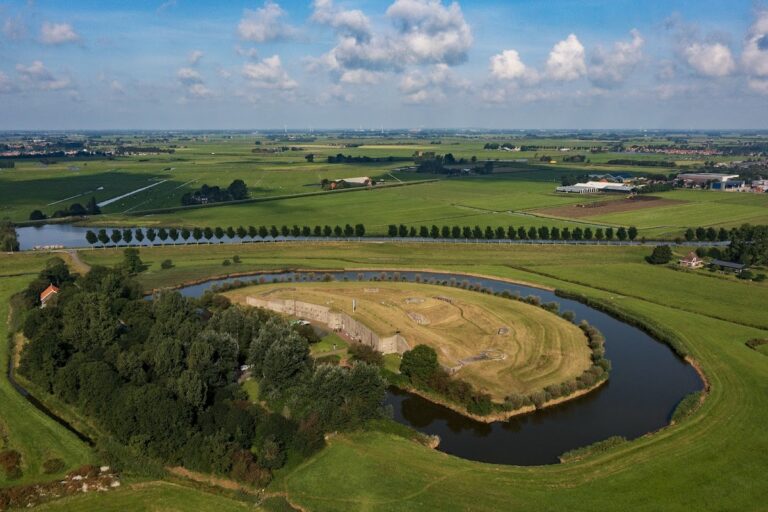
Fort bij Marken-Binnen is a Dutch fort at Marken-Binnen in the Netherlands, completed around 1905 as part of the Stelling van Amsterdam, a defensive ring around Amsterdam that used controlled flooding, dikes, forts, and artillery positions. Also known as Fort Knollendam and Fort Markenbinnen, it was built to defend the Markervaart access route, a passage through terrain that could not easily be flooded. The Model A fort could accommodate 300 soldiers.
Water barrier and artillery position
Between 1899 and 1901, a short linear embankment was built halfway across the Starnmeer polder. It extended from the Knollendammervaart to the dike of the Markerpolder and served two connected defensive purposes. It helped keep the southern part of the polder dry during inundation, while also providing a position for artillery. Inundation deliberately flooded land to slow advancing forces, with the water kept too shallow for normal navigation.
Later uses
After the Second World War, the fort was used by the Bescherming Bevolking, a Dutch civil-defense organization responsible for firefighting, first aid, and rescue during large-scale disasters. The organization was abolished in 1986. Part of the fort is now used by RBOC for training firefighters and emergency-service personnel, while another part serves recreational activities. Staatsbosbeheer, the Dutch government organization managing state-owned nature and woodland areas, owns the site.
Remains
Fort bij Marken-Binnen stands beside the Markervaart in the Starnmeer polder. Concrete forms its principal construction material. The site includes the fort itself, the remains of a linear embankment connected with the surrounding water defenses, and a later building that replaced the original engineering shed.
Fort and defensive earthworks
Concrete fort
The main fort is a concrete Model A structure completed around 1905 for the defense of the Markervaart access route. Its planned accommodation allowed up to 300 soldiers. The fort remains partly devoted to emergency-service training and partly to recreational use, continuing its adaptation to functions beyond its original military purpose.
Linear embankment
The short embankment ran from the Knollendammervaart to the Markerpolder dike across the Starnmeer polder. Its construction combined water management with artillery use, creating a barrier that supported inundation while offering a military position. Large sections have since been excavated away.
Engineering shed
The original engineering shed was demolished around 1940. A replacement building was erected in 2007 in accordance with the original construction drawings, preserving the building’s planned form in a later structure.
Nearby sites