Castello di Bosco di Corniglio: A Medieval Hilltop Fortress in Italy


Site at a Glance
- Rating
- 4.4
- Popularity
- Very Low
- Country
- Italy
- Primary era
- Medieval
- Eras represented
- Medieval, Early Modern
- Civilizations
- Holy Roman Empire
- Site type
- Military
- Remains
- Castle
On this page9 sections
History
Castello di Bosco di Corniglio is a medieval hilltop fortress ruin in Italy, built around 1400 or in the early fifteenth century as a defensive and residential stronghold. Located in Bosco di Corniglio, a hamlet of Corniglio in the Province of Parma, the castle became involved in struggles among powerful noble houses for control of the surrounding territory.
Rossi possession and Visconti capture
The castle was associated with conflicts between the Terzi and Fieschi families. An imperial diploma issued by Sigismund of Luxembourg in 1413, formally recording a possession under imperial authority, identified the site as belonging to the Rossi family. The designation “Castello di Bosco” included the associated settlement and the places of Braia and Graiana.
The Visconti captured the castle in 1431. Pier Maria I de’ Rossi later bought it back for 9,600 imperial lire, a historical monetary unit used in transactions under imperial authority. During the Rossi period, the poet Gerardo Rustici called the castle “alto Bosco” in his sonata Cantilena pro potenti D. Petro Maria Berceti Comite.
Fieschi siege and Rossi recovery
In his will of 1464, Pier Maria II de’ Rossi left the castle to his son Bertrando. On 1 September 1482, Obietto Fieschi, allied with Ludovico Sforza, Duke of Milan, during the war against the Rossis, besieged the castle with three groups of armed men. The fortress was captured without artillery after the castellan, the official responsible for commanding and administering a castle, betrayed its defenses. The castellan was Michele Bajardi of Calestano, whom Pier Maria II had appointed to the command.
The Fieschi retained the fief after Guido de’ Rossi was defeated and a Rossi fortress fell on 21 June 1483. On 30 November 1521, Lazzaro Malaspina and Antonio de Sanctis seized Castello di Bosco on behalf of Filippo Maria de’ Rossi, governor of Modena and son of Guido de’ Rossi. Filippo found the castle in a decayed condition and restored the keep while strengthening the foundations of the corner towers.
Decline and abandonment
After Filippo de’ Rossi died in 1529, ownership passed to his sons Camillo and Marsilio. When Marsilio died in 1560, his share went to Camillo’s son, Filippo Maria the Younger. Filippo Maria later fell out of favor with the Farnese and was imprisoned, prompting the ducal chamber to confiscate the castle in 1593.
Abandoned after the confiscation, the castle rapidly deteriorated. By 1804, only its foundations and the remains of one tower could be observed. The site now survives in fragmentary form as an abandoned medieval fortification ruin.
Remains
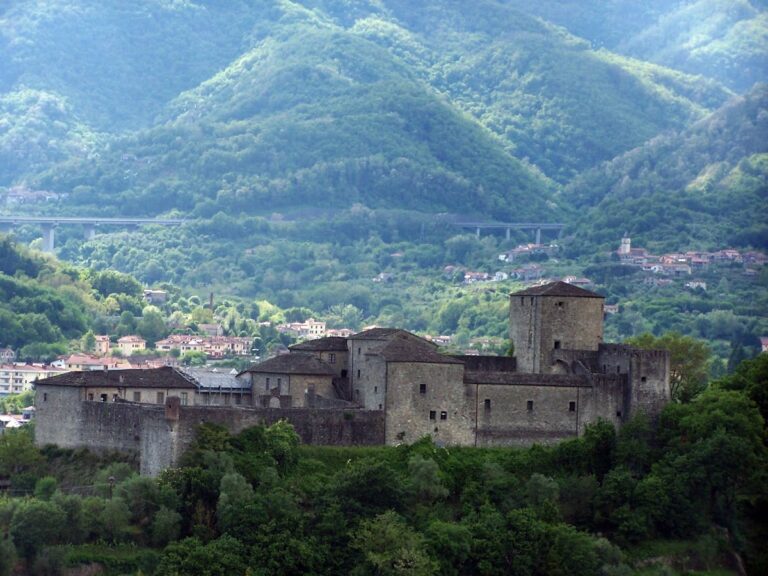
Set on a hilltop at approximately 792 meters above sea level, the castle was constructed in rubble masonry. Its defensive arrangement consisted of a central keep, corner towers, and a perimeter wall enclosing the fortified area. The visible remains preserve the tower fragments and sections of that enclosing wall, together with the foundations that define the former structure.
Fortified structures
Keep
The keep was the principal fortified tower of Castello di Bosco di Corniglio. Filippo de’ Rossi restored it after finding the castle in decay during the early sixteenth century. Its surviving presence is represented by the fragmentary remains of the castle’s towered structures.
Corner towers
The castle’s corner towers formed part of its defensive layout. During Filippo de’ Rossi’s restoration, their foundations were strengthened. The remains visible today include parts of one tower and the foundations of the former fortification.
Perimeter wall
A rubble-masonry perimeter wall enclosed the hilltop castle. Sections of this wall survive alongside the tower remains, allowing the defensive boundary of the former complex to be recognized in the ruin.