Fort du Grand Langoustier: A French Coastal Artillery Work on Porquerolles


Site at a Glance
- Rating
- 4.7
- Popularity
- Very Low
- Country
- France
- Primary era
- Early Modern
- External website
- Open
- Eras represented
- Early Modern, Modern
- Civilizations
- French
- Site type
- Military
- Remains
- Fort
On this page8 sections
History
Fort du Grand Langoustier is a French military fort on Porquerolles Island at Hyères, France, built between 1633 and 1640 for coastal defence. Its construction is attributed to Cardinal Richelieu, a leading French churchman and statesman who served as chief minister to Louis XIII and helped strengthen France’s military power.
Seventeenth-century foundation and Revolutionary War
The fort’s original purpose was military. In 1793, during the French Revolutionary Wars, English forces occupied Porquerolles. The fort was relatively little affected by the occupation, although four platforms for large-calibre guns were added that year.
Napoleonic improvements
In 1810, during the Continental Blockade, Napoleon I promoted changes to the fort. The blockade was his attempt to restrict British trade with continental Europe. A direct-access passage was cut through the tower’s northwestern side to reach the lower level and its powder magazine. The armament then comprised two 36-pounder guns and two 12-pounder guns, served by 15 gunners and 50 infantrymen. As this was judged insufficient, the nearby Avancée and Southwest Battery was established with two additional 36-pounders and two 12-pounders.
Nineteenth-century reorganization and abandonment
After the fall of Napoleon’s Empire, the fort was placed on inactive status in 1815. In 1841, the Mixed Commission for Coastal Armament proposed two 36-pounders and two howitzers for the Avancée Battery, with a crew of 20 men and an associated guardhouse. The Revision Commission later decided to concentrate the armament in a single new battery adjoining the fort. Its construction and gun installation took place from 1847 to 1849. In 1858, rifled artillery, whose spiral-grooved barrels gave projectiles greater range and accuracy, required the guns to be replaced with identical weapons modified at the factory.
The battery was decommissioned in 1874 after more powerful works at La Repentance and Giens entered service. The fort itself ceased to be an active military work in 1883, having been abandoned since 1875.
Preservation and heritage protection
A first preservation initiative began in 1989 through the Protee association, the same year that the fort was entered on France’s supplementary inventory of historic monuments. Major restoration started in 1998 under Dr Paul Vuillard, with the agreement of the French Navy and support from Port-Cros National Park and the Architect of Buildings of France. Responsibility passed to the French Coastal Conservatory in 2006, and restoration continued from 2006 to 2010. The fort is owned by the French Coastal Conservatory and lies within Port-Cros National Park.
Remains
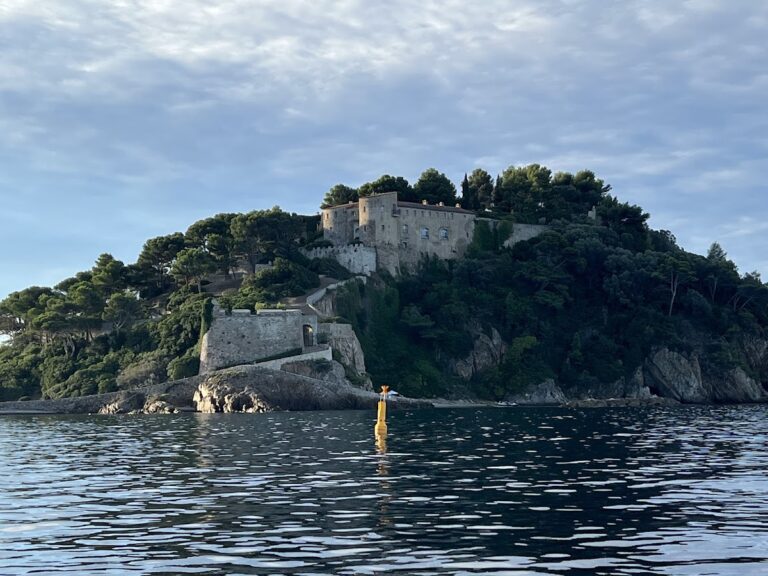
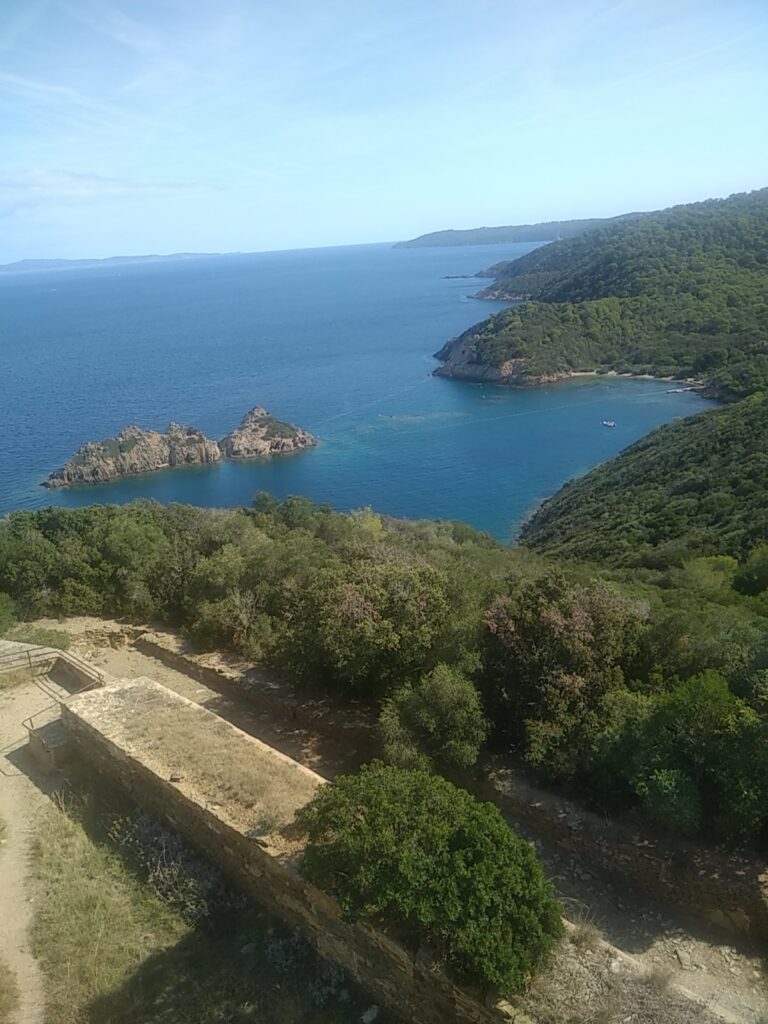
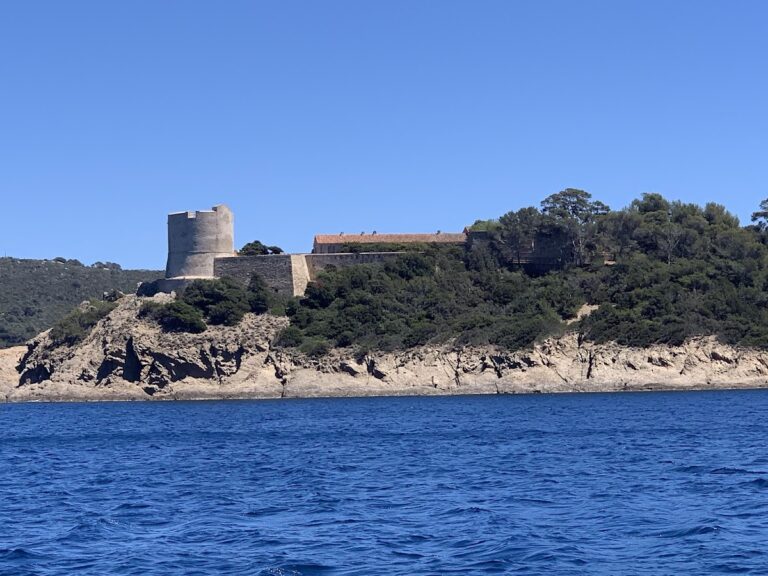
Fort du Grand Langoustier stands at the western end of Porquerolles Island, on the Pointe du Grand Langoustier above the Anse de Port Fay. It faces the landing place at La Tour Fondue on the Giens peninsula, with the islands of Petit Langoustier, Grand Ribaud, and Petit Ribaud between the fort and the mainland, approximately 3.4 kilometres away. The structure is built on soft grey or black argillaceous schist containing layers of quartz.
Fortification tower and defenses
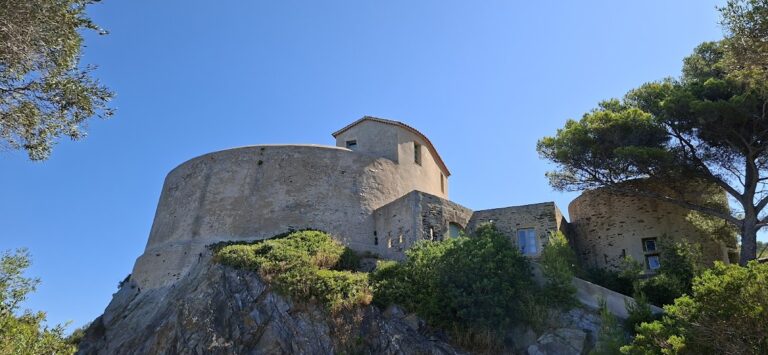
The principal building is a square artillery tower with a pyramidal form, arranged over two levels and a terrace. The ground floor, formerly the powder magazine, and the first level are covered by vaults. A spiral staircase links the upper level with the terrace. Around the tower, a defended wall-walk is protected by a parapet pierced with loopholes for firearms. At the entrance, a machicolation, a projecting defensive structure with openings for attacks against those below, provided vertical protection. A polygonal enclosure surrounds the tower and contains further firearm loopholes. The passage cut through the northwestern side in 1810 leads directly to the lower level.
Artillery batteries
The later artillery arrangement included a battery adjoining the fort and an associated guardhouse. The four large-calibre gun platforms added in 1793 formed an earlier alteration to the defensive works, while the battery built between 1847 and 1849 concentrated the fort’s later armament in a new installation beside the tower.
Nearby sites