Gut Projensdorf: A Historic Noble Estate in Germany


Site at a Glance
- Rating
- 3.9
- Popularity
- Very Low
- Country
- Germany
- Primary era
- Early Modern
- Eras represented
- Early Modern
- Civilizations
- Holy Roman Empire
- Site type
- Domestic
- Remains
- Manor House
On this page8 sections
History
Medieval Origins and Noble Ownership
Gut Projensdorf is a historic noble estate with a manor house in Altenholz, Germany. It was first recorded in 1378 as “villam Prodenstorpe,” a name probably meaning “village of Prodan.” The estate belonged to the Kiel landed-estate district. Neolithic megalithic tombs and Bronze Age burial mounds on the Achtstückenberg, west of the estate, indicate early settlement in the surrounding area.
Johann Bisch, the mayor of Kiel who died in 1379, acquired Projensdorf and arranged for its revenues to support a vicariate of St. Nicholas Church in Kiel after his death. A vicariate was an endowed ecclesiastical office or benefice, commonly supported by assigned revenues and connected with religious duties. This arrangement ended in 1497, when a regional assembly awarded the estate to John I, king of Denmark, Norway, and Sweden. He sold it to the nobleman Hans von Ahlefeldt.
Soon afterward, Joachim von Wittorff, who died in 1519, received Projensdorf as a fief. His son Jasper von Wittorf was named as owner in 1543. In 1597 the estate was known as “Progestorp” and belonged to Jasper’s son Paul von Wittorf, who died the following year.
Estate Families and Administration
Anna von Rantzau owned the estate in 1626. By 1689, Gut Projensdorf, Gut Knoop, and Gut Uhlenhorst belonged to Friedrich von Rantzau, an official of Gottorf and a regional councillor who died in 1723. Heinrich Christoph von Baudissin, who held several nearby estates, was recorded as the owner in 1750. His son, Heinrich Friedrich, Count von Baudissin, a Privy Conference Councillor, succeeded him in 1776.
Joseph, Count von Baudissin of Borstel, began managing Projensdorf in 1824. The estate was sold to the Hamburg syndic Amsinck in 1838. Until Prussia took control of it in 1867, Projensdorf also exercised patrimonial judicial authority. This was a form of court authority held by the estate owner over the people living on the estate.
From 1867 to 1928, the Projensdorf estate district belonged to the Kronshagen administrative district, successively within the Kiel district, the Kiel rural district, and the Bordesholm district. An estate district was an administrative unit centred on a large landed estate. Prussia abolished these units in 1928, and Projensdorf was incorporated into the municipality of Klausdorf, now part of Altenholz in the Eckernförde district.
From the Nineteenth Century to the Present
Ferdinand von Spee, a physician and professor of anatomy at the University of Kiel from 1891 to 1933, became the owner of Projensdorf. After retiring in 1933, he lived at the estate and died there in 1937. That year, his heirs sold Projensdorf to the banker Otto Knapp, a partner in Ahlmann Bank. Knapp later left it to his son Klaus-Dieter Knapp, a farmer. In 1999, Klaus-Dieter Knapp and his wife, Sigrid Knapp-von Conrady, transferred the estate to their daughter Almuth Hassenstein, born Knapp. She and her family live in the manor house.
The manor house suffered a major fire in 2008, but the damage was repaired soon afterward. The building is protected as a historic monument. Since 2005, civil marriage ceremonies have taken place at the estate, and the manor house is also used for cultural gatherings.
Remains
Estate Setting and Buildings
Gut Projensdorf lies west of Kiel-Holtenau near the Old Eider Canal, in the municipality of Altenholz. The Eider Canal formerly ran east of the estate. Since 1895, the Kiel Canal, an artificial waterway linking the North Sea and the Baltic Sea across Schleswig-Holstein, has cut through the grounds and runs directly alongside the manor house.
Manor House
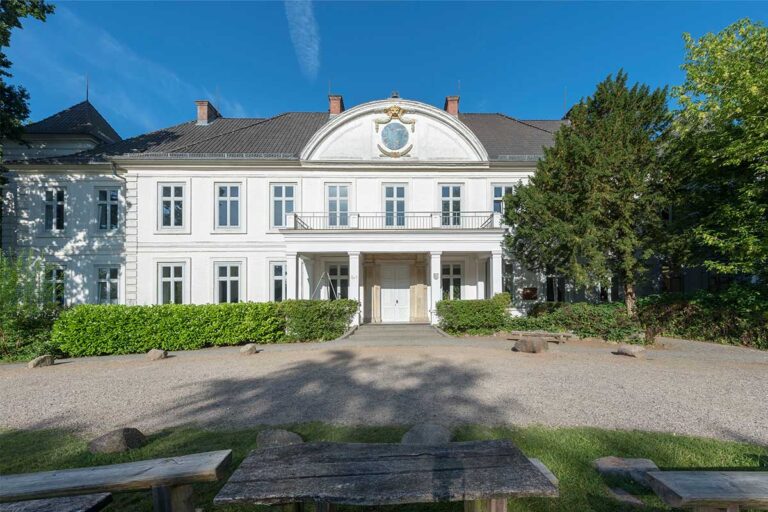
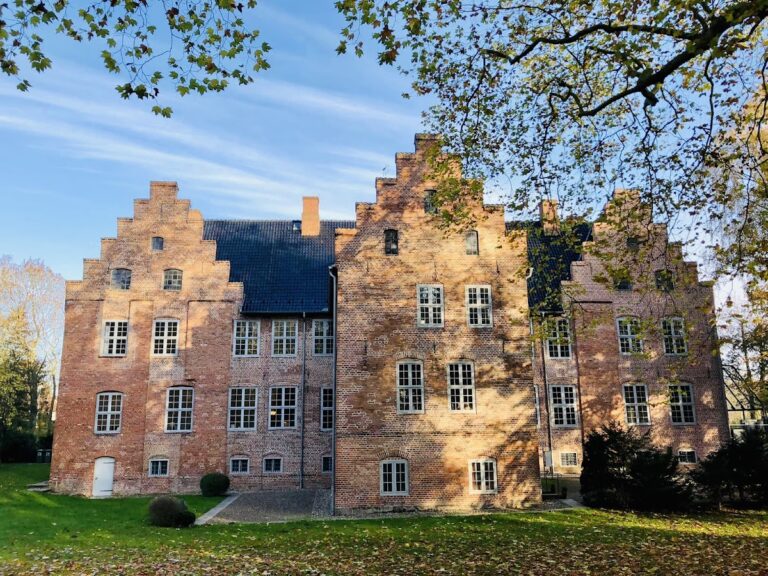
The manor house was built in 1780. Parts of its original building fabric remain, and the structure retains its role as the residential centre of the estate. After the 2008 fire, the damaged building was repaired. Its protected historic-monument status recognizes the surviving manor house as part of the estate’s architectural heritage.
Farm Buildings and Riding Facility
Several farm buildings surround the manor house. They form part of the working estate and accommodate a riding facility, placing the principal residence within a group of agricultural buildings rather than as an isolated structure.
Nearby sites