Stettenberg Castle: Medieval Spur Castle Ruins in Germany


Site at a Glance
- Rating
- 4
- Popularity
- Very Low
- Country
- Germany
- Primary era
- Medieval
- Eras represented
- Medieval
- Civilizations
- Holy Roman Empire
- Site type
- Military
- Remains
- Castle
On this page6 sections
History
Stettenberg Castle, formerly known as Burgstall Stettenburg, is a ruined medieval spur castle in Germany at Obervolkach, now within the city of Volkach in Bavaria. Its construction is generally placed in the first half of the thirteenth century, although its exact foundation date is unknown. The surviving bossage masonry, formed from projecting stone blocks with worked borders, supports this dating. When the castle was first mentioned in 1225, the record referred only to its ditches.
The Lords of Stettenberg
The castle was the ancestral seat of the Lords of Stettenberg, feudal vassals of the Würzburg prince-bishopric. This was a territory governed by a bishop who combined ecclesiastical authority with secular political power. The best-known member of the family was Eberhard of Stettenberg, who died in 1443 and had been elected Bishop of Worms in 1426.
The castle was linked to the surrounding economy as well as to the family’s position. A charter of Count Rupert of Castell mentions vineyards that he owned beside the Stettenburg, and a mill stood below the castle in the thirteenth century.
Rebuilding Plans and Later Rule
In 1339, Friedrich of Castell received permission from Emperor Louis the Bavarian to rebuild the castle. The project did not proceed because the prince-bishop of Würzburg withheld his consent. Two later castle lords were appointed by Bishop Otto of Wolfskeel, reinforcing the site’s continuing connection with the Würzburg ecclesiastical territory.
The surviving remains are privately owned. The castle structures are protected as an architectural monument, while the ditches and ramparts are registered as an archaeological monument by the Bavarian State Office for Monument Protection.
Remains
Hilltop Layout and Defenses
Stettenberg Castle occupied a west-northwest-facing spur of the 273.7-metre Stettenberg, at about 240 metres above sea level and roughly 30 metres below the summit. The Volkach River borders the site to the west and southwest, while the Weidachbach valley lies to the east and southeast. The castle probably formed a single-part hilltop fortification with a rectangular plan extending from northwest to southeast, measuring approximately 80 metres in length and 40 metres in width. Woodland covers the northern part of the hill, and vineyards occupy the southern part.
The eastern side, where the terrain was most vulnerable to attack, was defended by a neck ditch. Much of this ditch has been filled and levelled, while sections remain beside the northern and southern slopes. An inner rampart follows the ditch and was probably formed from the collapsed curtain wall. The foundation of that wall remains visible at the northeastern corner. Two slope ditches continue north and south from the neck ditch. The northern ditch is about 2 metres deep and 5 metres wide, and a western rampart extends for approximately 20 metres, surviving up to 2 metres wide and 1 metre high.
Keep
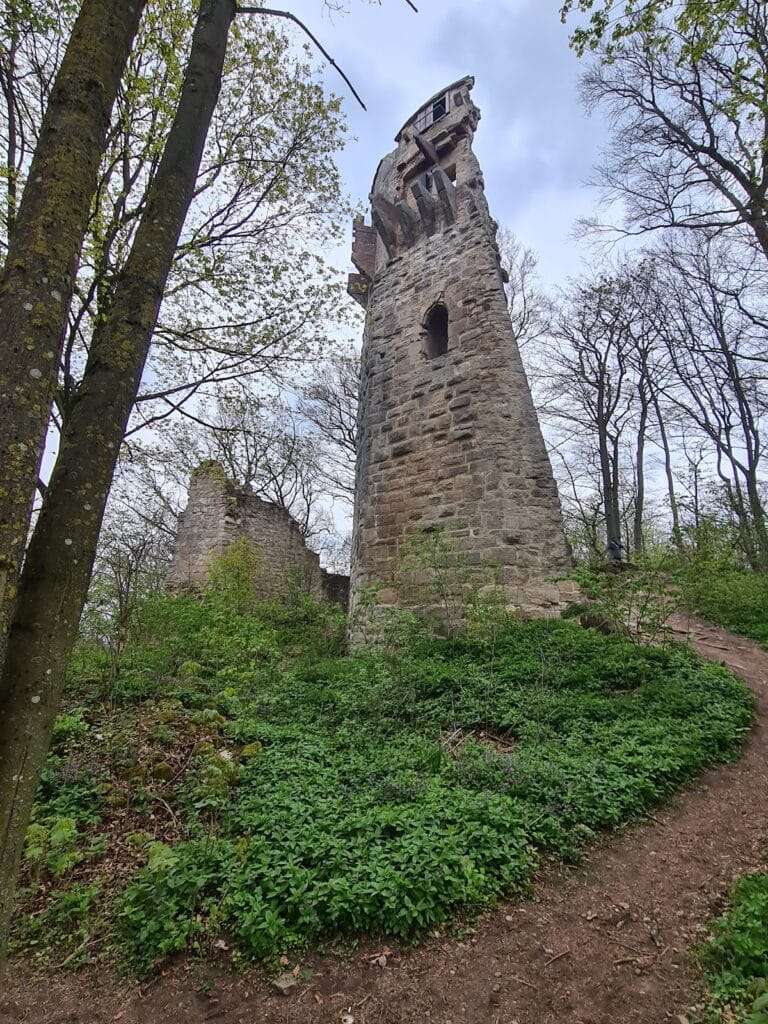
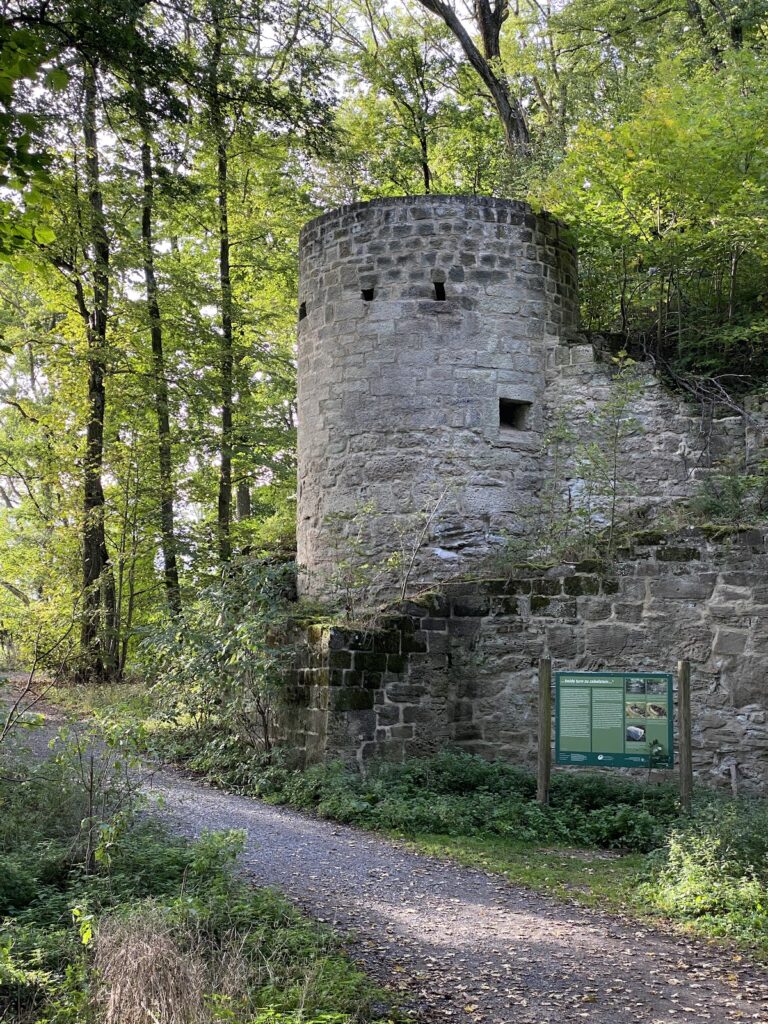
The keep, a high defensive tower that was not usually intended as a residence, stood at the centre of the narrow eastern side, about 10 metres behind the neck ditch. Its square plan measures 8 by 8 metres, and its walls are 2 metres thick. Standing masonry survives to approximately 4 metres high.
The tower was constructed with two-shell masonry. The outer facing uses bossage blocks, whose raised faces project from the joints, with continuous dressed marginal bands forming worked borders around them. Small squared blocks make up the inner facing, while rubble fills the space between the two faces. A narrow slit-like opening passes through the full thickness of the wall.