Burg Karlstein: A Gothic Castle and Former Feudal Residence in Austria


Site at a Glance
- Rating
- 3.9
- Popularity
- Very Low
- Country
- Austria
- Primary era
- Medieval
- Eras represented
- Medieval, Early Modern
- Civilizations
- Habsburg, Holy Roman Empire
- Site type
- Military
- Remains
- Castle
On this page7 sections
History
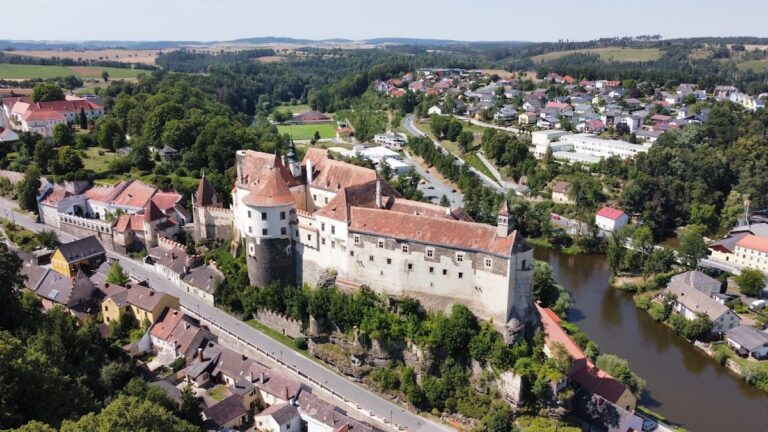
Burg Karlstein, also known as Schloss Karlstein, is a Gothic castle in Austria, standing at Karlstein an der Thaya in Lower Austria. First recorded as Chadelstain in 1112, it functioned as a feudal castle, a fortified residence held by a vassal in return for service to a territorial ruler.
Medieval and early modern castle
Various noble families held Karlstein while it remained under the authority of the respective territorial ruler. Since ownership did not remain with one family for long periods, the castle was repeatedly rebuilt and enlarged. These successive changes altered both its appearance and its practical uses.
Under the Puchheim family, Karlstein briefly became a centre of the Reformation from 1576. This sixteenth-century religious movement challenged the authority and practices of the Western Church and led to the formation of new Protestant churches. The peasant leader Georg Schrembser was probably imprisoned at the castle until his execution in 1597.
Industrial and wartime transformations
The castle later changed from an aristocratic residence into a clock factory, which operated there from 1880 onward. It also served temporarily as a prison. By 1914, when Count van der Straten owned the property, Karlstein was uninhabitable.
During the First World War, an internment camp was established at the castle, and the Montenegrin General Staff was held there. A general staff was a senior military headquarters responsible for planning and coordinating armed forces.
Political refugees and later uses
As the Hungarian Soviet Republic, the short-lived communist state established in Hungary in 1919, came to an end on 1 August 1919, Béla Kun, Jenő Landler, and about 40 people in total fled into German-Austrian territory. They received asylum and were initially housed at the Drosendorf internment camp before being brought together at Karlstein, where they faced possible extradition to the Hungarian successor state. Later, in the 1960s, the castle was used as a youth hostel and guesthouse.
Remains
Burg Karlstein occupies a steep rock at Karlstein an der Thaya. Its surviving fabric reflects repeated rebuilding and enlargement over the centuries. The castle is described as a Gothic structure built with stone, masonry, and wood, while the surviving chapel provides a sixteenth-century element within the later complex.
Castle structure
The castle’s form developed through successive alterations connected with its changing ownership and uses. Stone, masonry, and wood make up the Gothic construction, while the steep rocky position defines its physical setting.
Castle chapel
The castle chapel dates from the sixteenth century and remains part of the surviving complex. It preserves a direct architectural connection with the period when Karlstein was associated with the Puchheim family and the Reformation.