Tersløsegaard: A Historic Estate in Denmark


Site at a Glance
- Rating
- 4.5
- Popularity
- Very Low
- Country
- Denmark
- Primary era
- Modern
- External website
- Open
- Eras represented
- Medieval, Modern
- Civilizations
- Danish
- Site type
- Domestic
- Remains
- Manor House
On this page7 sections
History
Tersløsegaard is a historic estate in Denmark, near Dianalund, whose history reaches back to the thirteenth century. Its first known owner was Anders Knudsen Grosøn, who married a daughter of Esbern Snare, a twelfth-century Danish nobleman and military leader.
Medieval Ownership
Jens Grubbe acquired the estate in 1305, beginning more than a century of ownership by his descendants. When the last Grubbe owner, Niels Grubbe, died without sons, Tersløsegaard passed to his son-in-law Anders Jensen Passow. The Passow family retained it with only a few interruptions until the early sixteenth century.
The estate then entered the possession of the Bishopric of Roskilde. Following the Reformation, the Crown confiscated it and granted it to Mads Eriksen Bølle, who had helped Christian II defend Copenhagen. Tersløsegaard remained with the Bølle family until 1604.
From the Brahe Family to Ludvig Holberg
Steen Brahe became the next owner. He was the brother of the astronomer Tyge Brahe, served on the Privy Council for 32 years, and held Kalundborg Castle in fee for 28 years. Later owners came from the Brahe, Lindenov, Bjelke, Klingenberg, Heespen, and related families.
Ludvig Holberg purchased Tersløsegaard in 1745, together with its churches and tenant farms. Holberg was an eighteenth-century Danish-Norwegian author, playwright, and historian, known especially for his comedies and writings on history and law. He supported efforts to reopen Sorø Academy, a Danish educational institution with medieval origins that was re-established in the eighteenth century.
Because Holberg was unmarried and childless, he agreed to leave his estates, library, and most of his fortune to Sorø Academy. An agreement with the king granted him the title Baron of Holberg and exempted income from his estates from taxation. Holberg spent his summers at Tersløsegaard. After cattle disease killed almost all his cattle within a week, he kept sheep and horses instead of replacing cattle during later outbreaks.
Preservation and Modern Stewardship
Holberg died in 1756. His will required several rooms at Tersløsegaard to be made available to a “good widow.” Sorø Academy owned the estate after his death and sold most of its land in lots in 1816. The owner of nearby Kammersgave acquired most of these parcels.
The main building deteriorated and was sold at auction in 1861. G. F. R. Grüner, a former Sorø Academy student, joined three other former students in an effort to preserve the estate and the widow’s residence. Royal approval came in 1862, and a board managed the property with members including the Count of Frijsenborg, the barons of Lehn and Juellinge, and Tersløsegaard’s owner.
After Grüner died in 1890, the estate again fell into neglect and its remaining land was sold. The Sorø Academy alumni society formed a fundraising committee, acquired Tersløsegaard in 1905, and completed a comprehensive refurbishment in 1916. The property was later converted into a self-owning foundation. It now contains an exhibition devoted to Holberg. The main building was entered in the Danish registry of protected buildings and places on 23 December 1982.
Remains
Main Building
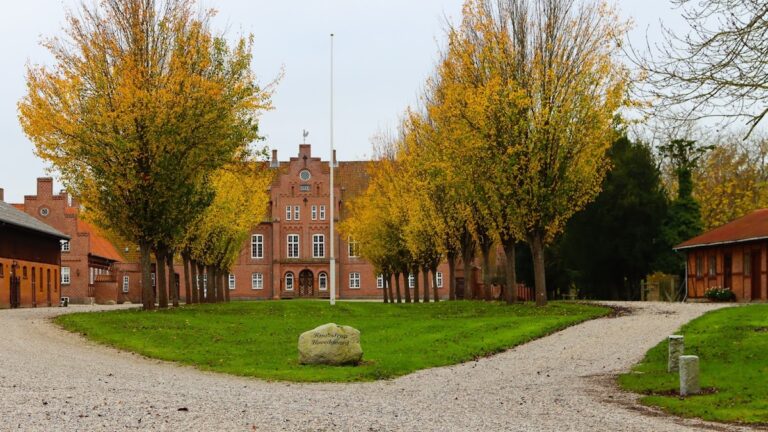
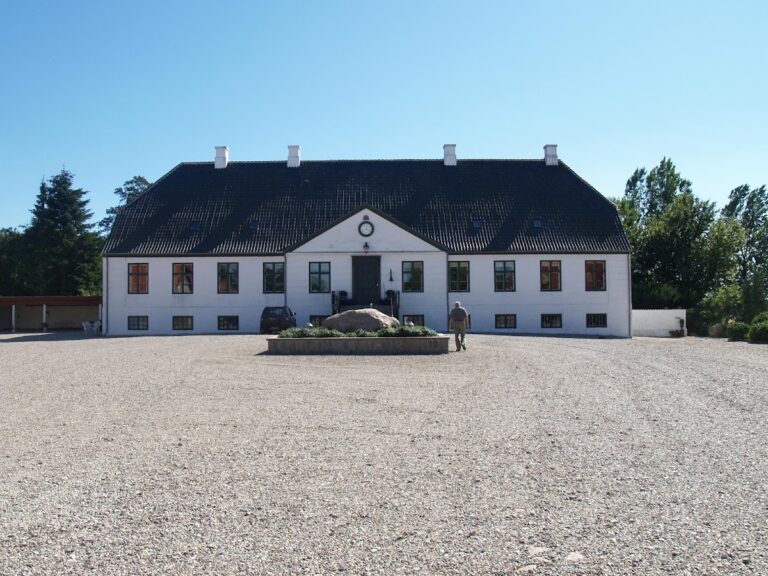
Tersløsegaard is arranged as a three-winged complex beneath a half-hipped red-tile roof. This roof form has smaller sloping sections at the ends rather than full gables. The walls use timber framing, a system of wooden posts and beams with the spaces between them infilled and covered with white render.
The oldest part of the main building dates from 1832. During the second half of the nineteenth century, the building was lengthened and enlarged with two side wings. Its cellar dates from the Middle Ages, giving the present complex a physical connection with the estate’s earlier history.
Martin Nyrop thoroughly restored the building after its acquisition in 1905. Further refurbishments took place in 1930 and 2012. The building’s present use includes the Holberg exhibition, while its protected status reflects its preserved architectural and historical character.
Garden
The garden was redesigned by Carl Theodor Sørensen in 1957 and later adapted by Svend-Ingvar Andersson in 1978 and 1979. Both were landscape designers known for their work on gardens and designed landscapes, and their interventions form part of the estate’s modern physical development.
Nearby sites