Chřibský hrádek: A Medieval Rock Castle and Possible Mining Refuge in Czechia


Site at a Glance
- Rating
- 4.5
- Popularity
- Very Low
- Country
- Czechia
- Primary era
- Medieval
- Eras represented
- Medieval
- Civilizations
- Holy Roman Empire, Kingdom of Bohemia
- Site type
- Military
- Remains
- Castle
On this page7 sections
History
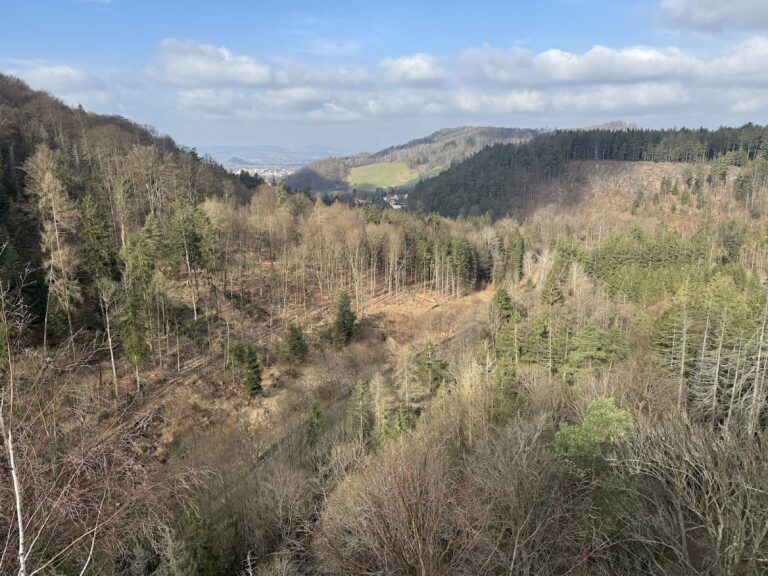
Chřibský hrádek is a ruined medieval rock castle in Czechia, situated in the southern part of Doubice’s territory near Chřibská in the Elbe Sandstone Mountains. Archaeological evidence places its origin in the second half of the thirteenth century and the beginning of the fourteenth, during the transition from Přemyslid rule, the medieval dynasty of Bohemia, to the reign of John of Luxembourg, king of Bohemia from 1310 to 1346. The site was probably founded by the Michalovice family, a Bohemian noble lineage, as a guard post along the Old Prague Road, a medieval trade route leading toward Lusatia.
Foundation and early use
The castle’s original name, builder, and later owners are unknown. One interpretation holds that it may have housed a judicial official responsible for a reeve’s district at Chřibská, meaning a local administrative area overseen by a reeve. More recent archaeological evidence indicates that the site had been abandoned by the first half of the fourteenth century, only a relatively short time after its probable foundation.
Destruction and changing interpretations
Traces of violent burning have been identified at the site and probably belong to the period of the Hussite Wars, conflicts in the Bohemian lands from 1419 to 1434 associated with the religious reform movement initiated by Jan Hus. The castle may have failed to survive the military operations that affected the region between 1440 and 1445, when the Upper Lusatian League of Six Cities took part in fighting there. Later names included Pustý zámek, meaning “Deserted Castle,” and Karlštejn, an invented name rather than the site’s original designation.
An archaeological investigation in 2003 questioned whether the surviving ramparts and ditch had been defensive works. It instead proposed that the site may have served as a refuge for prospectors or miners. Chřibský hrádek has been protected as a cultural monument since 1966.
Remains
Rock outcrop and castle layout
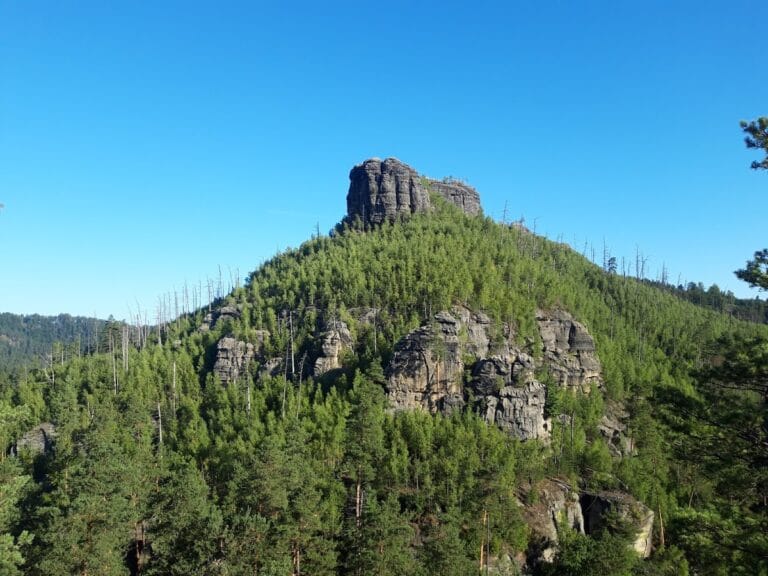
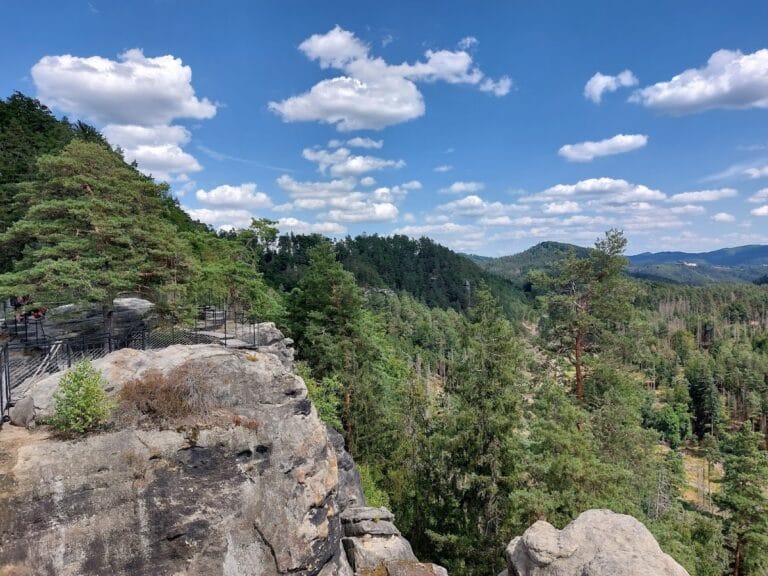
The remains occupy an area of roughly 50 by 50 metres on a rock outcrop about 30 metres above the valley of the Doubický Stream. The outcrop stands on the stream’s left bank and is encircled by the watercourse. A small castle core occupied the rock plateau, while a forecourt, the outer part of a castle complex adjoining its main core, lay at the foot of the rock.
The forecourt was especially protected on its northern and eastern sides by two ditches between two ramparts. Their earthwork remains can still be seen in the terrain. A wooden staircase probably provided access to the plateau, where the core apparently contained a single wooden tower or principal building. No above-ground masonry survives.
Carved rock features
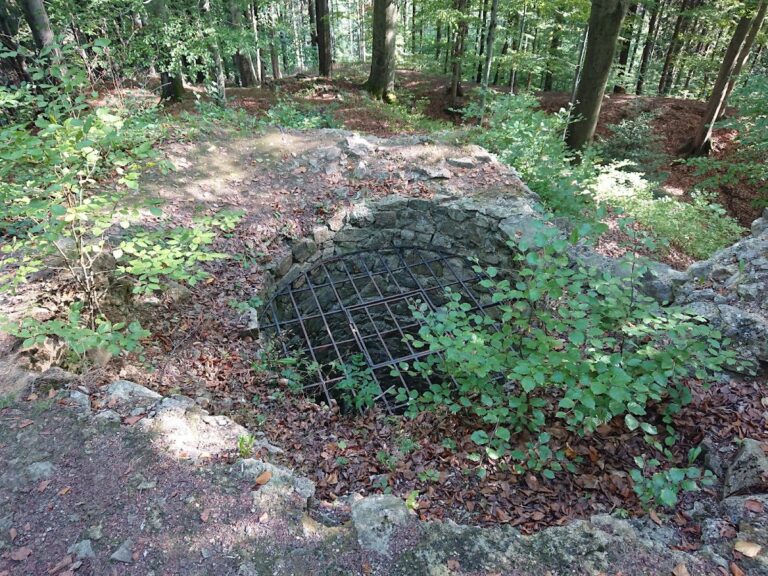
A recess for a supporting beam was cut into the rock, alongside a carved niche with the year 1690 inscribed beside it. The rock also contains a carved room or cellar and several sockets for wooden beams. These features preserve evidence of structures that were once attached to or supported by the outcrop, even though their wooden superstructure has disappeared.
Later collapse and representation
In spring 1850, a large section of the rock supporting the castle collapsed into the stream. An illustration by Karl Brandt in F. A. Heber’s Böhmens Burgen showed several openings resembling windows in the rock, but these were considered fanciful additions. Only one rock window exists. The supposed rooms behind the other openings were thought to have collapsed, possibly as a result of treasure hunting.