Château de la Houssaye: A Fortified Seigneurial Residence in France


Site at a Glance
- Rating
- 4.6
- Popularity
- Very Low
- Country
- France
- Primary era
- Medieval
- Eras represented
- Medieval, Early Modern
- Civilizations
- French
- Site type
- Military
- Remains
- Castle
On this page17 sections
History
Château de la Houssaye is a historic château in Malay-le-Grand, France, whose origins are generally placed in the early fifteenth century. The present seigneurial residence may have been begun after the division of the Viezchastel inheritance on 18 January 1485. Its history reflects the authority of the Viezchastel and Barbisy families, the judicial privileges of a rural lordship, and the later transformation of the estate into a private country residence.
The Viezchastel estate
Dreux de Viezchastel acquired the Houssaye estate in 1426. The Viezchastel family was one of the prominent families of Sens and appears in records from 1207. Dreux held several receiverships for Sens, Auxerre, and the Crown before his death before 1437.
His son Pierre de Viezchastel, born in 1413, served as master of the household to the ladies of Scotland in 1447 and as master of the household to the king between 1462 and 1469. He died before 1482, while his descendants became connected with the succession of La Houssaye. Following the inheritance division of 1485, Jacqueline de Viezchastel received La Houssaye, while her sister Charlotte received the mills and their customary milling rights.
Jean de Brisemur, also known as de Brisemmes dit de Paris, and his wife Jacqueline undertook building work at La Houssaye after the division. Jean died before 1492. Their daughter Cécile de Brisemur, Lady of Villeneufve, married Bénigne de Barbisy, linking the estate to the family that would hold it for more than two centuries.
The Barbisy lordship
From the sixteenth century, the Barbisy, also called Berbizey, family were regarded as lords of La Houssaye. Bénigne de Barbisy served Louis XII as an equerry during the Italian Wars, the French campaigns in Italy during the late fifteenth and early sixteenth centuries, and received 300 livres from the king at Milan. In 1515, Pope Leo X granted him a bull authorizing the establishment of a chapel in Sens under the invocation of the Holy Sepulchre.
A chapel was established at La Houssaye in 1534 with the consent of the Chapter of Sens and the approval of the Archbishop of Sens. It was later rededicated to Saint Louis on 5 September 1971. La Houssaye functioned as a fief, a lordship held within a feudal relationship, as a seigneurie, or landed lordship, and as a prévôté, a local administrative and judicial unit headed by a provost.
The Archbishop of Sens was the feudal overlord, and the lords of La Houssaye rendered homage to him. Marie de Malhortie, the wife of Bénigne de Barbisy, made an acknowledgment in 1548. In 1674, François de Barbisy rendered homage and provided an acknowledgment that included details of the territory. The lords also exercised high, middle, and low justice, meaning several levels of seigneurial judicial authority. The prévôté came under the bailliage of Sens, a royal judicial and administrative district.
Conflict and contested rights
During the Wars of Religion, the French conflicts between Catholics and Protestants in the sixteenth century, La Houssaye was sometimes described as a Huguenot refuge. Jehan de Barbisy opposed the Catholic League, which held influence in Sens. The seigneurial right of justice allowed a woman to be imprisoned at the château, but a letter issued by François, Duke of Alençon, on 11 May 1569 ordered the captain of La Houssaye to surrender her and other prisoners to the justice of Sens.
Jehan de Barbisy died on 20 May 1574. Three of his sons later died fighting in Poitou alongside Henri de Navarre, who became Henri IV, the first Bourbon king of France. These events place La Houssaye within the political and military tensions that affected the region during the religious conflicts.
A separate dispute concerned the compulsory use of the mills of Malay. In 1634, Philippe de Barbisy, lord of La Houssaye, lost his claim that the estate was an independent fief and should not be bound by the parish milling obligation. A banal mill was a mill whose customary users could be required to have their grain ground there in return for a payment. The dispute was renewed in 1713, after Gaillot du Val d’Epizy had acquired the estate, when tenants and the farm manager were prosecuted for failing to take their grain to the mills of Malay.
The litigation arose from the inheritance division of 1485. Jacqueline de Viezchastel had received La Houssaye, while Charlotte had received the mills and their customary rights. The cases therefore brought family inheritance, seigneurial privilege, feudal claims, and the customary rights of the parish into conflict.
From seigneurial residence to country retreat
The Barbisy family remained at La Houssaye until 1710. On 30 March that year, Marguerite du Gaigneau de Châteaumorand, widow of François de Barbisy the younger, sold the domain to Gaillot du Val d’Epizy. The property later passed through Louis du Val de La Houssaye to his first cousin and then to Pierre du Val.
Large windows were inserted during later alterations, and a balustraded staircase was constructed in the seventeenth century. After the murder of Gaillot Duval d’Episy, son, in 1736, the château ceased to function primarily as a seigneurial residence and became a country retreat. It then deteriorated gradually.
Gaillot Duval d’Episy was murdered on 23 November 1736 in the Crot à l’Ogre woods by Louis Dalençon, the son of a wealthy Sens tanner. Dalençon initially fled beyond the jurisdiction of the bailliage of Sens and was condemned in absentia. Louis XV later granted him letters of pardon, and he was acquitted in 1739.
Revolutionary and modern history
During the French Revolution, Château de la Houssaye was not sold as national property. Pierre de la Houssaye and his wife, Marie Madeleine Charlotte d’Episy, were removed from the list of émigrés after officials established that they were living in France.
Louis-Antoine Fauvelet de Bourrienne acquired the château and estate in 1809. A native of the Sens area, Bourrienne had been Napoleon’s childhood friend and former secretary and later became a minister of state under Louis XVIII. He made the property a dowry for his daughter Émilie when she married Samuel Massieu de Clerval. Louis XVIII and members of the royal family signed the marriage contract at the Tuileries Palace on 15 March 1815.
The family of the present private owners acquired the estate from Bourrienne’s descendants in 1925. Restoration began in 1965, following a fire that damaged the outbuildings in 1964. The château remains privately owned and is not open to visitors. Its chapel bell received protection as a historic monument in 1966.
The estate was also connected to a wartime episode in July 1944. The former Houssaye tileworks at La Mattre had become a farm when a Polish farmer sheltered a Polish and a Ukrainian deserter from the German army. A German commando attacked the farm on 13 July, captured the deserters, and seized the farmer, who later disappeared. The buildings were burned, while his wife and two children escaped to Château de la Houssaye, where members of the Resistance took charge of them.
Remains
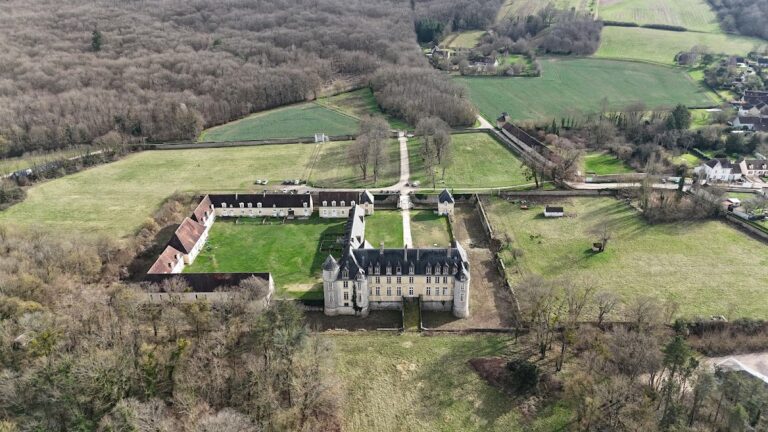
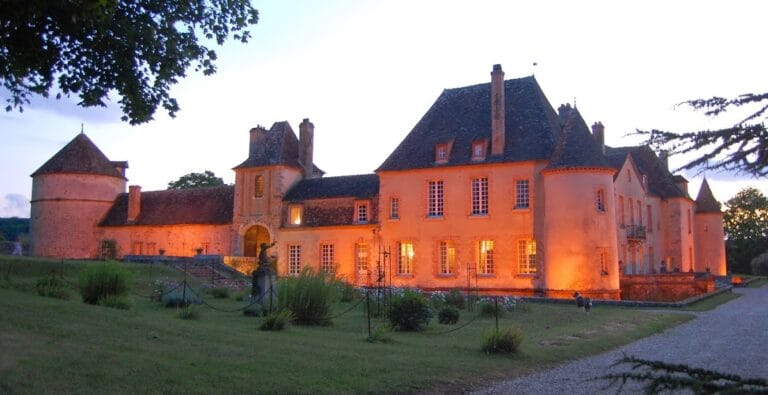
Château de la Houssaye consists of a principal building with the Noroît and Surôit towers, defensive walls, an inner courtyard, service buildings, and the chapel installed in the largest tower at the southeast corner. The surviving fabric is associated with the sixteenth through eighteenth centuries, while earlier construction is represented by foundations found beneath the present ground level. Sandstone, including the hard rustic stone known as cliquart sandstone, was used deliberately in several defensive and structural parts of the complex.
Fortifications and principal building
Noroît and Surôit towers
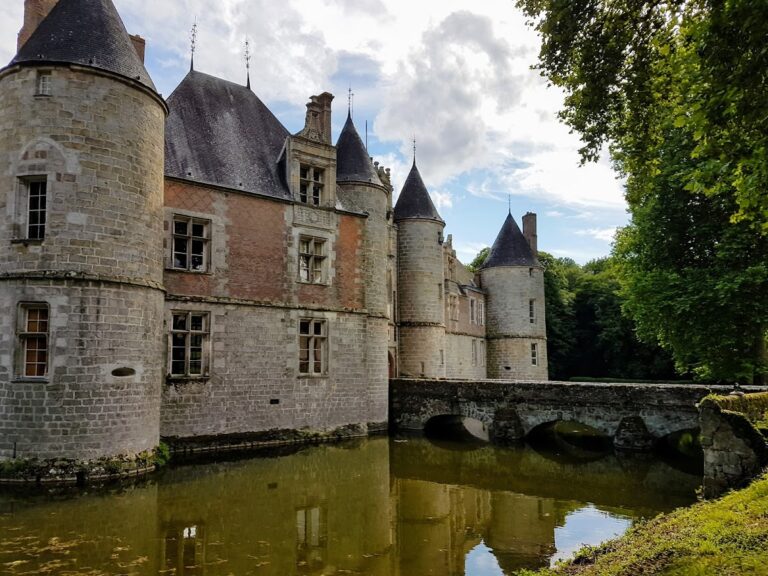
The principal building is flanked by the Noroît and Surôit towers. Their masonry includes cliquart sandstone, a local variety distinct from Fontainebleau sandstone. The same material was used for the façade, helping give the main residence and its towers a planned defensive character. Large windows were inserted during later alterations, changing parts of the earlier external appearance.
Curtain wall and defensive works
A curtain wall, meaning a defensive wall joining towers, includes a half-tower topped by a watchtower and a hoarding, a covered gallery projecting from a wall or tower. The complex also retains traces of a drawbridge, horizontally oriented loopholes for observation or defensive fire, enclosing walls, and ditches. Sandstone was used for the northern half-tower, projections over the ditch, and the gate known as the Sens Gate. The site also contains latrines and a well filled to a depth of 30 metres.
Local buildings around the château generally used flint set in lime plaster. Sandstone was reserved for supporting piers and for structural elements carrying roof timbers, while the château employed it more extensively in its façade and defensive features. Quarries for this stone lay about 500 metres away at a place called Les Roches.
Chapel and internal structures
Chapel in the southeast tower
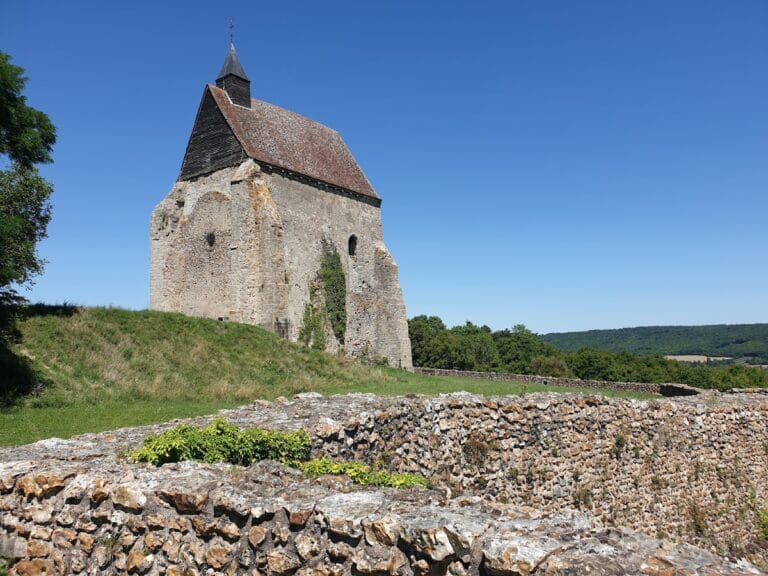
The chapel occupies the southeast tower. Its bronze bell bears a relief inscription naming François de Berbizy, knight and lord of La Houssais, as its sponsor and dating the casting to 1654. An ornamental cross is also shown on the bell. Excavations in 2009 revealed the foundations of another building approximately one metre below the present ground level.
Cellar and staircase
The château includes a vaulted cellar with a semicircular barrel vault. A seventeenth-century staircase with balusters rises between the floors, providing a surviving example of the alterations made during the period when the residence was still associated with the Barbisy lordship.
Service buildings and agricultural estate
Communs and carriage house
A secondary building known as the Communs forms part of the complex. The estate also includes an eighteenth-century carriage house with a stable, built over an earlier construction. The 1674 description of the domain listed the seigneurial house, courtyard, garden, barn, cowshed, stables, dovecote, enclosed grounds, and orchard.
La Mattre tileworks
The former tileworks stood at the hamlet of La Mattre, where tiles and bricks were formed and fired. It became prosperous during the seventeenth century and supplied building materials beyond the immediate area. In 1655, it supplied 50,000 roof tiles measuring about 16 by 32 centimetres and 60,000 bricks measuring about 21.6 by 10.8 by 5.4 centimetres. These materials were transported to the port of Rosoy for use elsewhere. A further 20,000 tiles were delivered to Rosoy in 1657 for a roofer from Milly-en-Gâtinais.
Territory of the seigneurie
The 1674 description placed the estate at the edge of the territory of Malay-le-Vicomte, adjoining the territories of Noé, Dimont, and Véron and the woods of Noé. It listed approximately 300 arpents of land, including about 100 arpents of arable ground and 200 arpents of coppiced woodland. An arpent was a historical land measure whose size varied by locality. The domain also included about 24 additional arpents of arable land and holdings at the hamlet of Les Fleuris containing nine houses and other buildings.