Fort São Roque: A Portuguese Frontier Fortification at Castelo de Vide

Site at a Glance
- Rating
- 3.1
- Popularity
- Very Low
- Country
- Portugal
- Primary era
- Early Modern
- Eras represented
- Early Modern
- Civilizations
- Portuguese
- Site type
- Military
- Remains
- Fort
On this page5 sections
History
Fort São Roque is a Portuguese fortification at Castelo de Vide, built during the seventeenth-century Portuguese Restoration War to modernize the town’s defenses for artillery. Its strategic value came from its position near the frontier and its commanding location.
Construction during the Restoration War
The Portuguese Restoration War was the conflict through which Portugal reestablished its independence from the Spanish Habsburg monarchy. Construction of Fort São Roque began in 1641, and the work expanded from 1644 under Nicolau de Langres, a French military engineer and architect. The project adapted Castelo de Vide’s defensive system to the growing effectiveness of large firearms such as cannons.
By 1660, the defenses of Castelo de Vide were arranged around two principal centers: the castle to the west and Fort São Roque to the east. An extensive line of walls connected and enclosed these positions around the town. The resulting fortification system had a garrison of 600 men and three cavalry companies.
War, occupation, and deactivation
Castelo de Vide was besieged and conquered in 1704 during the War of the Spanish Succession, an early-eighteenth-century European conflict over the Spanish throne. In 1801, during the brief War of the Oranges between Portugal and Spain, the fortified town was occupied without resistance.
French troops under General André Masséna later occupied the town during the Peninsular War in 1811. The Peninsular War was the Iberian phase of the wider conflict against Napoleonic France. Destruction suffered after these events contributed to the fort’s deactivation from 1823 onward, and its deterioration then intensified.
National heritage
Fort São Roque was classified as a National Monument by a decree published on 23 June 1910. In Portugal, this designation recognizes sites considered to have national cultural importance.
Remains
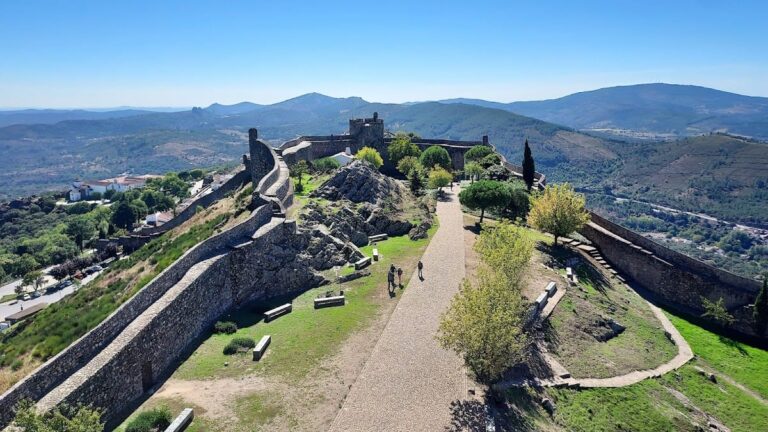
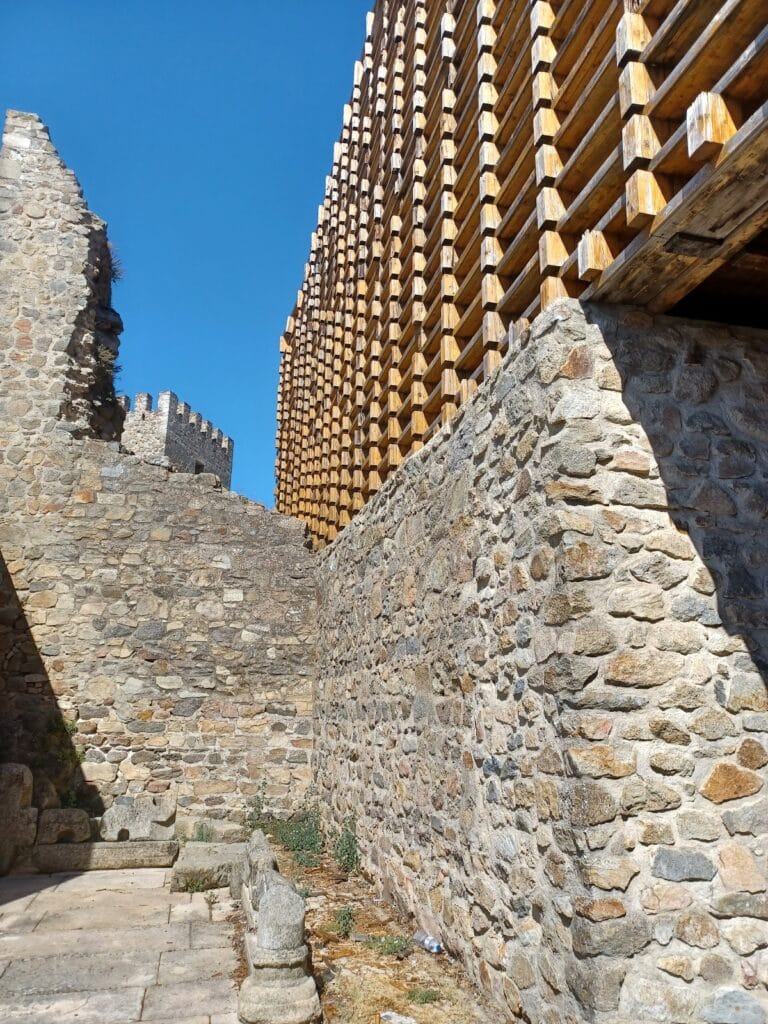
Fort São Roque stands on the summit of a hill at Castelo de Vide, north of the São Mamede mountain range in the Alentejo. Its plan is star-shaped, with broad walls adapted to irregular terrain. This form allowed the defensive walls to cover one another and reduced vulnerable angles against artillery.
The fort formed the eastern principal center of Castelo de Vide’s defenses. An extensive line of walls connected it with the castle to the west and surrounded the town, making the fort part of a larger defensive layout rather than an isolated position.