Sinagoga Medieval de Castelo de Vide: A Medieval Synagogue in Portugal


Site at a Glance
- Rating
- 4.4
- Popularity
- Low
- Country
- Portugal
- Primary era
- Medieval
- External website
- Open
- Eras represented
- Medieval, Early Modern
- Civilizations
- Portuguese
- Site type
- Religious
- Remains
- Synagogue
On this page10 sections
History
Sinagoga Medieval de Castelo de Vide is a late-fourteenth-century Gothic synagogue in Portugal, built by the town’s established Jewish community. It stands in the former Jewish quarter, making it one of the two surviving medieval synagogues in Portugal that predate the expulsion of the Jews, alongside the Synagogue of Tomar.
The medieval Jewish quarter
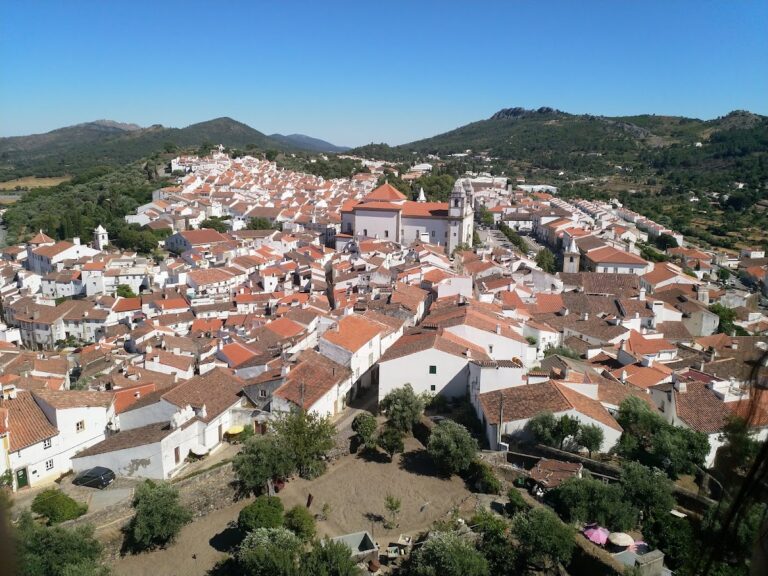
The Jewish quarter occupied the northern part of the medieval town, close to Castelo de Vide Castle. Jews initially lived there alongside Christians rather than within a segregated ghetto. The synagogue served this community as a place of worship and formed part of a wider group of religious, educational, and residential spaces.
Conversion, abandonment, and reuse
In 1496, King Manuel I ordered the forced conversion or expulsion of Portugal’s Jews. Marranos, a term used for Iberian Jews who converted to Christianity, sometimes under coercion, while privately maintaining Jewish practices, continued to use the synagogue for worship and schooling until the middle of the sixteenth century.
From the mid-sixteenth to the eighteenth century, at least the basement went unused, and the building was probably abandoned as a whole. Extensive work at the end of the eighteenth century changed it into a private house. Chimneys were added, and a doorway between the former men’s and women’s rooms was probably inserted. By the end of the nineteenth century, the basement served as a stable.
Rediscovery and commemoration
A privately funded restoration in 1972 revealed the concealed stone structure identified as the Torah ark. Archaeological work followed in the basement in 1988 and 1989, while part of the floor beside the ark collapsed in October 2000. In 1989, Portuguese President Mário Soares visited the synagogue and apologized on Portugal’s behalf to Jews for persecutions during the Inquisition.
The building was registered as a Building of Public Interest on 21 December 1974 and remains protected as a heritage monument. Since April 2019, it has housed a small museum devoted to the history of Castelo de Vide’s Jewish community.
Remains
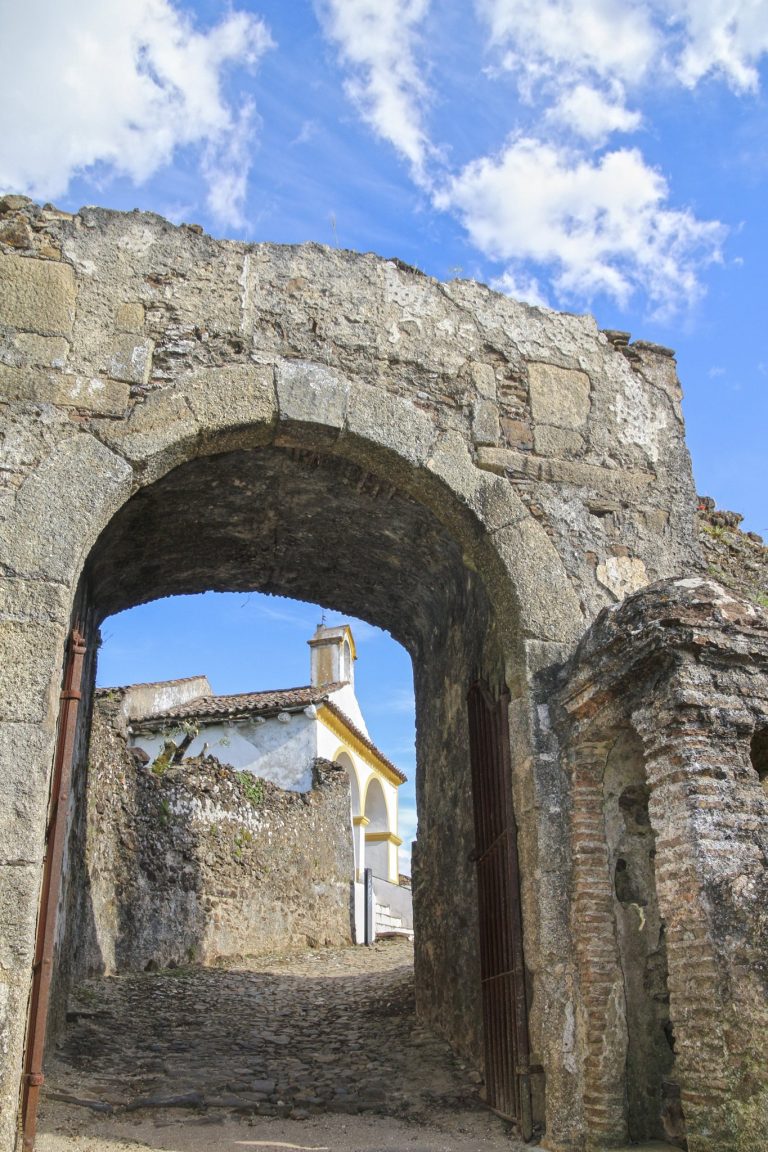
The synagogue is a small, two-storey Gothic building occupying approximately 80 square metres on a sloping corner plot at the junction of Rua da Judiaria and Rua da Fonte. It is oriented from east to west and has an adjoining building that contained a school and residential space. Pointed stone arches define its entrances and reflect the Gothic architectural tradition, a medieval style associated with pointed arches and related structural forms.
Entrances and rooms
The western section faces Rua da Judiaria at street level. Its main entrance consists of three pointed-arch doorways. The lower southern section, facing Rua da Fonte, has another pointed-arch doorway. One entrance includes a mezuzah recess, which held a small case containing a handwritten scroll with biblical verses, including the Shema Yisrael, a central Jewish declaration of faith affirming that God is one.
Interior arrangement
Prayer rooms
The upper floor contained the central prayer room, where the men of the community gathered. Women used a separate room with its own entrance on the right. A doorway between these former areas was probably added when the building was converted into a private house in the late eighteenth century.
Basement
The basement accommodated economic or service activities and included residential rooms. Until the end of the fifteenth or the beginning of the sixteenth century, grain-storage silos were set into its floor. They were probably abandoned because of high ground moisture, and the depressions visible today were created when the silos were filled. These depressions were first interpreted as the remains of a mikveh, a Jewish ritual bath for immersion, but the existence of a mikveh was later ruled out.
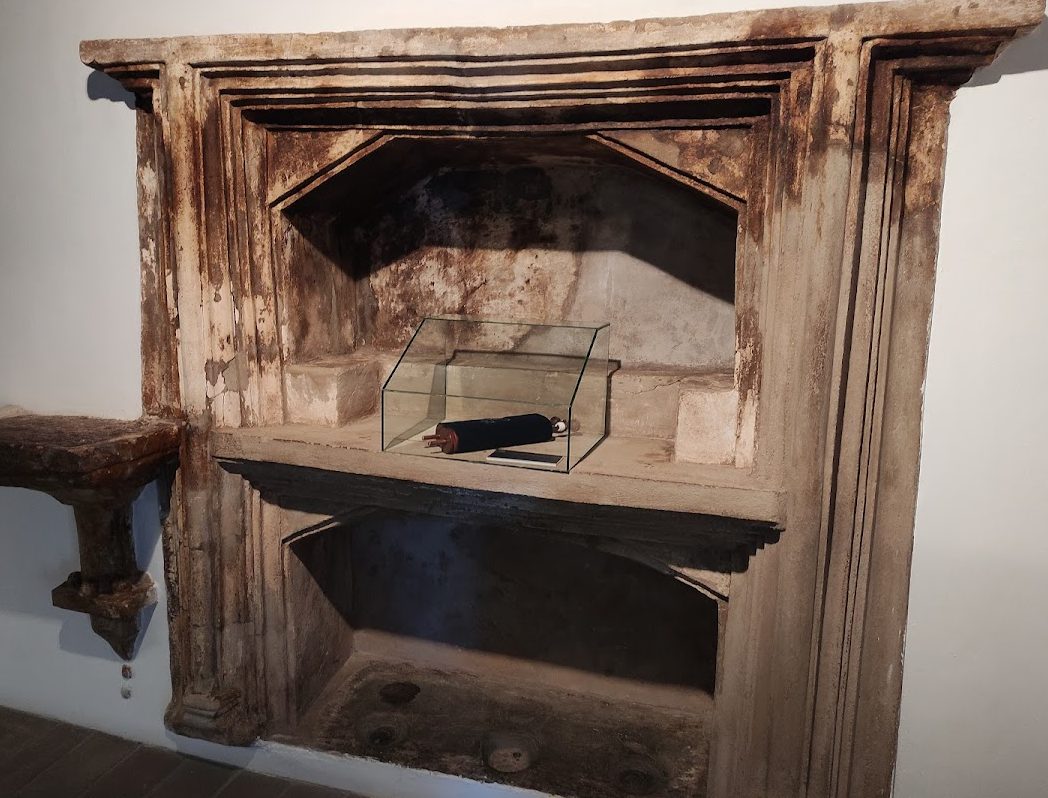
Torah ark
Inside the building is a carved stone Torah ark, or tabernacle, dating from the fifteenth century. A Torah ark is the cabinet used in a synagogue to store Torah scrolls. The left scripture pedestal is decorated with seven balls, symbolizing the six days of creation and the one day of rest. The original ark is displayed by the museum in the former synagogue.