Thubursicum: A Roman and Byzantine City in Algeria


Site at a Glance
- Rating
- 4.8
- Popularity
- Very Low
- Country
- Algeria
- Primary era
- Classical
- Eras represented
- Classical, Medieval
- Civilizations
- Amazigh, Byzantine, Roman
- Site type
- City
On this page19 sections
History
Thubursicum is an ancient Roman and Byzantine archaeological site at Khemissa in Algeria, developed from a principal settlement of an indigenous Berber tribe of Numidia into a Roman city. It occupied a strategic position on the road between Hippo Regius, near present-day Annaba, and Theveste, present-day Tebessa. The settlement later became a Christian center and remained in use through the Vandalic and Byzantine periods.
Numidian Origins and Roman Development
Thubursicum originated in the ancient kingdom and region of Numidia, an area inhabited in part by Berber peoples. Tacitus, the Roman historian, probably associated the town with the revolt of Tacfarinas, a Numidian military leader who led an uprising against Roman rule during the reign of Emperor Tiberius, around AD 15 to 24.
Under Roman authority, Emperor Trajan elevated the settlement to the status of a municipium around AD 100. A municipium was a Roman town whose inhabitants received Roman civic rights while retaining a degree of local administration. The town took the official name Municipium Ulpium Traianum Augustum Thubursicu Numidarum, and its citizens were enrolled in the Papiria tribe, one of the Roman voting tribes used for civic and administrative organization. An inscription from AD 100 calls the settlement a civitas, or Roman civic community, while another from AD 113 identifies it as a municipium. By AD 270, Thubursicum had become a Roman colony, known in Roman terms as a colonia.
The city occupied approximately 65 hectares as it expanded northward and westward. Its strategic location supported an agricultural population, and most of its inhabitants were farmers. The road connecting Hippo Regius and Theveste gave the settlement a place within the wider network of Roman Africa.
Christian Center and Episcopal History
Thubursicum later became the seat of a bishopric and an important Christian center in the region. Religious disputes between Catholic and Donatist communities shaped its history. Donatism was a North African Christian movement that rejected the authority of clergy considered compromised during persecution, creating a prolonged dispute with the Catholic Church.
Augustine of Hippo, the Christian theologian and bishop, visited Thubursicum twice in 397 and 398. He came to meet Donatist bishops and discuss an end to the schism. Among the late Roman bishops was Fortunio, a Donatist associated with a public discussion with Augustine. Maurentius was a Catholic bishop known from AD 407 and the years after 416, while Ianuarius was a Donatist bishop recorded in AD 411.
Frumensius was the last known bishop of Thubursicum. In AD 484, the Vandal king Huneric summoned him to Carthage and condemned him to exile. The episode reflects the religious and political pressures affecting North African Christian communities during Vandal rule.
Vandalic and Byzantine Rule
Thubursicum belonged to the Vandalic Kingdom of Carthage from 435 to 534. The Eastern Roman Empire reconquered the town during the Vandalic War in 534. Byzantine authorities then built a chapel and small forts, and Thubursicum remained within the Byzantine prefecture and Exarchate of Africa until the Muslim conquest of the Maghreb in 698. An exarchate was a Byzantine territory governed by an exarch, who combined civil and military authority.
The site also retained an ecclesiastical identity after its ancient residential bishopric ceased to function. Since 1933, Thubursicum has been recognized as a suppressed Catholic episcopal see and a titular see, meaning that the bishopric survives as an ecclesiastical title rather than as an active residential diocese.
Excavation and Conservation
Archaeological excavation began in 1865, followed by further work in 1877 and several campaigns during the early twentieth century. Excavations between 1902 and 1911 were associated with Stéphane Gsell, a French historian and archaeologist known for his research on ancient North Africa. Other work took place between 1900 and 1922 and during 1903 to 1905. Only part of the ancient town was cleared. Many of the recovered objects, particularly Roman statues, are preserved at the museum in Guelma.
A conservation and enhancement study in 1997 inventoried the monuments of Khemissa, assessed threats to their condition, and prepared technical records and treatment recommendations for individual structures. Its proposed approach favored minimal intervention and the protection of the ancient remains.
Remains
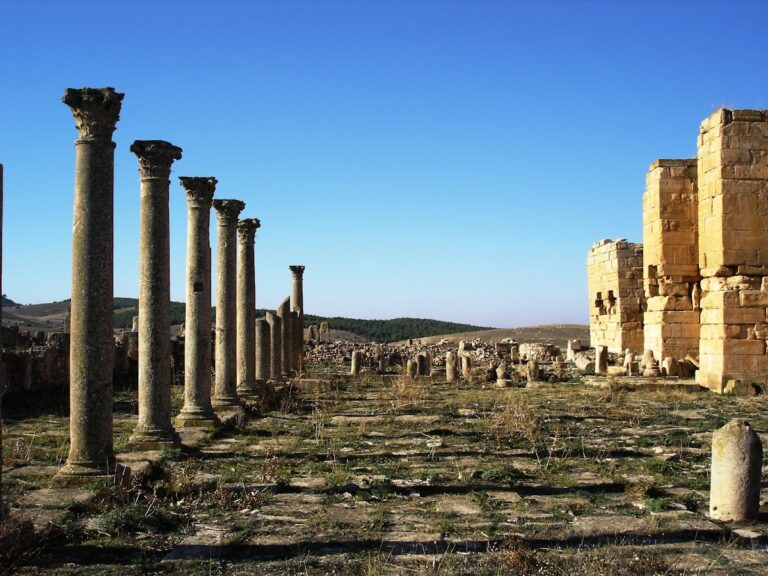
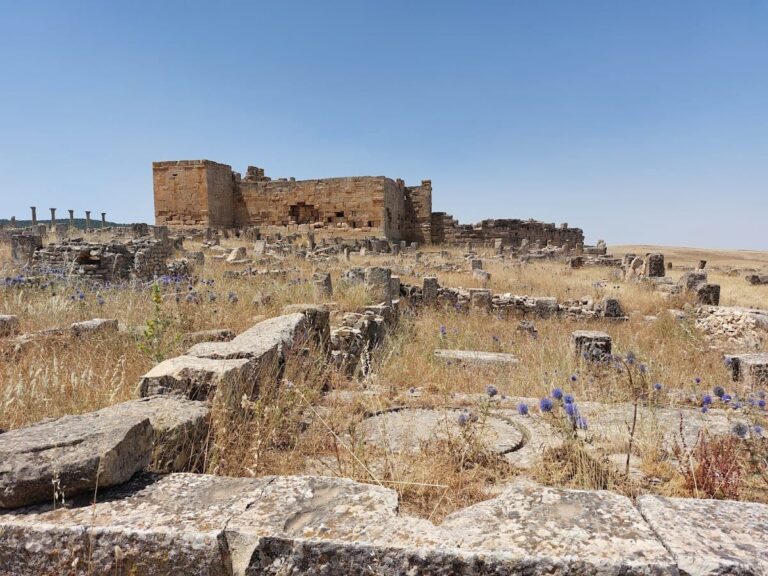
The archaeological site, described as the largest in eastern Algeria, occupies a mountainous setting in northeastern Algeria near the source of the Medjerda River. It lies at approximately 950 metres above sea level. The surviving remains extend across an urban landscape of Roman and Byzantine buildings, public spaces, streets, houses, religious structures, waterworks, and funerary monuments.
Theatre and Spring Sanctuary
Roman Theatre
The Roman theatre was built against a natural slope during the second or third century AD, within the period from Trajan’s reign to the Severan dynasty. Cut sandstone forms the structure, which remains one of the most beautiful and best-preserved ancient theatres in North Africa. The stage measures approximately 43 metres across and 9 metres in depth. Its stage wall rises about 9 metres and contains three doors set within semicircular exedrae, or recessed architectural spaces, framed by columns whose bases survive.
Two spiral staircases were built into the thickness of the stage wall. They probably led to a balcony above the stage, which may have enabled theatrical appearances. The orchestra, the semicircular area between the stage building and the seating, measures approximately 22.50 metres in diameter. Three rows were intended for movable chairs, with a first level of thirteen rows above them and a second level beyond.
The theatre may not have been completed according to its original plan. Columns and entablature elements have not been found, and Gsell considered the building unfinished and poorly decorated. Its surviving stage wall, seating arrangement, and sandstone construction nevertheless preserve the principal form of the performance building.
Spring Complex
Immediately northeast of the theatre stands the Spring Complex, a monumental sanctuary organized around two water basins. In antiquity, the spring was believed to be the source of the Bagradas River, the ancient name of the Medjerda, which flows into the Mediterranean in Tunisia between Utica and Carthage.
The northern part of the complex contained a colonnaded courtyard with a central temple. The temple held a statue of Neptune, now preserved in the Roman Theatre of Guelma. The water basins and temple joined practical water use with the religious importance assigned to the spring.
Forums and Civic Buildings
Old Forum
The Old Forum formed a principal civic space, approximately 35 metres square, with colonnades on three sides. Shops stood around the square, together with a temple dedicated to the Spirit of the Numidian People, a Capitolium, and a basilica. A Capitolium was a Roman temple dedicated to Jupiter, Juno, and Minerva, the Capitoline triad.
The forum paving was repaired between AD 323 and 333. Its stated side measurements are 21.7 metres on the east and west, 29.3 metres on the south, and 20.8 metres on the north. A single-bay monumental arch spanned the road linking the Old Forum with the New Forum.
New Forum and Market
About a generation after the paving repairs, the Old Forum was superseded by a New Forum at the foot of the hill. Constructed between AD 360 and 370, the later civic area consisted of a rectangular piazza and a macellum, a purpose-built Roman market usually arranged around a courtyard.
The macellum was a rectangular building with stalls arranged around a colonnaded courtyard. Its position within the New Forum formed part of the later civic and commercial center of Thubursicum.
Monumental Arches
Thubursicum preserves more than one monumental gateway. One arch marked the road between the Old and New Forums, while another is identified as the Arch of Trajan, also called the Arch of Honour and Triumph. These structures formed part of the city’s public architecture and its movement between major civic spaces.
Baths, Waterworks, and Fortifications
Baths and Cisterns
Ancient public baths formed part of the urban remains, including a monumental bath complex on the west side of the New Forum. Cisterns supplied water to two nearby bathhouses. The reservoirs were constructed as five parallel vaulted chambers, creating a substantial water-storage system within the city.
Byzantine Fort
The monumental bath complex beside the New Forum was later refurbished for use as a Byzantine fort. Other Byzantine forts and a chapel also belong to the later phase of the site, when the town was incorporated into the Eastern Roman administrative and military system.
Religious, Domestic, and Funerary Remains
Basilica and Temples
A rectangular basilica associated with the bishopric was built in the second century. Its walls were covered with marble. Other remains include temples, porticos, tables of measures, and statues of divinities and notable people.
A stone bears the sign of Tanit, the symbol of the Carthaginian goddess. The design consists of a triangle representing the human body, a circle above it representing the head, and a horizontal line representing the hands. The sign preserves an element of the region’s earlier religious traditions within the wider remains of the ancient town.
Urban and Funerary Features
Streets and Roman houses survive alongside judicial and civic buildings, monumental gates, an aqueduct, and funerary monuments bearing numerous epitaphs. These features extend the picture of Thubursicum beyond its public centers to its residential, administrative, water-supply, and burial areas.
Roman and Byzantine ruins remain across the site, while many excavated statues and other objects are preserved at the Guelma Museum. Together, the structures and movable finds provide evidence for the city’s long development from a Numidian settlement through Roman civic expansion, Christian prominence, Vandalic rule, and Byzantine occupation.