Lambaesis, Roman Military City and Fortress in Algeria
Site at a Glance
- Rating
- 4.6
- Popularity
- Very Low
- Country
- Algeria
- Primary era
- Classical
- Eras represented
- Classical
- Civilizations
- Roman
- Site type
- City
On this page16 sections
History
Lambaesis, Roman Military City, is an archaeological site beside Tazoult in Algeria, built and developed by the Romans as a military settlement in Numidia. Its earliest military occupation dates to 81, while the principal legionary base took shape during the reign of Hadrian, probably around 125, within a wider establishment dated to about 123–129. Lambaesis became the main base of Legio III Augusta, the Roman legion responsible for military operations in Africa for much of the imperial period, and grew into a major center of military administration and civilian life.
Foundation and Hadrianic expansion
A military detachment established a camp at Lambaesis in 81, and further camps followed. The legion was transferred from Theveste under Trajan around 100, although the chronology of the permanent legionary fortress remains uncertain. Under Hadrian, the settlement expanded into a large military complex and a civilian town. Soldiers, veterans, Roman colonists, Romanized Berbers, and other personnel lived around the installations, while veterans were settled at Cuicul, Sitifis, and Thamugadi.
Lambaesis controlled routes across the Aurès region toward the Chott el-Hodna. It served as a military center from which troops were sent to maintain order and suppress revolts in northern Numidia. Military engineers also helped construct the civilian town, linking the fortress to the urban community that developed beside it.
Hadrian inspected Legio III Augusta and auxiliary troops at Lambaesis in 128, probably during the first half of July or early summer. After watching military exercises, he delivered an adlocutio, a formal address by a Roman commander to assembled soldiers. The long inscription recording the speech praised the troops’ engineering, field fortification, and tactical abilities, while criticizing aspects of cavalry deployment and the conduct of two commanders.
The exercises included the construction of a fortified marching camp about 2 km west of the principia, the fortress headquarters. The soldiers used unusually large stones and cut a ditch through hard rock. Cavalry demonstrations included the circulus cantabricus, a coordinated mounted exercise involving circular maneuvers.
From civilian settlement to provincial capital
By 166, Lambaesis had a civilian vicus, a smaller settlement or urban district that did not initially possess the full status of a Roman city. Ten curiae, civic divisions used for local administration, were recorded there. The settlement later became a municipium, a Roman city with civic rights and local government, and received colonial status during the reign of Septimius Severus.
When Numidia was separated from Africa Proconsularis, Lambaesis became the capital of the new province and was governed in close connection with the legionary command. Septimius Severus may have visited the city with his imperial family in 202 or 203, although the journey remains disputed. Inscriptions from Lambaesis and other African cities support the possibility, while the emperor’s recorded obligations in Rome and the silence of several ancient writers have led to a cautious assessment.
The road connecting the eastern gate of the legionary camp with the civilian settlement was probably renewed in connection with this possible imperial visit. Known as the via Septimana, it was repaired again under Diocletian and Maximian, apparently with imperial funding.
Late Roman military and Christian history
Diocletian divided Numidia into Numidia Cirtensis in the north and Numidia Militiana in the south, with Lambaesis as the capital of the southern province. Constantine the Great later reunited the two provinces under administration from Cirta, which was renamed Constantina. Lambaesis consequently lost its provincial-capital status by about 313–315.
Political disturbances associated with the Gordian revolt led to the temporary disbandment of Legio III Augusta from 238 to 253. The legion was restored under Valerian and Gallienus and then carried the name Augusta Restituta. A unit of Legio VII Gemina may have occupied the base during the period of disbandment. Legio III Augusta finally departed after 392, and the town soon declined.
Lambaesis was also an episcopal center in late antiquity. Privatus, whom Cyprian of Carthage described as an old heretic, was removed from office by a synod of ninety bishops held at Lambaesis around 240. Another bishop, Januarius, attended the Council of Carthage on 1 September 256 and supported the position that baptisms performed outside the recognized church were invalid.
During the persecution under Valerian, the deacon James and the lector Marian were transferred from imprisonment at Cirta to the prefect of Numidia at Lambaesis. They were beheaded on 6 May 259 together with a large group of lay Christians killed during several days of executions.
Destruction, later settlement, and archaeological work
The town probably suffered severe destruction before the reign of Justinian, perhaps during raids from the Aurès Mountains that caused destruction or depopulation. Byzantine forces occupied Lambaesis and its vicinity from the sixth century. Arabs conquered the area around 683, and the remaining settlement later became known as Bar-el-Molouk. Lambaesis declined into a minor town, although parts of its monuments continued to survive.
The French colonial prison incorporated ancient monuments into its walls, concealing portions of the Roman remains. Ancient town walls were also dismantled for nearby farmhouses and modern villages, which made their original extent and alignment difficult to determine.
Excavation began in 1848 under Colonel Carbuccia of the Second Foreign Legion Regiment. Archaeological work between 2006 and 2010 uncovered frescoes showing the failed sacrifice of Phrixos and Hellé and a fresco of a tigress. These discoveries added to the evidence for the richness of the ancient settlement. A joint Algerian-French survey conducted from 3 October to 2 November 2019 sought to establish the city’s actual extent and reassess its heritage classification, which had been made in 1928 during the French occupation without accurately defining the site’s area.
Lambaesis has remained a Roman Catholic titular see since the eighteenth century. The title was initially revived as Lambaisis and renamed Lambaesis in 1925. Marc Pelchat has held the title since 25 October 2016.
Remains
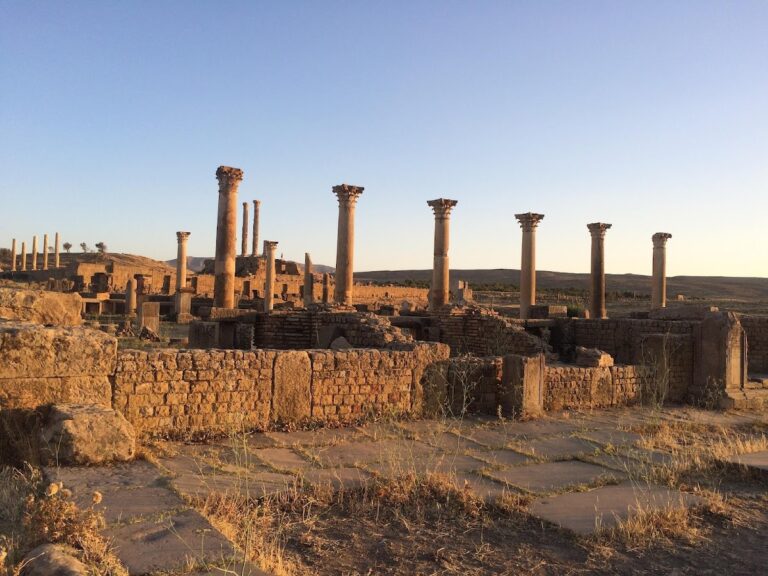
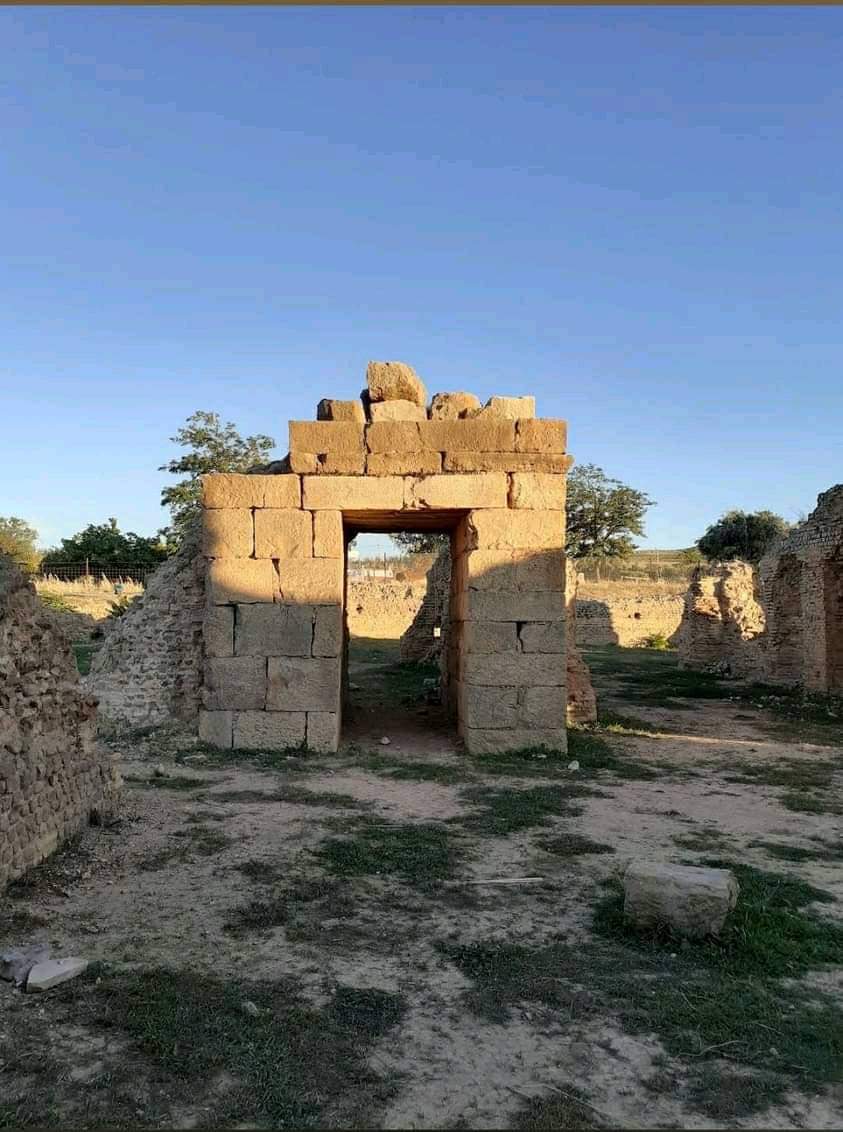
The ruins occupy lower terraces of the Aurès Mountains, across a plain and the spurs of Djebel Asker at about 622 m above sea level. The ancient settlement consists of a civilian city and a separate legionary fortress, together with triumphal arches, temples, aqueducts, baths, an amphitheatre, cemeteries, and extensive masonry from private houses. The fortress stands on level ground approximately 1 km from the center of the ancient city and measures about 500 by 450 m. Part of its area is occupied by the modern penitentiary and its gardens.
The legionary fortress
The principia
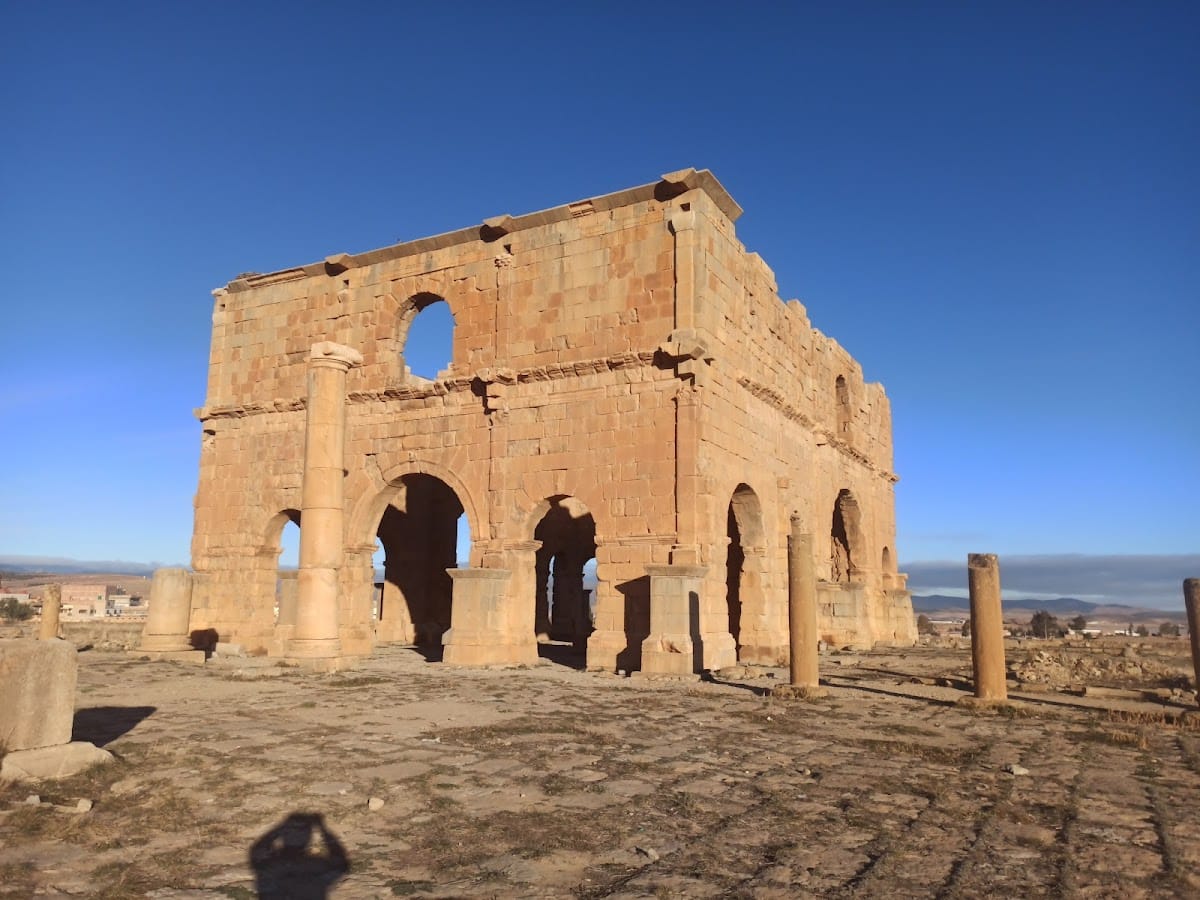
The fortress was arranged around two principal roads crossing at right angles. At their center stood the building traditionally called the praetorium, although it was the principia, the headquarters complex of Legio III Augusta. Founded in 128 and restored in the late third century, it was a rectangular building about 28 m long, 20 m wide, and 15 m high. Its tetrapylon plan allowed the two main roads to pass through it.
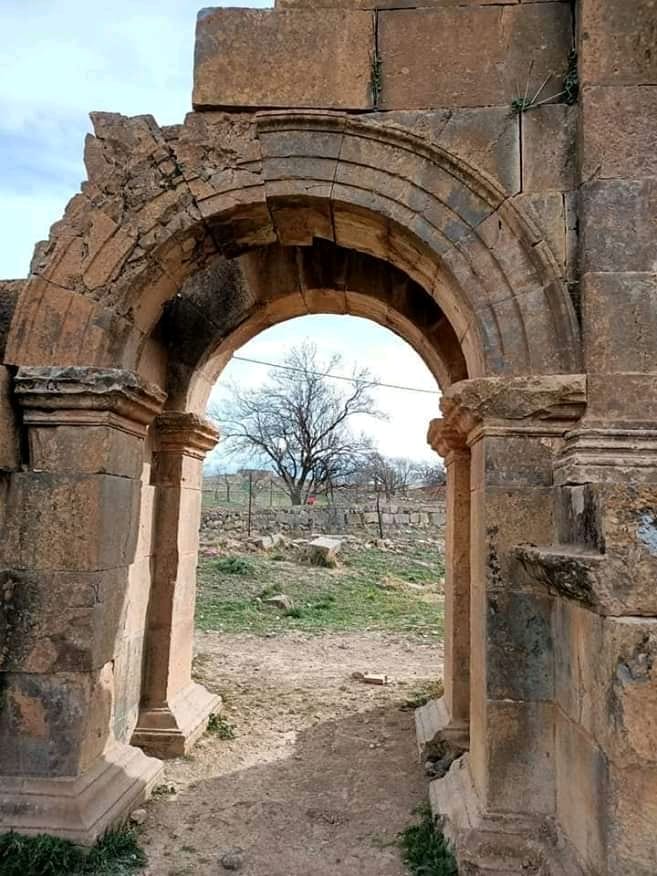
The headquarters had broad round-headed openings, a large interior hall, and a southern façade with a peristyle, or colonnaded gallery, preserved to about half the wall height. Massive Ionic columns formed the front row, with a corresponding row of Corinthian pilasters. Detached columns and pilasters decorated the other sides. Sculpted keystones show Victories, eagles, allegorical figures holding a cornucopia and patera, a shallow ritual bowl, and a military standard bearing the inscription “LEG III AUG.” The former headquarters was later reused as a local French Army headquarters and partly restored.
Courts, arsenals, and treasury
A large paved court behind the headquarters was bordered by porticoes and symmetrical rooms. These spaces functioned as armories or weapons halls. Stone and terracotta projectiles were found there, while one associated arsenal contained many thousands of projectiles. At the rear, a three-aisled basilica held smaller rooms, including a central chamber that probably served as the legionary treasury.
Baths and fortress approaches
Baths stood southeast of the headquarters. Further Roman baths, including a complex with identifiable hot-bath rooms, lay near the eastern triumphal arch. The fortress and city were connected by substantial roads and gates. Seven gates were still standing in 1765, while an Arab tradition gave the city forty gates.
Arches, amphitheatre, and civic monuments
Triumphal arches and the via Septimana
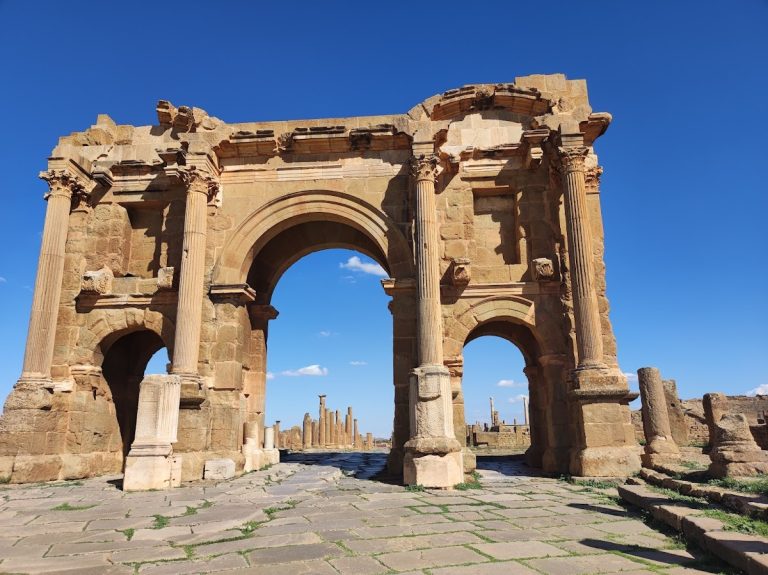
A triumphal arch dedicated to Commodus stood east of the fortress on the road toward Timgad. A second arch, with three bays and erected under Septimius Severus, marked the eastern entrance to the ancient city. The paved via Septimana passed beneath or near this arch and linked the urban settlement with the legionary camp.
Amphitheatre
An amphitheatre stood outside the walls, below the town and camp. Built under Marcus Aurelius, it retains well-preserved underground areas and parts of the machinery used for public spectacles. The building itself is in poor condition, with some seating steps surviving.
Temples
Three temples occupied the city center. The Temple of Aesculapius was a healing sanctuary associated with medical and thermal treatment for soldiers. It was heavily damaged and retains one standing column, although its façade remained complete in the mid-nineteenth century. Statues of Aesculapius and Hygieia were found there.
The Capitolium was dedicated to Jupiter, Juno, and Minerva, the Capitoline Triad of Roman religion. After rubble was cleared, its portico retained eight columns. A third central temple has not been securely attributed to a particular deity.
Urban landscape, cemeteries, and inscriptions
Aqueducts, private houses, numerous walls, and other urban remains extend across the civilian settlement. Cemeteries lie principally to the north and east, where stone tomb markers remain in their original alignments. A comparable cemetery to the west was heavily quarried for building stone used in modern villages.
Lambaesis and its surrounding area have produced 4,185 inscriptions included in Corpus Inscriptionum Latinarum VIII, more than 2,500 of them relating specifically to the camp. Most are brief epitaphs, while others illuminate the organization and history of the settlement. One inscription records an officers’ club that collected money to cover members’ travel expenses when they were transferred to another posting. Another fragment concerns the rules governing the legionary trumpeters.
Mosaics, statues, and the local museum
The site and its vicinity yielded statues, mosaics, and other antiquities. Fine mosaics discovered in 1905 near the Arch of Septimius Severus include scenes associated with Bacchus and the Four Seasons. Other finds include a mosaic depicting a physician or Asclepius, a statue of a child with a bird, a sundial, and a rounded-nozzle lamp excavated in 1880.
Ancient objects from the surrounding area were collected in the local museum. Some important works were taken to Paris and some later returned to the Archaeological Museum of Algiers, including a bronze statue of a boy with an eagle. The collection also included statues, mosaics, and inscriptions. By 2016 the museum building was at risk of collapse and had been closed.