Fort de Tancrémont: A Belgian Fortress of the Liège Defensive Position


Site at a Glance
- Rating
- 4.3
- Popularity
- Low
- Country
- Belgium
- Primary era
- Modern
- External website
- Open
- Eras represented
- Modern
- Civilizations
- Belgian
- Site type
- Military
- Remains
- Fort
On this page14 sections
History
Fort de Tancrémont is a Belgian fortification near Theux, Belgium, built in the 1930s as part of the Fortified Position of Liège. It was completed on 8 August 1938 in the interwar period and was the last of four newer forts added to the defensive system surrounding Liège. The fort is currently designated Fort de Pepinster.
The interwar defensive line
The Fortified Position of Liège was a Belgian defensive system surrounding Liège. Its older forts, constructed in the 1880s, formed the inner line known as PFL II. The four newer forts, Tancrémont, Eben-Emael, Aubin-Neufchâteau, and Battice, formed the outer line called PFL I. Tancrémont occupied the southernmost position in this newer group.
Construction followed the Belgian fortification principles developed before the First World War by General Henri Alexis Brialmont, a Belgian general and military engineer whose designs strongly influenced the country’s permanent forts. The new work also incorporated changes based on experience in the First World War. Lieutenant Victor Gérard directed construction. Finishing continued until 1938, and some work was still under way when Germany invaded Belgium.
The German attack in 1940
In 1940, Captain Abel Devos commanded Tancrémont within the Liège Fortress Regiment under Major Parmentier. The garrison consisted of 15 officers, 54 non-commissioned officers, and 500 soldiers. German forces attacked on 12 May, one day after capturing Fort Eben-Emael.
On 20 and 21 May, General Fedor von Bock demanded that Tancrémont and Battice surrender. The demand followed the capture of Aubin-Neufchâteau, an operation that had caused heavy casualties on both sides. Battice capitulated on 22 May, while Tancrémont refused and German forces bypassed it.
The garrison continued fighting after the Belgian field army capitulated on 28 May. Captain Devos first believed that the surrender order applied only to field forces. After receiving written confirmation from General Spang, he surrendered the fort at about 11:00 on 29 May 1940. Tancrémont was the last Belgian fort, and the last Belgian unit, to surrender during the opening phase of the Second World War. Its garrison was taken prisoner and sent to Silesia.
Preservation and memory
The fort is preserved and administered by the Amicale du Fort de Tancrémont, which descended from the Fraternelle du Fort de Pepinster. Captain Devos founded that association in September 1942 to bring together members of the garrison and their families. Tancrémont is protected as classified heritage in Belgium. Maurice Gast, the last surviving veteran of the original garrison, remained at the fort after the surrender to maintain its electrical systems. He died in 2020 at the age of 100.
Remains
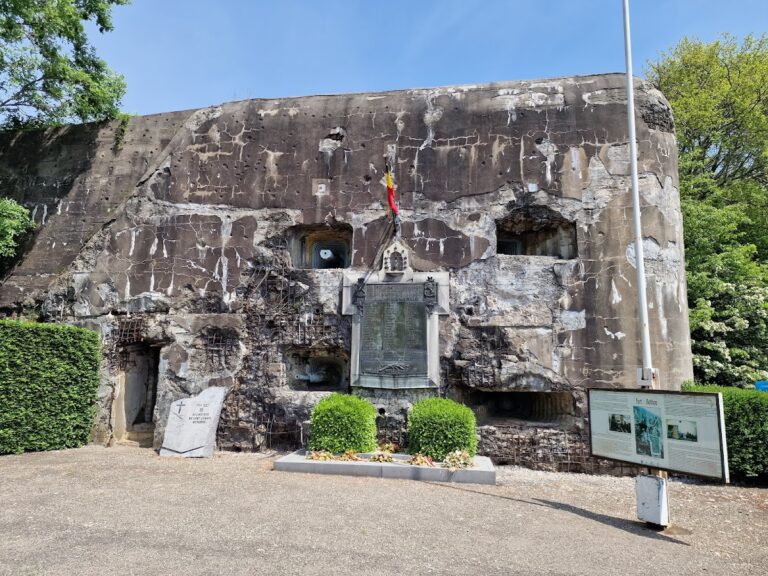
Tancrémont is a compact concrete and reinforced-concrete fort on a ridge between Pepinster and Theux, about 3 kilometres south of Pepinster and 18 kilometres southeast of Liège, near the Belgian-Dutch border. Its main body lies south of the RN666 road, while Blocks B.O and B.P stand on the opposite side. The combat elements occupy a central massif surrounded by a defended ditch. Deep excavation and burial formed part of the fort’s protection, leaving most of the structure underground and exposing mainly the tops of its blocks.
Combat blocks and artillery
Entrance block B.I
Block B.I served as the peacetime entrance. It contained light weapons, a searchlight, and an observation cupola, an armoured structure used to observe the surrounding ground.
Artillery blocks B.II and B.IV
Blocks B.II and B.IV carried twin 75-millimetre guns in retractable turrets. Their principal weapons were Bofors Model 1934 guns manufactured by the Fonderie Royale des Canons, with a stated range of up to 10.5 kilometres. Tancrémont was among the smaller newer Belgian forts and had a maximum artillery calibre of 75 millimetres. Its guns could not provide sufficient range for mutual artillery support with neighbouring forts.
Observation block B.III
Block B.III contained three observation cloches, fixed or retractable armoured cupolas used for observation or weapons. These installations had periscopes and machine guns. The block was originally intended to receive a turret with 120-millimetre guns, as at Eben-Emael and Battice, but that installation was not built.
Central block B.M.
At the centre of the fort, Block B.M. held an observation installation and three 81-millimetre mortars. A false cupola, designated Block K, was also part of the fort’s external defensive arrangement.
Ditch defenses and service blocks
Counterscarp positions
The counterscarp positions C.II, C.III, and C.IV defended the ditches. A counterscarp position is a defensive installation placed on or near the outer face of a ditch so that weapons can fire along it. These positions carried 47-millimetre anti-tank guns, machine guns, and grenade launchers. The anti-tank guns were Model 1936 weapons made by the Fonderie Royale des Canons.
Blocks B.O and B.P
Blocks B.O and B.P provided ventilation and stood outside the main defensive perimeter, linking to the fort through underground galleries. Block B.P rose above the principal living quarters, served as the wartime entrance, and carried machine guns. Block B.O also functioned as an emergency exit.
Underground network and wartime vulnerability
The underground network contains slightly less than 2 kilometres of galleries at depths of approximately 20 to 28 metres below the surface. These passages connect the command post, underground barracks, machine room, combat positions, and ammunition magazines. Unlike the other three newer forts in the Liège line, Tancrémont had no rolling drawbridge at its entrance because of its late completion.
During the 1940 invasion, excavations made by workers provided access to the main fort and weakened its security and protection. The fort’s unfinished state therefore affected the defensive system at the moment it was called upon to resist the German attack.