Fort of Arrifana: A Coastal Defence Fort in Portugal


Site at a Glance
- Rating
- 4.7
- Popularity
- Low
- Country
- Portugal
- Primary era
- Early Modern
- Eras represented
- Early Modern, Modern
- Civilizations
- Portuguese
- Site type
- Military
- Remains
- Fort
On this page6 sections
History
The Fort of Arrifana is a coastal fort in Portugal near Aljezur, built in 1635 to protect the tuna-fishing grounds and defend the coast. Its position above Arrifana Beach gave it a role in guarding this stretch of the Vicentine Coast.
Construction and reconstruction
By 1654, the fort was reportedly unguarded. It was reconstructed in 1670, but little is known about its history during the following decades. The earthquake and tsunami of 1755 then destroyed much of the structure. The tsunami reportedly reached approximately 55 metres, and the sea returned three times, striking the fort. Only the battery and the curtain wall, the connecting defensive wall at the entrance, were reported to have remained standing.
The fort’s strategic position led to another rebuilding in 1762, ordered by the Marquis of Louriçal, the governor of the Kingdom of the Algarve. It was equipped with two cannons and assigned a garrison of seven soldiers. Heavy seas caused further damage during the winter of 1765, and repairs were completed in 1771. By 1792, a corporal and six soldiers occupied the fort, although its condition was already poor.
Military use and decline
During the Portuguese Civil War of 1828 to 1834, a conflict between constitutional liberal forces and supporters of absolutist rule, the fort was rebuilt and rearmed. In October 1831, its stores contained 204 calibre-12 projectiles, 40 fuses, 40 loaded cartridges, and approximately 90 kilograms of gunpowder.
The fort was later abandoned for about a century. In 1940, it was transferred to the Ministry of Finance. Attempts to place it under the responsibility of the Portuguese Navy failed, and the Navy described it as the dismantled ruins of an old fort without sufficient historical or artistic interest to justify preservation by the state.
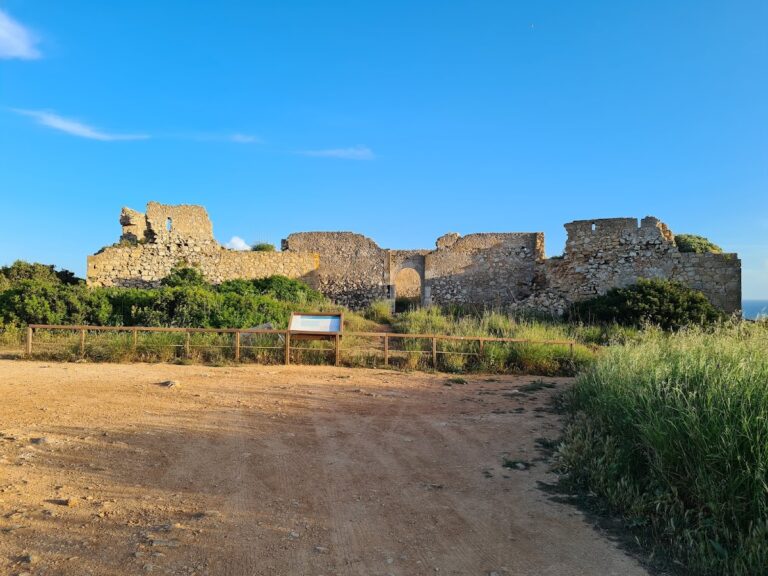
From 2007, the Municipality of Aljezur reconstructed the front wall and entrance, while also carrying out drainage and related improvements. A small archaeological study in 2011 established that the original walls had been built from stone and mortar directly on the bedrock.
Remains
Promontory layout
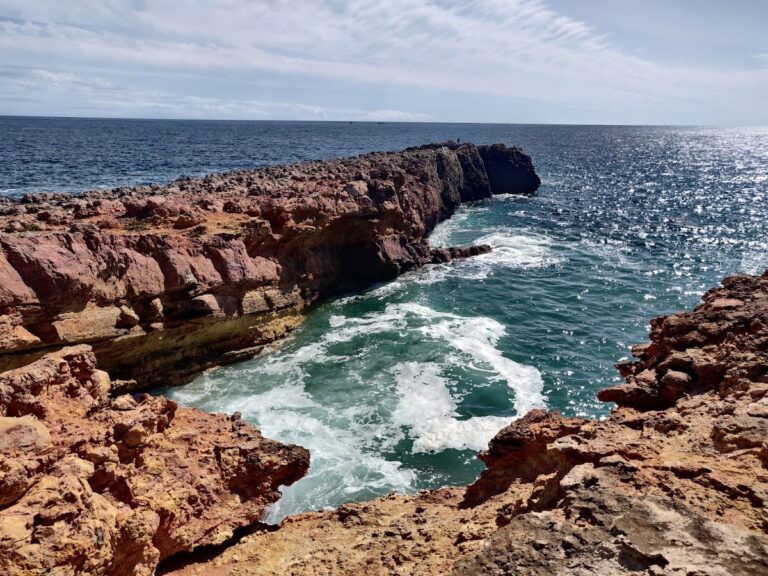
The Fort of Arrifana stands on a promontory overlooking Arrifana Beach and the surrounding coast. Its plan was divided into two sections connected by a narrow corridor of rock. The forward section, positioned immediately behind the entrance, contained a guardhouse and lodgings. The surviving arrangement reflects the fort’s adaptation to the rocky promontory and its coastal defensive purpose.
Entrance and artillery position
The entrance included a stone bearing the fort’s construction date, the Portuguese national coat of arms, and the coat of arms of Gonçalo Coutinho, a Portuguese official who served as Governor of the Algarve. A sea-facing battery, a fortified position designed to hold artillery, contained two artillery pieces. It was one of the parts reported to have survived the 1755 earthquake and tsunami. The entrance and front wall were reconstructed in 2007, while the original construction used stone-and-mortar walls laid directly on the underlying rock.