Izzeddin Fortress: Ottoman Defence and Political Prison in Greece


Site at a Glance
- Rating
- 4.1
- Popularity
- Low
- Country
- Greece
- Primary era
- Modern
- Eras represented
- Modern
- Civilizations
- Ottoman
- Site type
- Military
- Remains
- Fort
On this page9 sections
History
Izzeddin Fortress is an Ottoman fortification in Greece, built at the entrance to Souda Bay on Crete in 1872 during the Ottoman period. It replaced an Ottoman defensive tower erected there in 1646, after the conquest of Crete, and became the principal defensive work of Souda Bay.
Ottoman fortification
Rauf Pasha, the Ottoman governor of Crete, directed the construction of the present fortress. It was named after Yusuf Izzeddin Efendi, the eldest son of Sultan Abdulaziz, who ruled the Ottoman Empire from 1861 to 1876. The Greek form of Yusuf Izzeddin Efendi’s name gave the fortress its name.
In February 1878, about 2,000 Cretan insurgents tried unsuccessfully to seize Izzeddin during the western Cretan uprising associated with the Russo-Turkish War. The fortress retained its military importance until the establishment of the semi-autonomous Cretan State in 1898. After an outer wall had been built around it, the complex was converted into a prison.
Prison and political detention
The prison first held ordinary criminals, but it gradually became a major place of detention for political prisoners, including condemned prisoners. Eleftherios Venizelos, a leading Cretan politician who later served several times as prime minister of Greece, spent 15 days there in 1903 after being accused of insulting a supporter of Prince George, the metropolitan Eumenios.
During the dictatorship of General Theodoros Pangalos, whose regime ruled Greece in 1925 and 1926, many of his political opponents were imprisoned at Izzeddin. After General Georgios Kondylis overthrew Pangalos in 1926, Pangalos himself spent two years in the fortress. In 1930 and 1931, about 40 political prisoners, most of them communists, were held there after the adoption of an anti-communist law under Venizelos’s government.
Prison operations stopped during the German occupation of Crete, which began in May 1941. German forces used the fortress as a military base, barracks, and storage area for supplies. The prison reopened in 1948 during the Greek Civil War, the armed conflict fought in Greece from 1946 to 1949 between the government and communist-led forces. That year, 105 condemned political prisoners were transferred there from an island prison camp. Izzeddin continued to hold communists and other political opponents during the Civil War and for the following two decades.
Conditions were notoriously harsh. Deteriorated Ottoman water reservoirs contributed to repeated cases of typhus during the Civil War and the subsequent two decades. Georgios Erithriadis, a member of the Central Committee of the Communist Party, died of typhus on 21 January 1963 while being taken from the prison to a hospital in Chania.
Executions took place near Kalami, in the area now occupied by the cemetery, rather than inside the fortress. Four former members of the Greek People’s Liberation Army, the principal resistance military organization associated with the communist-led wartime resistance, were executed there together in April 1949. The last death sentence carried out in Greece took place at Izzeddin in 1972.
Education, closure, and later status
The last political prisoners were released in June 1964. The prison then held ordinary criminals until the military dictatorship that ruled Greece from 1967 to 1974 again led to the imprisonment of communists and other political opponents. The prison closed after the fall of the dictatorship in 1974.
As its prison function weakened after the Civil War, Izzeddin also became a center for prisoner education and literacy work. Prisoners wrote studies, novels, poetry collections, and translations, and formed theater groups that performed works by Moliere, Shakespeare, Bertolt Brecht, and D. Psathas.
The fortress was used as a filming location for Days of ’36, Stone Years, and The Last Note. Stone Years portrays the true story of two young Greek communists imprisoned during the postwar period, including childbirth, the raising of a child inside the prison, and the couple’s church wedding there.
In 1975, the fortress was transferred to the Greek Navy, which maintains a base in Souda Bay. It received historical-monument status in 1986 and was transferred to the Ministry of Culture. In 2007, it passed to the State Property Company. The protected monument has since been largely abandoned and is generally closed to visitors. Limited access has been associated with the feast of Saint Eleftherios on 14 and 15 December. In 2019, the Communist Party of Greece called for the fortress to be transferred from the State Property Company to the Ministry of Culture or local government with ministerial support.
Remains
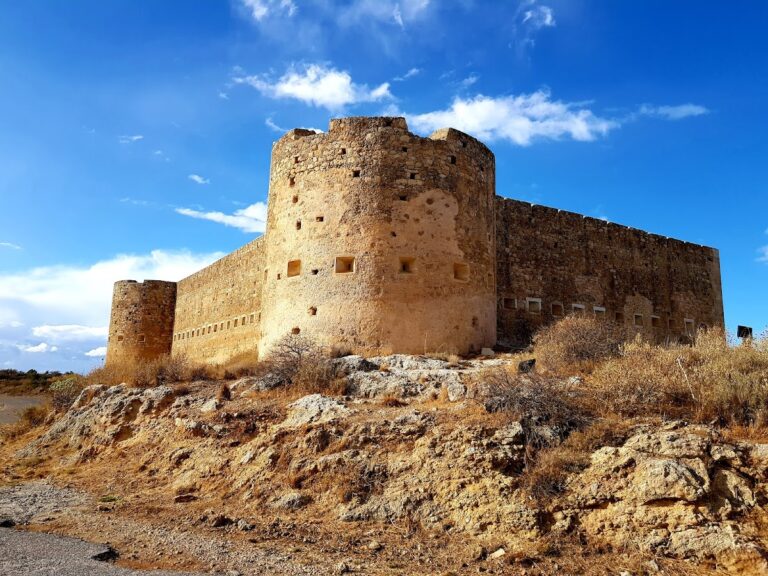
Izzeddin Fortress occupies elevated ground beside the entrance to Souda Bay near Kalami. The 1872 Ottoman fortress replaced the earlier defensive tower and was built with walls approximately 3.5 metres thick. Twelve artillery pieces were installed on the northern side to control entry into the bay. An outer defensive wall was later constructed around the fortress before its conversion into a prison.
Fortifications and prison structures
Outer wall and military sections
Parts of the outer defensive wall have collapsed, including sections around the powder-magazine area and along the western side. The powder-magazine section has suffered damage, as has part of the administrative building. These surviving and damaged structures preserve the fortress’s transformation from a coastal military installation into an enclosed prison complex.
Cells and water reservoirs
The prison cells were dark, poorly ventilated, damp, and affected by mold. One recorded cell could hold no more than two people. The prison’s only toilet was a large metal barrel that prisoners called “Bevin,” after Ernest Bevin, the postwar British foreign secretary. Ottoman water reservoirs formed part of the complex, and their deterioration later contributed to unsanitary conditions and the spread of typhus.
Chapel and prisoner-made features
Prisoners built a small chapel dedicated to Saint Eleftherios in the southern part of the fortress. They painted its icons, carved a wooden iconostasis, the screen of icons separating the sanctuary from the main worship space in an Eastern Orthodox church, and made chandeliers and lamps. They also laid out the square around the chapel. The chapel and its square remain the focus of the fortress’s limited annual public access connected with the feast of Saint Eleftherios.
Nearby sites