Fort of Zambujal: A Peninsular War Defence of Lisbon


Site at a Glance
- Rating
- 4.5
- Popularity
- Low
- Country
- Portugal
- Primary era
- Modern
- External website
- Open
- Eras represented
- Modern
- Civilizations
- British, Portuguese
- Site type
- Military
- Remains
- Fort
On this page9 sections
History
The Fort of Zambujal, also known as the Fort of Casas Velhas, is a Peninsular War fortification in Portugal, built by British and Portuguese troops in 1809–1810 to help defend Lisbon from French forces. It formed part of the Second Line of the Lines of Torres Vedras, a system of field fortifications constructed north of Lisbon during the 1807–1814 conflict between Napoleonic France and an allied coalition that included Britain, Portugal, and Spain.
Construction and military purpose
The fort was built as work No. 95 after two French invasions had been repelled. Its construction was ordered by Arthur Wellesley, 1st Duke of Wellington, the British commander who directed the Lines of Torres Vedras. The defences were intended not only to block a further advance on Lisbon but also to secure a possible Luso-British retreat and evacuation.
Its position allowed the fort to control the gorge and valley around it, the road between Ericeira and Sintra, and approaches connected with the mouth of the Lisandro River and São Julião beaches. Alongside the other Carvoeira redoubts, it was intended to cover a retreat through the Lisandro mouth and along the Carvoeira road while supporting the English fleet.
The third French invasion
During the third French invasion of Portugal, commanded by Marshal André Masséna, French forces reached the Lines of Torres Vedras but failed to break through them. After five months, Masséna’s army retreated. At its peak, the Fort of Zambujal held 250 soldiers and two cannon.
Archaeology and protection
Archaeological excavations in 2009 established the fort’s plan and investigated the techniques used to build its earth and timber defences. Conservation and restoration work that year stabilized erosion and recovered collapsed structures. The fort and the other fortifications of the Lines of Torres Vedras were declared national heritage by Portugal’s Directorate-General for Cultural Heritage on 1 March 2018. It was classified as a National Monument on 21 March 2019.
Remains
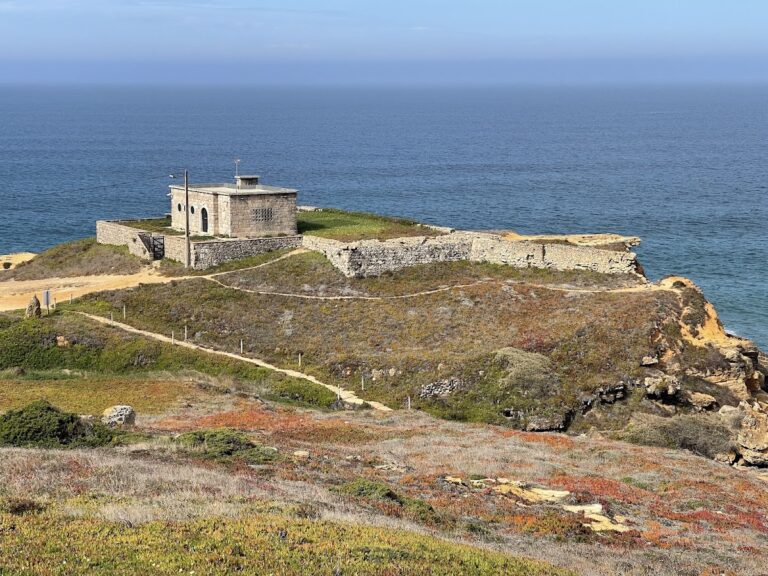
The Fort of Zambujal stands at approximately 102 metres above sea level on an elevated position in the Serra Gorda, overlooking the Lisandro River and its tributary, the Vidigueira stream. Its composite layout consists of a principal redoubt, a fortified enclosure smaller than a permanent fortress, adapted to the terrain and described as quadrangular, together with a second structure probably used as a firing or observation platform. A tunnel connects the two structures, while a moat encloses the entire area.
Redoubt and bastion
Central redoubt
The central redoubt has an irregular hexagonal plan and was built into the underlying rock. A dry moat was excavated in that rock around it. Inside the enclosure are a powder magazine and several traverses, earth banks designed to shield troops and installations from incoming fire.
Advanced bastion
An advanced bastion, a projecting defensive position for weapons and flanking fire, held the gun emplacements. It was linked to the main redoubt by a tunnel cut through the rock and by a moat.
Earth and timber defences
The fort’s construction combined earthworks and timber elements. The traverses formed the principal earth structures, while a palisade and a platform were among the timber components. A plan dating from 1814 preserves the arrangement of the fortification. The remains are preserved and described as being in good condition.
Nearby sites