Forte Campomolon: An Unfinished Italian First World War Fortress


Site at a Glance
- Rating
- 4.4
- Popularity
- Low
- Country
- Italy
- Primary era
- Modern
- External website
- Open
- Eras represented
- Modern
- Civilizations
- Italian
- Site type
- Military
- Remains
- Fort
On this page11 sections
History
Forte Campomolon is an unfinished Italian First World War fortress on Monte Campomolon in northern Italy, near Arsiero in the Province of Vicenza. Planned as part of Italy’s fortified frontier facing the Austro-Hungarian positions on the Altopiano dei Sette Comuni, a high plateau that formed part of the pre-war border zone, it was intended to protect the Valle Campiluzzi and Passo Tonezza to the south.
Planning and construction
Construction began on 1 May 1911 with earthworks, a military access road, and preparation of the gun position. By 1 May 1912, the road could be used although it remained unfinished. The approximately 70-metre-long troop accommodation building and the gun depots had been completed, while the cistern was still being built. In October that year, work on the battery block had not yet begun.
By 1 May 1913, the initial preparatory work was considered complete. Austro-Hungarian military intelligence believed that the planned fort would receive four or six 149 mm A-type guns in armored turrets, together with several protected machine-gun positions. Full-scale construction of the battery block began in February, with its principal direction of fire already facing north. The project remained incomplete: the battery block reached only one storey, the infantry ditch was not built, and the entrance area with its readiness rooms was the part that was ultimately finished.
The armored turrets had been ordered from Germany, but changing political circumstances prevented their delivery. Turrets first intended for the cancelled Forte Monte Rione were later considered for installation at Campomolon. On 20 June 1916, however, the turrets stored at Cornolo were reported destroyed along with two 280 mm gun carriages. The permanent battery therefore never received its planned turret guns, and the fort was never officially placed in service. This status probably contributed to the limited Italian wartime documentation concerning the installation.
Wartime use and capture
Italy’s neutrality from August 1914 to May 1915 brought construction to a halt. During this period, a continuous trench line was made along the ridge from La Croce di Torao across Monte Campomolon to Soglio Melignone, with as many as 600 workers employed on the works. Although the permanent fort remained unfinished, mobile heavy artillery was positioned at and around it.
After Italy declared war on Austria-Hungary on 23 May 1915, Forte Campomolon became involved in the fighting. Heavy field howitzers belonging to Battery 102 of the German Alpine Corps, a German mountain formation operating alongside Austro-Hungarian forces on the Alpine front, shelled the fort on 29 May. A 305 mm mortar then bombarded it in June and July 1915.
During the Austro-Hungarian Spring Offensive of 1916, a major attack in the Alpine theatre, the fort was attacked on 19 May after its combat capability had been judged very low. It was taken almost without resistance, and the Italian troops withdrew. By 20 May 1916, the position had been abandoned and its guns had been rendered unusable.
The retreating Italians carried out several small demolitions, particularly around the barracks. The entrance block and the unfinished armored battery were not affected. Second Lieutenant Paolo Ferrario may have destroyed a 149 mm gun battery on the lower slope before receiving mortal wounds. Two commemorative plaques at the site are dedicated to him. The present ruined condition of Forte Campomolon is not attributed to First World War combat damage, and no explanation for its later deterioration is given.
Remains
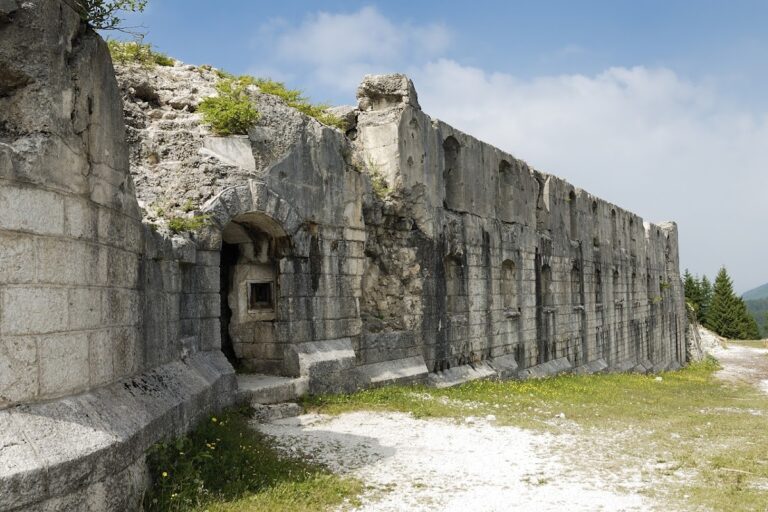
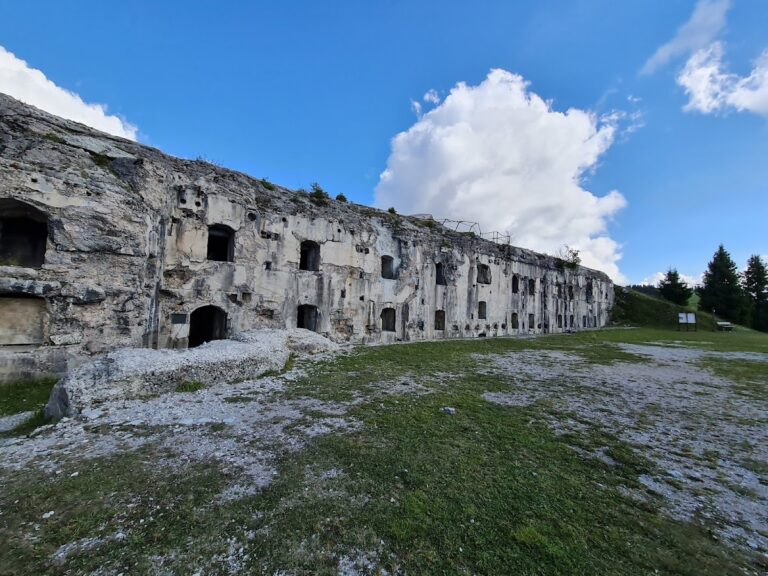
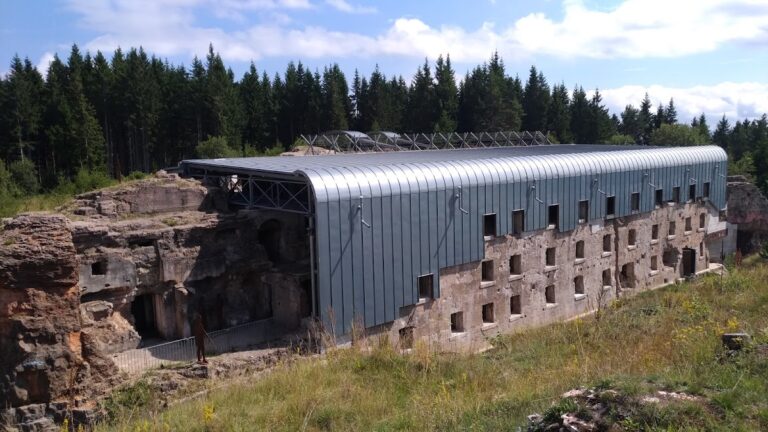
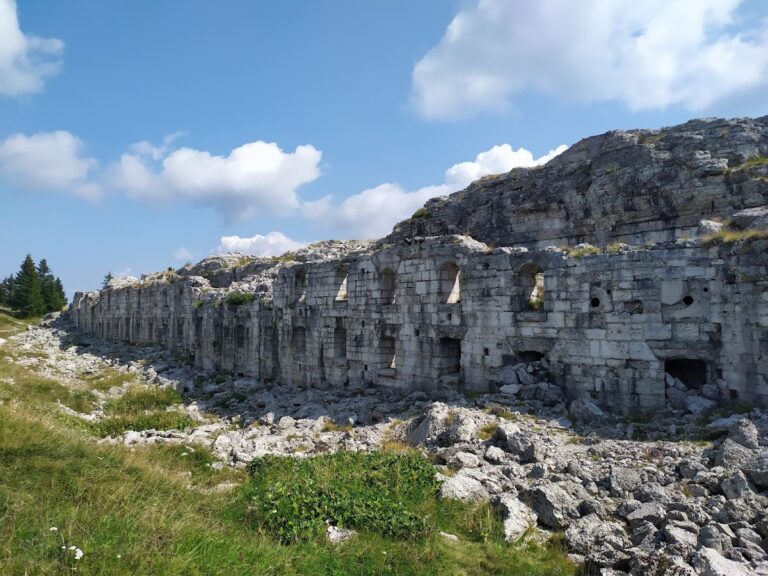
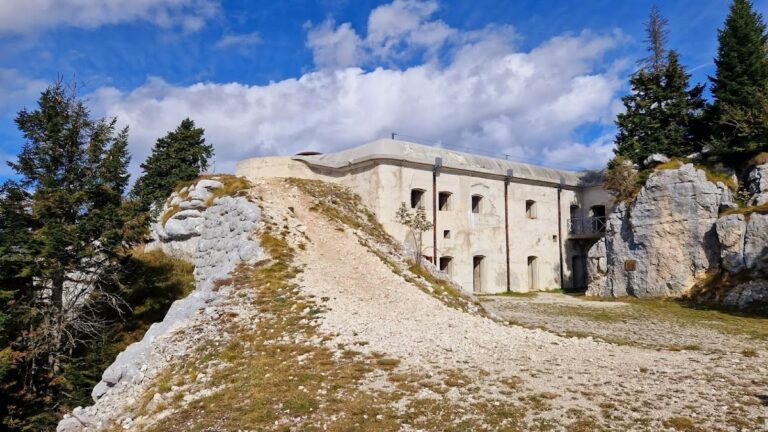
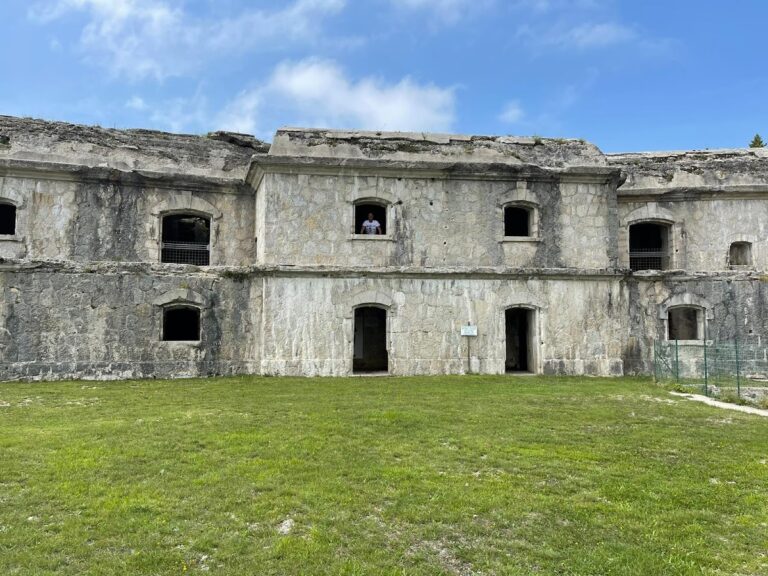
Fragments of Forte Campomolon occupy the summit of Monte Campomolon at 1,853 metres, approximately 6.5 kilometres east of the Austro-Hungarian fortifications at Serrada and Sommo. The installation consisted of a partially completed battery block, an entrance area, the barracks zone, depots, and associated military earthworks. It was constructed from unreinforced concrete faced with limestone blocks, and restoration work has been carried out through the Ecomuseum of the Great War in the Vicentine Pre-Alps.
Battery and entrance works
Battery block
The battery block was designed as a fléche, a fortification plan shaped like an arrowhead with recessed sides arranged to support defensive fire. Its two recessed flanks were approximately 50 metres long, and each was intended to hold two gun turrets with 25 metres between the positions. The structure was built on a single level. Its planned infantry ditch remained unbuilt, while the incomplete block included Casemate 13, a fortified chamber for artillery or other weapons.
The projected armament comprised four or six 149 mm A-type guns in armored turrets and protected machine-gun positions. The intended turrets were probably three-part cupolas with 180 mm armor. No turrets were installed. The surviving battery is therefore a partially completed concrete structure rather than a finished permanent artillery fort.
Entrance area
The entrance area adjoined the left side of the battery block and included the readiness rooms, spaces prepared for troops to take up their positions quickly. It was the principal completed part of the fort and remained unaffected by the small demolitions carried out during the Italian withdrawal. The entrance works now form part of the ruinous remains of the installation.
Accommodation and military earthworks
Troop building and depots
The troop accommodation building stood below the summit beside the military access road and measured approximately 70 metres in length. The gun depots were completed during the construction phase, while the cistern was still unfinished in May 1912. Demolitions during the retreat particularly affected the barracks area, whose surviving remains belong to the incomplete support zone below the main battery.
Ridge defenses
The fort was associated with military earthworks extending along the ridge from La Croce di Torao over Monte Campomolon to Soglio Melignone. The continuous trench line was built while Italy remained neutral, employing as many as 600 workers. These earthworks supplemented the unfinished permanent battery and formed part of the wider defensive position on the mountain.
Mobile artillery positions
Heavy artillery occupied the fort’s parade area even though the permanent armored battery was incomplete. Two 280 mm howitzers from the coastal artillery and two 210 mm howitzers stood there as Battery 533. Two additional 280 mm coastal howitzers were placed at Forcella Molon as Battery 534, while four 149 mm guns were later deployed along the access road as Battery 519.
Four older 280 mm M79 C howitzers were also recorded in the fort’s area, although they did not fire during the bombardments described. A 305 mm mortar at Forcella Molon struck a detached ammunition depot and caused an extremely powerful explosion. Only one further mortar round is recorded as having hit the fort itself, striking Casemate 13 in the incomplete battery block. Forte Campomolon survives today in a ruinous state, with restoration undertaken as part of the Ecomuseum of the Great War in the Vicentine Pre-Alps.
Nearby sites