Werk Serrada: An Austro-Hungarian Frontier Fort in Italy


Site at a Glance
- Rating
- 4.5
- Popularity
- Low
- Country
- Italy
- Primary era
- Modern
- Eras represented
- Modern
- Civilizations
- Austria-Hungary, Habsburg
- Site type
- Military
- Remains
- Fort
On this page18 sections
History
Werk Serrada, also known as Forte Dosso del Sommo, is an Austro-Hungarian fortification in Italy, built between 1911 and 12 September 1914 in the late frontier-fortification period before the First World War. Standing about four kilometres south of Folgaria at an elevation of 1,670 metres, it formed part of the Folgaria fortress group and was the last and most modern fort built on the Italian front.
Construction and defensive purpose
The fort was designed to block the road through Val Terragnolo from the south and to guard the route over Passo Coe from Tonezza. A breakthrough through Val Terragnolo would have opened the way to Rovereto. An advance through Passo Coe could have led to Calliano in the Adige Valley and threatened the valley-front from the rear. Werk Serrada therefore occupied a key position within the Austro-Hungarian frontier system in Trentino, which was built to defend the border against Italy.
Construction began in 1911. The initial design was prepared by the military engineer R. Mayer, also rendered R. Majer, and the work was completed under Captain Karl von Bedekovic. The estimated cost was 1,900,000 crowns, although the final expenditure exceeded that figure by 69,000 crowns. Captain Leo Schwarz commanded the completed fort.
Wartime service
The planned wartime garrison consisted of detachments from the Imperial-Royal Tyrolean Landesschützen Regiment “Trent” No. I and Fortress Artillery Battalion No. 6, with an establishment of four officers and 227 men. The Landesschützen were Austrian territorial infantry within the Austrian half of Austria-Hungary’s armed forces. When Italy entered the war, however, the designated units were serving on the Eastern Front. The first defence of Werk Serrada consequently relied on available formations, including artillery companies from Fortress Artillery Battalions Nos. 1 and 8, an infantry marching battalion of the Landesschützen Regiment “Innichen” No. III, and Standschützen, locally raised riflemen used for regional defence.
Italian artillery began firing at about 4:00 a.m. on 25 May 1915. A 28-centimetre howitzer near Monte Toraro opened fire from approximately 9.5 kilometres away. Between May and the end of October 1915, 4,229 shells of that calibre were directed at the fort. Werk Serrada was only moderately damaged, and Italian infantry did not assault it. Its defensive role continued until 1918, when the Austro-Hungarian military presence on this frontier ended.
The bombardment nevertheless exposed a weakness in the fort’s design. Twelve direct hits beginning on 9 June 1915 progressively destroyed the exposed concrete gallery connecting the front battery and casemate blocks. A 56-metre underground gallery was then driven through the rock to replace it. An additional underground access gallery was built between 2 September and 29 November 1915 because exposed approaches were vulnerable to artillery. This passage also supplied fresh air after the original ventilation system in the gorge began drawing in explosive gases.
During the war, Werk Serrada fired 26,103 rounds from its 10-centimetre guns, more than any other fort in the Folgaria and Lavarone groups. The fort also supported the Austro-Hungarian offensive known as the Strafexpedition in May 1916. The German term refers to the large offensive against Italian positions in Trentino.
Later military use and deterioration
In July 1931, the Italian Army used Werk Serrada for trials connected with the planned Alpine Wall, an Italian system of frontier fortifications begun in the early 1930s. A 30.5-centimetre coastal howitzer was placed 127 metres from the fort on an improvised wooden slide. The arrangement simulated near-vertical fire from a distance of ten kilometres. The experiments also tested the resistance of armour steel and radio communication between the cupolas of Werk Sommo and Werk Serrada.
During the Mussolini era, armoured components and reinforcing steel were blasted out and recovered as scrap. This caused substantial later damage to the fort. Werk Serrada is now owned by the Municipality of Folgaria. Its surviving structures are largely demolished and dangerous, although wartime damage was less extensive than at several neighbouring works.
Remains
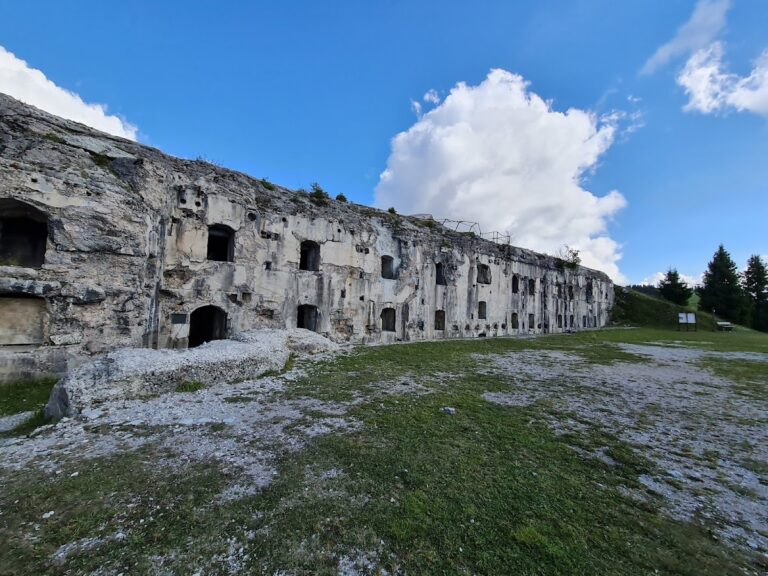
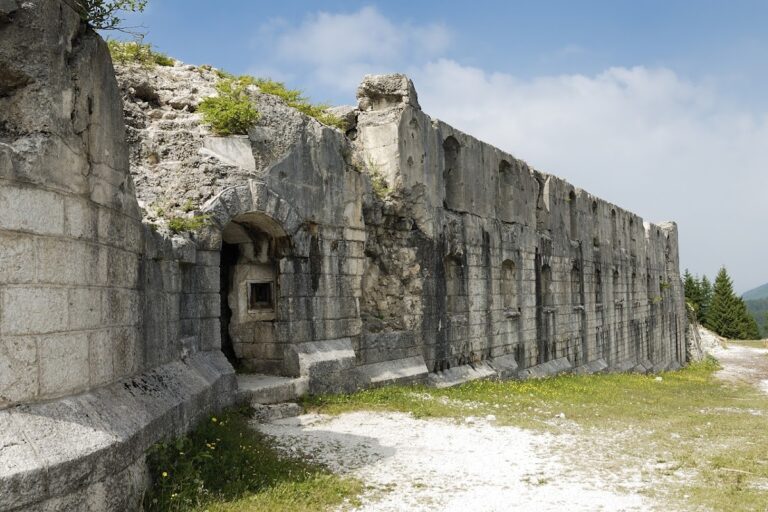
Werk Serrada followed a dispersed plan intended to reduce the effects of artillery fire. Unlike the compact forts of the earlier Vogl period, its elements were arranged as staggered, laterally offset blocks. The principal block was approximately 100 metres long and 8 metres wide. Two battery blocks, a forward machine-gun block, and the front-trench defence were connected by galleries and passages. The fort occupied a position overlooking Val Terragnolo, with views toward Pasubio, the Lavarone and Asiago plateaus, and the Passo Coe area. Optical connections linked it with the neighbouring forts of Sommo Alto and Sebastiano, while the Forra del Lupo trench connected it with the settlement of Serrada.
Defensive layout and protection
Ditch and galleries
A ditch up to seven metres deep protected the fort on three sides. The close-defence installation and front battery block stood approximately 45 metres apart. Ammunition magazines were built against the natural rock on the enemy-facing side, with lifts carrying ammunition to the guns. The battery and casemate components were connected by an above-ground concrete gallery, while underground passages through the rock linked the forward machine-gun block, front battery block, and trench defence. The exposed gallery was later replaced by the 56-metre underground passage after bombardment had shown that its concrete was not sufficiently resistant.
Roof construction
The casemate roofs were 2.5 to 2.8 metres thick and reinforced with I-beams. NP 40 beams, approximately 40 centimetres high, were used on the upper level, and NP 26 beams were used in intermediate floors. The unreinforced exposed gallery could be penetrated by 28-centimetre shells, whereas the reinforced roofs required shells of about 30.5 centimetres for penetration. Galvanised sheet metal covered the roof against the weather. Similar covers protected the gun cupolas in peacetime, but after mobilisation only a small cover remained over the openings in each armoured cupola.
Front and machine-gun defences
Front-trench defence
The two-storey front-trench defence contained two 6-centimetre M.10 casemate guns on its lower level. Its upper level held two armoured casemates, each equipped with two machine guns, as well as two 25-centimetre searchlights. These installations formed the close-defence position at the front of the dispersed fort.
Forward machine-gun block
The forward machine-gun block contained two fixed armoured cupolas. Each cupola mounted two Schwarzlose M7/12 machine guns, the standard Austro-Hungarian water-cooled machine gun of the First World War. Prepared positions outside the block could accommodate up to 20 additional infantrymen for close defence. A rear exit led to the roof and was protected by a small defensive enclosure. The passage from the battery block to the trench defence also ran through this complex.
Battery and casemate blocks
Forward battery block
The forward battery block held two armoured howitzer cupolas. Each contained one 10-centimetre M.9 turret howitzer on a depression mount, which allowed the gun to fire at relatively low elevation from inside its armoured cupola. The block also had fixed machine-gun cupolas mounting one and two machine guns, a rotating observation cupola that could carry a machine gun, and a 60-centimetre searchlight. During periods without bombardment, the searchlight could be installed on the roof to illuminate the road toward Monte Maggio.
The block had two levels. Its lower level consisted mainly of a connecting passage, from which the gallery to the rear block and the underground passage to the machine-gun block branched. The same level contained the bases of the fixed machine-gun cupolas, an ammunition magazine, a readiness room, and a lavatory.
Rear battery and casemate block
The rear battery and casemate block contained two more armoured howitzer cupolas, each with one M.9 turret howitzer on a depression mount. A 35-centimetre searchlight stood in each cupola. Two fixed machine-gun cupolas, each carrying two machine guns, were positioned at the ends of the roof. A throat-defence armoured casemate contained a 25-centimetre searchlight and a machine gun covering the rear approach. The four-storey block also provided accommodation and supply facilities.
Armament
The complete armament comprised four 10-centimetre M.9 howitzers in rotating cupolas, two 6-centimetre guns protected by an armoured shield in the counterscarp fortification, and 22 machine guns behind armoured loopholes and in fixed armoured cupolas. The howitzer cupolas were approximately 2.85 metres in diameter, weighed about 18 tonnes, and had a range of 7 to 8 kilometres.
Underground access and bombardment damage
Access gallery
A 260-metre underground access gallery extended northwest from the left side of the rear casemate block. Thirteen chambers cut into the rock along its length provided shelter from 30.5-centimetre shells. The gallery formed part of the wartime response to the exposed approaches and the damage inflicted on the original above-ground connection.
Armoured components
Twenty-eight shells struck the fort’s armoured components. One shell penetrated the front armour of Turret Howitzer No. I but was a dud. A direct hit on Turret Howitzer No. II produced only an 11-centimetre-deep dent, while a hit on the rotating observation post disabled it for four days. Four displaced weather-protection covers were mistaken by Italian artillery for the fort’s armoured cupolas and shelled for several days.
The surviving concrete and armoured elements were later damaged when reinforcing steel and other armour were removed or blasted out. Werk Serrada consequently survives in an unstable condition, and only limited external access is considered safe.