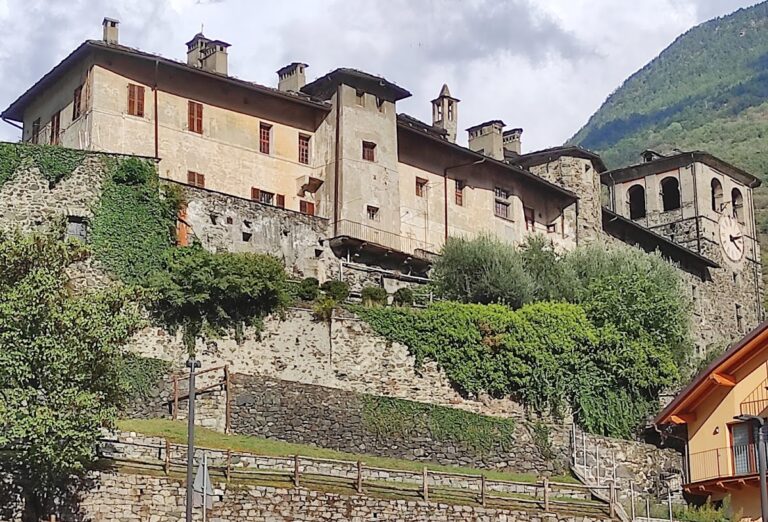
Forte Machaby – Forte Lucini: A Military Complex in Italy


Site at a Glance
- Rating
- 4.7
- Popularity
- Low
- Country
- Italy
- Primary era
- Modern
- External website
- Open
- Eras represented
- Early Modern, Modern
- Civilizations
- Duchy of Savoy, Italian
- Site type
- Military
- Remains
- Fort
On this page9 sections
History
Forte Machaby – Forte Lucini is a military complex in Italy, on the Machaby promontory at Arnad in the Aosta Valley, developed from a seventeenth-century fort and later rebuilt as a defensive position supporting Forte di Bard. Its location provided a strategic view over the territory of Arnad and the Dora Baltea valley.
Early fort and nineteenth-century rebuilding
The complex began with a military fort dating to the seventeenth century, within a history that extended across the seventeenth and eighteenth centuries. Around 1880 to 1885, military engineers, the specialists responsible for designing and building fortifications, constructed the Machaby defensive barracks over the remains of the earlier fort. The position formed part of the defensive system around Forte di Bard and stood near the Notre-Dame-des-Neiges sanctuary and the old settlement of Machaby.
The Machaby battery was placed above the barracks at the settlement of Lo Fort. Its purpose was to protect Forte di Bard against an attack on the fortress’s weaker right flank. It was equipped with six 149 G guns. A second battery was later built on the summit of Tête de Cou, also with six 149 G guns, extending the defensive works across the surrounding heights.
Military use and abandonment
The barracks housed the garrison responsible for the defensive works. During the twentieth century, the fort also became the logistical base for the Aosta Alpini Battalion’s summer training camps. The Alpini are Italy’s specialized mountain infantry corps. The military function was eventually reduced, and the complex was progressively abandoned.
Local recollections describe the final years of military activity. One tradition recalls soldiers, artillery, and large quantities of pasta prepared for troops and villagers, while also associating the First World War with the arrival of many soldiers and the removal of the guns down the landslide below the fort. Another recollection describes guards assigned to Machaby, Forte di Bard, and La Cou. It places the last military personnel at the barracks around 1920 to 1922 and recalls rooms with wooden floors, a water cistern, and cultivated gardens. The buildings then remained closed until the last war.
Municipal ownership and restoration
The municipality of Arnad purchased the fort from the Italian state in February 1968. Municipal restoration began in the winter of 2005 to 2006 and was completed in October 2010. The barracks were converted into an accommodation facility with an attached hostel and the Centro di Formazione Alpinistica. The accommodation facility was inaugurated in March 2012, giving the restored building a new institutional use while retaining its military structure.
Remains
Forte Machaby – Forte Lucini consists of the Tenente Lucini defensive barracks, the Machaby battery, and the Colle La Cou battery. The fortifications were built in rubble-stone and brick masonry covered with plaster. Together, the surviving buildings and ruined gun positions occupy the wooded slopes and higher ground around the Machaby promontory.
Tenente Lucini barracks
The Tenente Lucini barracks stand at about 717 metres above sea level in a centuries-old chestnut wood. The original fabric was retained wherever possible during restoration. The ground floor includes a communal area, manager’s accommodation, service rooms, an entrance courtyard, a kitchen, a staff room, two connected dining rooms, a common room, and a boiler room. Sleeping rooms and ancillary spaces occupy the upper floor, together with two rooms for accompanying staff and their adjoining service areas.
A transparent polycarbonate roof now covers the central courtyard, allowing the space to be used in bad weather. The restored facility also incorporates photovoltaic and geothermal systems and collects rainwater. These measures provide energy autonomy equivalent to approximately 90 percent of its requirements. The natural climbing area of Machaby, including the cliff known as the Paretone, lies near the barracks.
Artillery batteries
Machaby battery
The Machaby battery lies at about 843 metres above sea level and survives in ruins. Its guns stood on open gun platforms, positions where artillery fired over a parapet without an enclosing casemate. The gun positions remain alongside a counterscarp wall, a retaining or defensive wall on the outer side of a ditch, and a broad ditch.
Colle La Cou battery
The Colle La Cou battery occupies the summit of Tête de Cou at approximately 1,425 metres above sea level. It stands about an hour and a half on foot from the Machaby battery along a mule track. The battery is practically destroyed, with only a few remains of its open gun platforms surviving.