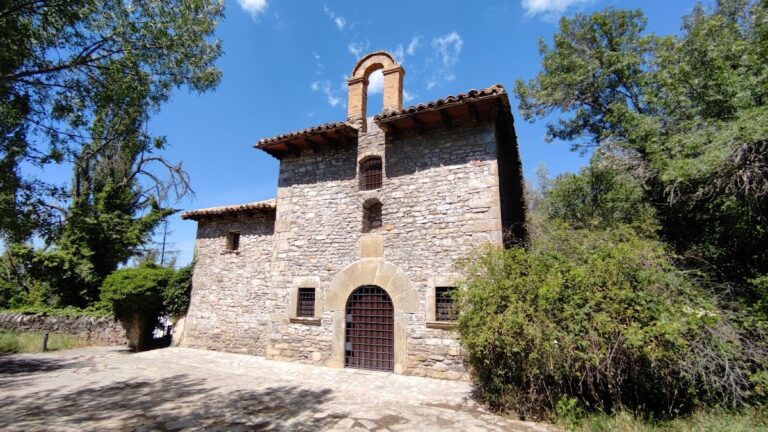
Fuerte de Coll de Ladrones: A Mountain Fort Defending the Canfranc Valley


Site at a Glance
- Rating
- 4.3
- Popularity
- Low
- Country
- Spain
- Primary era
- Modern
- External website
- Open
- Eras represented
- Modern
- Civilizations
- Spanish
- Site type
- Military
- Remains
- Fort
On this page8 sections
History
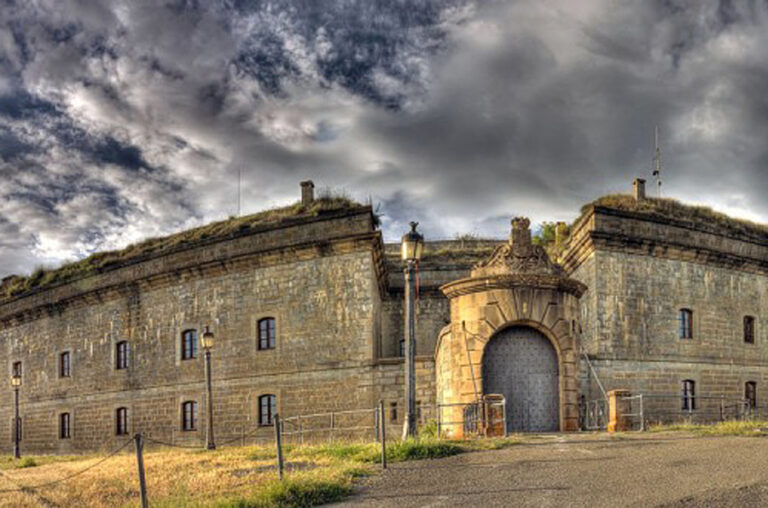
Fuerte de Coll de Ladrones is a nineteenth-century rifle fortification in Spain, built to defend the Canfranc Valley passage toward the French frontier. Its origins reach back to the late sixteenth century, but the surviving fort was constructed between 1888 and November 1900 as an example of modern military architecture adapted to mountainous terrain.
Earlier Defenses and Nineteenth-Century Construction
By the mid-nineteenth century, the Spanish government sought to strengthen the defenses of the Canfranc Valley. The memory of the Peninsular War of 1808–1814, when Spain fought Napoleon’s forces with British and Portuguese support, remained recent. Older defenses at Candanchú and Canfranc, together with the Espelunga Tower, also called Espelunga de Agulla, were regarded as ruinous.
Don Juan Martínez Zermeño, a leading Spanish military engineer of the nineteenth century, was sent to survey the western Aragonese Pyrenees and build a new fort. Construction of the present Fuerte de Coll de Ladrones began in 1888 and ended in November 1900.
Railway Defense and Later Status
The fort was intended to protect the new international railway associated with the Somport railway tunnel. It also served as a surveillance post against smuggling. A complementary fortification, the Torreta de los Fusileros, was built beside the road farther down the valley.
In October 1990, the Spanish Ministry of Defense auctioned the fort, which was awarded to a private company. Aragón designated Fuerte de Coll de Ladrones an Asset of Cultural Interest through a resolution dated 17 April 2006, published on 22 May 2006. This legal heritage designation protects buildings and sites of cultural value. The fort is also included as a military fort within the UNESCO World Heritage property “Routes of Santiago de Compostela: The French Way and the Routes of Northern Spain,” inscribed in 1993 under criteria ii, iv, and vi.
Remains
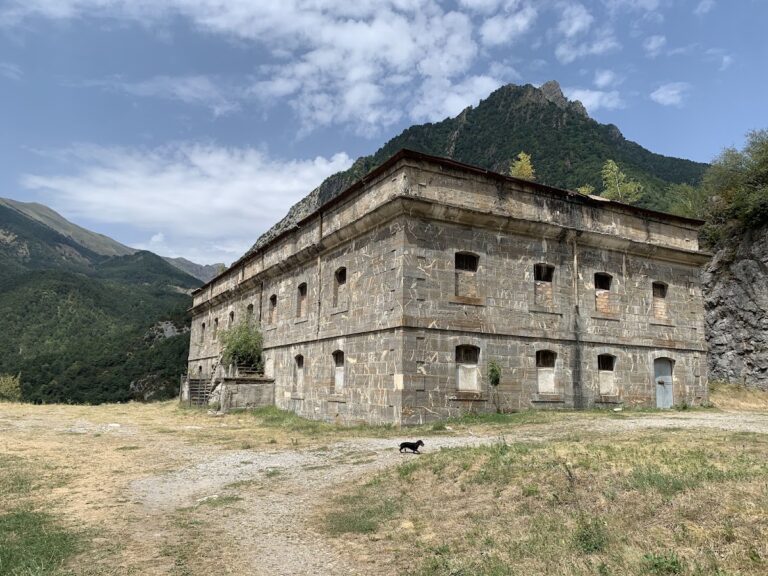
Fuerte de Coll de Ladrones occupies rocky outcrops at an elevation of 1,351 metres in the municipality of Canfranc. Its position blocks the passage through the Canfranc Valley, while the surrounding slopes are covered with firs, rowans, birches, maples, and blackthorn. Rock forms an essential part of the defensive system and is as important as, or more important than, the masonry walls.
Interior Buildings
Troop Barracks
Two buildings clad in local stone occupy the interior of the fort. The more shaded building served as troop barracks and contains two halls arranged across two storeys.
Officers’ Quarters and Infirmary
The more sunlit building contained the officers’ quarters, offices, and infirmary. Its grand staircase distinguishes this part of the interior from the barracks.
Artillery and Fire Positions
The artillery defenses include four embrasures, openings through which artillery could fire, oriented north and excavated into the rock. An associated powder magazine supported these positions.
An extensive loophole gallery, a rock-cut passage with narrow defensive openings, descends to a battery above the river. From this battery, the fort could directly command the road.
Nearby sites