Sønderskov Manor: A Renaissance Manor House and Local-History Museum in Denmark


Site at a Glance
- Rating
- 4.3
- Popularity
- Low
- Country
- Denmark
- Primary era
- Early Modern
- External website
- Open
- Eras represented
- Early Modern
- Civilizations
- Danish
- Site type
- Domestic
- Remains
- Manor House
On this page12 sections
History
Sønderskov Manor is a former manor house in Denmark near Brørup, in Vejen Municipality, Southern Jutland. The present Renaissance-style building was completed in 1620 after an earlier manor house was destroyed by fire, and the estate is now operated as a local-history museum.
Medieval ownership
The first known owner of Sønderskov was Niels Lagesen Rudbek, who held both Sønderskov and Nielsbygaard in 1390. By 1448, the estate had passed through the marriage of Jakob Nielsen to the heir of the former owner. Because Jakob was not of noble descent and could not legally own a manor, he transferred Sønderskov to the Ribe Cathedral Chapter, the governing body of clergy and administrators attached to Ribe Cathedral. The chapter later sold the estate, although the date of that sale is unknown. By 1483, Sønderskov belonged to Henrik Steen, a relative of Jakob Nielsen’s wife.
After Henrik Steen died, the estate was divided between his son Niels Steen and his daughter Anne Steensdatter. Anne eventually acquired her brother’s share and brought Sønderskov into her marriage to Thomas Galskyt. The property remained with the Galskyt family until the end of the sixteenth century.
The Galskyt and Rosenkrantz years
Sønderskov’s history during the sixteenth century was marked by violence within the nobility. Two of Thomas Galskyt’s sons, both later owners of the estate, were killed by fellow noblemen. Peder Galskyt was killed by Johan Juel in 1554, while Otto Galskyt was killed by Jakob Skram in 1574.
Peder’s widow, Bege Clausdatter, outlived their son Albert. Her son-in-law Christoffer Rosenkrantz was later executed for embezzlement. In 1600, Bege sold Sønderskov to Børge Rosenkrantz, who kept the estate until his death in 1614. He spent much of his time at his estate of Ørup in Scania, the historical region in what is now southern Sweden.
Fire and rebuilding
After Børge Rosenkrantz died, Sønderskov was sold to Thomas Juel in 1614. Juel already owned nearby Estrup Manor. Soon after the sale, the manor’s main building was destroyed by fire. Juel promptly commissioned a replacement, which was completed in 1620 and forms the basis of the surviving manor house.
Thomas Juel’s nephew Manderup Due inherited Sønderskov in 1648. Due was also a fiefholder in Thy, meaning that he administered territory or revenues held under a feudal arrangement. His holdings later passed to his son Jørgen Skeel Due, who spent much more time at Sønderskov than his father. During the 1690s, Jørgen Skeel Due purchased Føvling Church.
Changes in the eighteenth and nineteenth centuries
Jørgen Skeel Due’s son Jens Christoffer Due inherited the estate, but heavy debts forced him to mortgage Sønderskov to Hans Bachmann in 1720. Ownership then passed to Bachmann and, after Hans and his wife Christina Margrethe Bachmann died, to their daughter Christine Margrethe Bachmann. In 1749, she brought the estate into her marriage to Samuel Nicolaus Claudius, who served as county manager of Løgumkloster.
Claudius attempted to improve the management of Sønderskov but lost a legal dispute with the estate’s copyholders. A copyholder held land from a manor under customary or contractual tenure. During Claudius’s ownership, from 1750 to 1769, the manor probably received a series of tapestries depicting scenes from François de Salignac de la Mothe-Fénelon’s 1699 instructional novel Les Aventures de Télémaque. In 1753, Claudius also installed a new pulpit and altarpiece in Føvling Church.
Claudius sold Sønderskov to Jens Fr. Wodschou in 1769. The next owner was Frederik Christian Otto Wedel Jarlsberg, who also held Basnæs on Zealand and Glorup on Funen. He died at Sønderskov in 1779. The estate changed hands repeatedly in the following decades. Many copyholds were converted into freeholds, giving the holders more independent ownership, while parts of the manor’s land were sold in lots.
Peder Momsen acquired Sønderskov in 1818, beginning more than a century of Momsen family ownership. The estate was exchanged for other land and acquired by J. Bundsgaard in 1925, after which it again passed through several owners. The recorded succession includes members of the Steen, Galskyt, Rosenkrantz, Juel, Due, Bachmann, Momsen, and other families, followed by a series of private owners in the twentieth century.
Museum and protection
Sønderskov fell into disrepair during the 1970s. Master carpenter Helge Kragelund acquired the property in 1986 and undertook a comprehensive renovation of the main building over the next seven years. Sønderskov was entered on the Danish registry of protected buildings and places in 1918. Its later role as a local-history museum continues the building’s connection with the history of the surrounding estate and region.
Remains
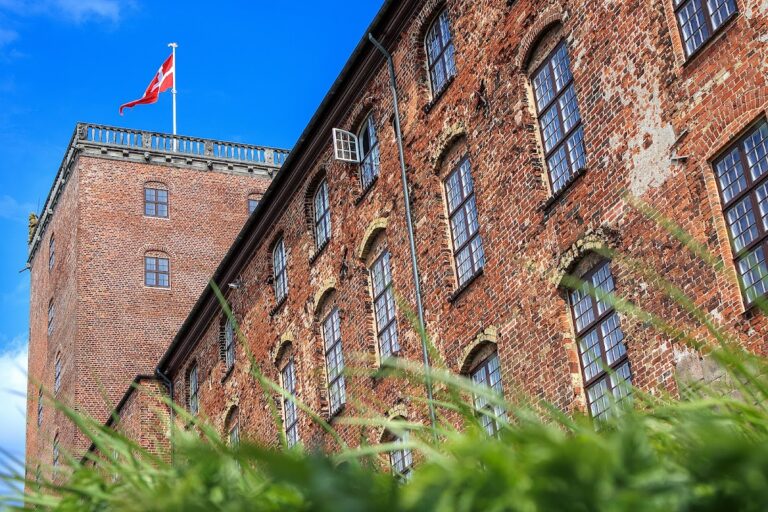
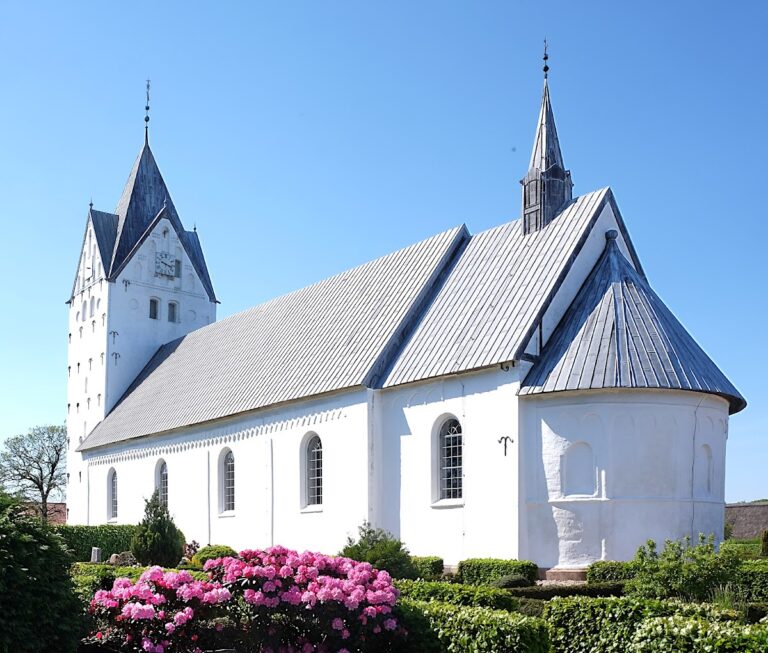
The surviving manor is a three-winged Renaissance-style building surrounded by moats. It is constructed of whitewashed brick, with visible wall anchors, a pitched roof covered in red tiles, and four whitewashed brick chimneys rising through the ridge. The northern main wing has two storeys, while the east and west wings each have three. Although the wings differ in height by storey count, they are of similar overall height. The surrounding park includes a large vegetable garden.
Main building and grounds
The present structure is the replacement commissioned by Thomas Juel after the earlier main building burned shortly after his purchase of the estate. Completed in 1620, it preserves the three-winged form and Renaissance character of the rebuilding. The moats encircle the building, while the park and vegetable garden form the associated grounds described with the manor.
Interior features
Telemachus tapestries
One first-floor room contains canvas tapestries with eight scenes from Fénelon’s 1699 novel Les Aventures de Télémaque. Fénelon was a French archbishop, theologian, and writer, and his instructional novel became a widely represented literary subject. The tapestries were probably installed while Samuel Nicolaus Claudius owned Sønderskov, between 1750 and 1769.
Runestone and historic shop interior
The museum vestibule contains a large ninth-century runestone, a stone bearing runic inscriptions associated with the Germanic peoples of northern Europe. The ticket office incorporates the interior furnishings of an old grocery shop, adding a later commercial interior to the building’s preserved historical features.
Military mural
Another mural is based on an illustration by Jacob de Gheyn for the 1717 military manual The Exercise of Armes. The manual comprised 117 engravings. De Gheyn was an artist and printmaker based in the Netherlands whose illustrated works included studies of military practice.