Ruine Schenkenburg: A Medieval Fortress in Germany


Site at a Glance
- Rating
- 4.5
- Popularity
- Low
- Country
- Germany
- Primary era
- Medieval
- External website
- Open
- Eras represented
- Medieval
- Civilizations
- Holy Roman Empire
- Site type
- Military
- Remains
- Castle
On this page11 sections
History
Ruine Schenkenburg is a medieval hilltop fortress in Germany, near Schenkenzell in Baden-Württemberg, probably built between 1220 and 1250 by the Schenken von Zell. These ministerials, service nobles who acted as administrators, military officers, and castle holders for higher-ranking lords, served the Counts of Freiburg and represented their mining interests in the Wittichen district. Together with Burg Wittichenstein and the former castle at Schenkenzell, Schenkenburg helped protect this mining area.
The Schenken von Zell
The family’s standing is reflected in a document from 1222, which names Hairicus, dean of Celle, as a witness immediately after the abbot of Alpirsbach. In 1298, Schenk Eberhard and his sons Konrad and Eberhart appeared together under a seal identifying them as the Schenken of Schenzell. Their heraldic arms, a divided shield bearing a half-rising eagle above a chevron, are also associated with the family.
Transfer to the Geroldsecks
At the beginning of the fourteenth century, the castle passed to the Lords of Geroldseck. The reason for the transfer is unknown. It may have followed disputes involving Counts Egen and Konrad II of Freiburg and Schenk Burkhard, who was reportedly held captive. Burkhard remained at Burg Wittichenstein until 1304, while members of the Schenken family are documented at Schenkenzell only until 1299.
Schenkenburg was in Geroldseck possession by 1301 and appeared among their castles in 1309. Burg Wittichenstein was also held by the Geroldsecks as a fief by 1312, indicating that the Schenken von Zell’s wider lordship had passed to the same dynasty.
War, sale, and destruction
Schenkenburg suffered heavy damage during the Geroldseck War of Succession in 1433, a conflict over the inheritance of Geroldseck territories. Building work continued in 1436 at Schenkenburg, Burg Romberg, and Wittichen Monastery.
Financial difficulties later forced Gangolf, Lord of Geroldseck and Schenkenzell, to sell all his possessions in the Kinzig Valley in 1498. The Counts of Fürstenberg acquired most of the lordship for 1,400 gulden, then bought Burg Wittichenstein in 1500 for another 920 gulden.
In 1513, Schenkenburg became an hereditary male fief, a feudal holding passed through the male line with attached obligations, under Junker Hans von Weitingen. His successors were accused of breaking their allegiance. In 1534, Count Wilhelm von Fürstenberg stormed and destroyed the castle. It was never rebuilt and has remained a substantial ruin.
Remains
Hilltop setting and defenses
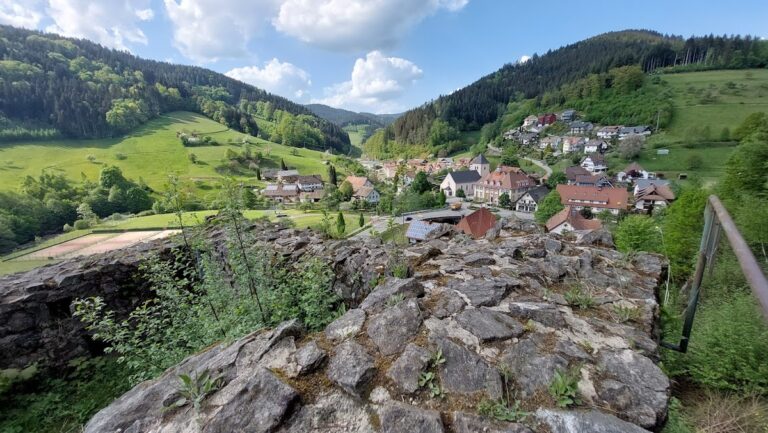
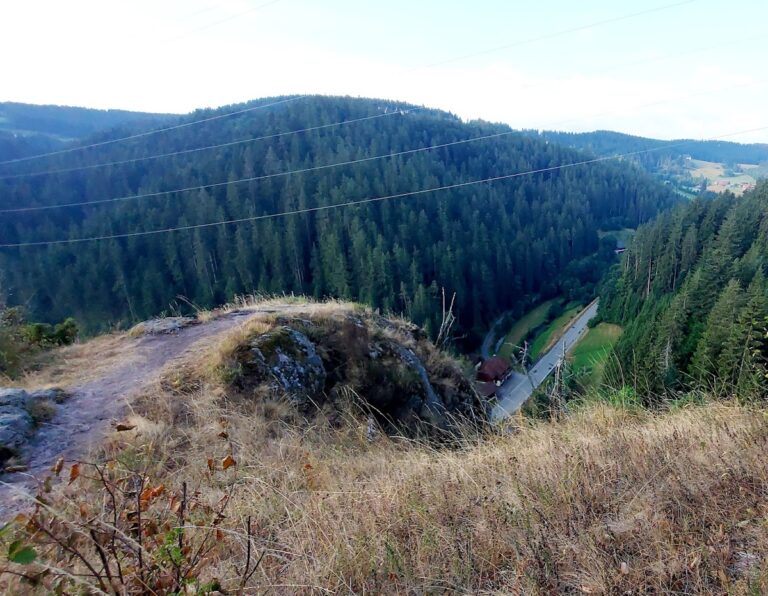
Ruine Schenkenburg stands at about 391 metres above sea level on an isolated hill or spur formed when a river cuts through a meander. Its position on a projecting spur in the upper Kinzig Valley gave the fortress a defined defensive setting. The masonry includes ashlar, carefully shaped stone blocks, with rusticated bosses on their exposed faces.
Neck ditch and approach
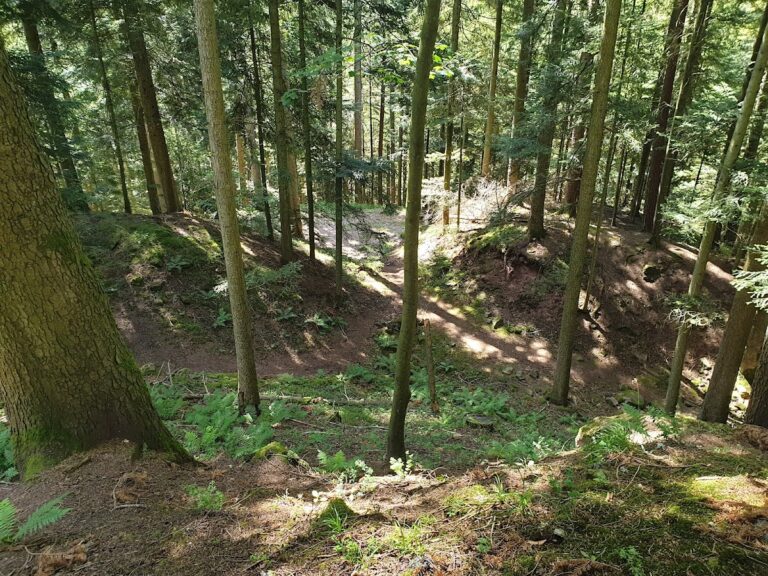
From the north, a narrow path crosses a deep neck ditch, a trench cut across the spur to isolate the castle. This approach leads toward the fortified area and illustrates how the natural landform was supplemented by artificial defenses.
Outer defensive enclosure
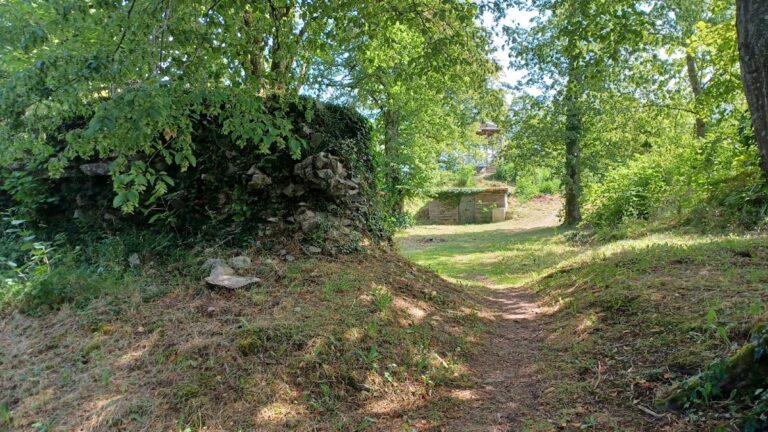
Parts of the zwinger, an outer defensive area between the main fortification and an additional enclosing wall, survive around the castle. Some sections are heavily overgrown, but the remaining enclosure forms part of the site’s visible defensive structure.
Principal buildings
Residential building
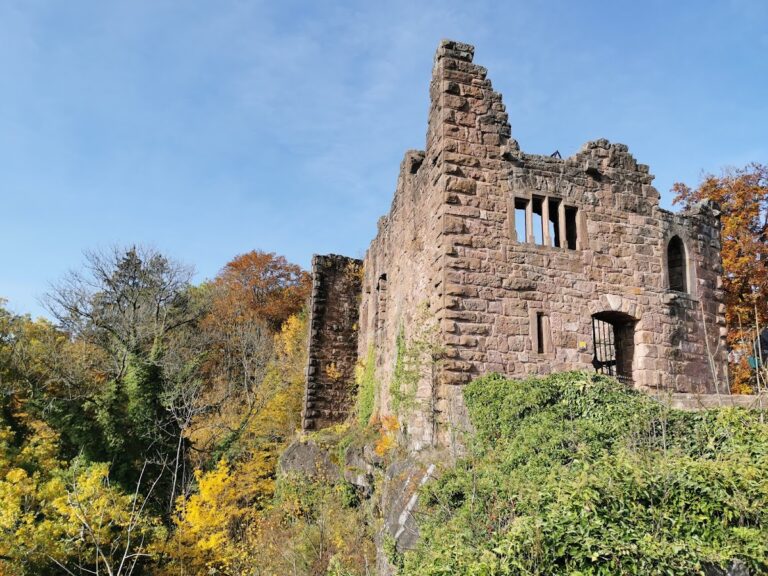
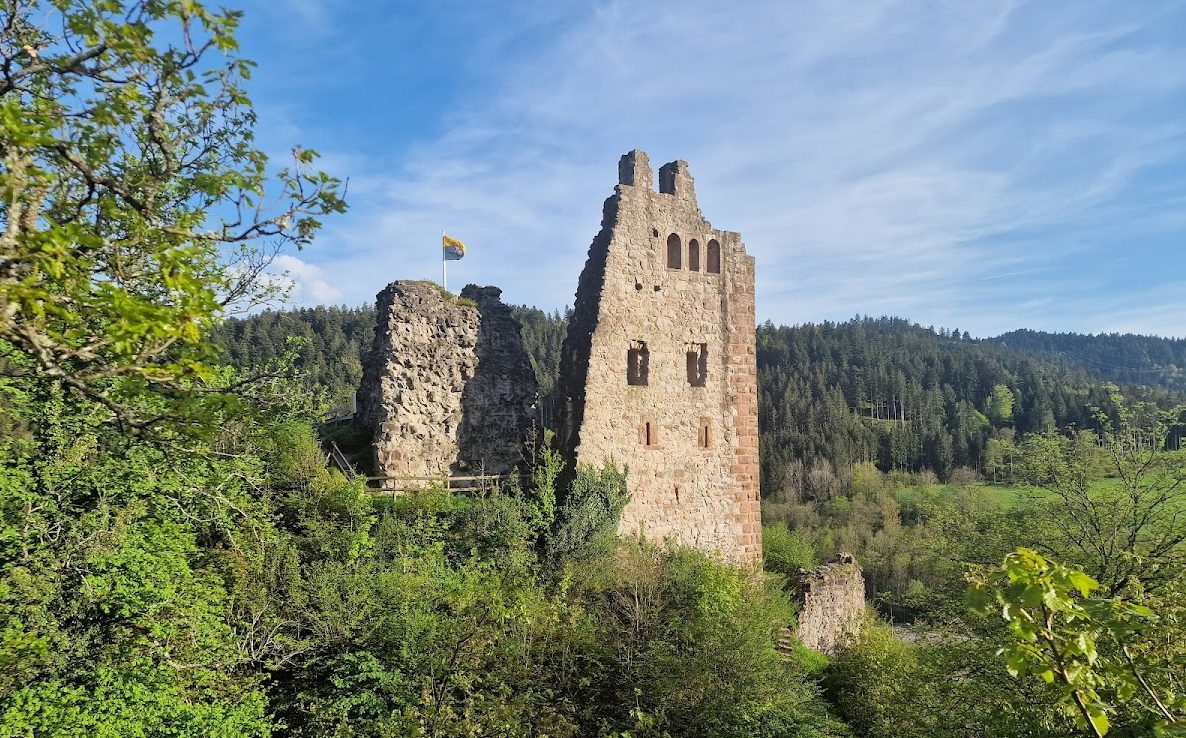
Parts of the palas, the castle’s principal residential and representative building, survive to heights that reach the third storey in places. Its remaining walls preserve evidence of the substantial residential core within the hilltop fortress.
Keep
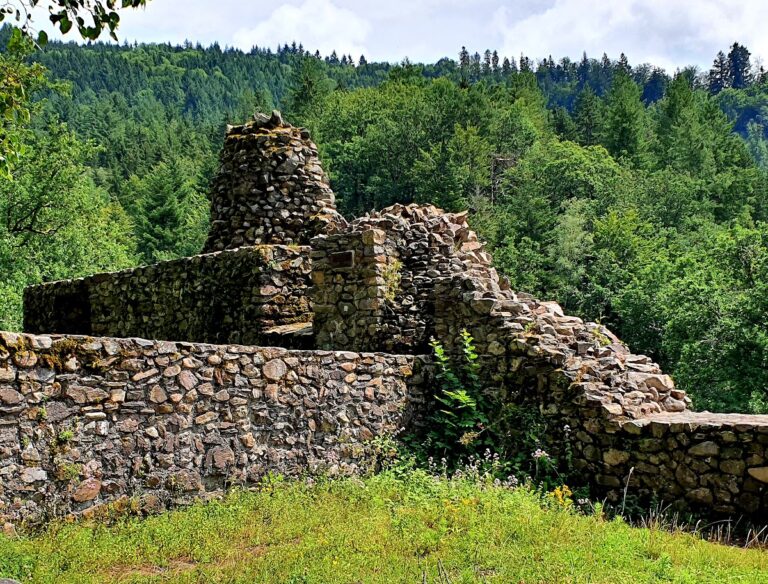
The stump of the keep, a defensive tower, also remains. Although only its lower remnant survives, it forms a separate surviving element of the castle’s fortified architecture alongside the residential building and outer defenses.
Nearby sites