Flakfortet: A Danish Sea Fortress in the Øresund


Site at a Glance
- Rating
- 4.4
- Popularity
- Low
- Country
- Denmark
- Primary era
- Modern
- External website
- Open
- Eras represented
- Modern
- Civilizations
- Danish
- Site type
- Military
- Remains
- Fort
On this page8 sections
History
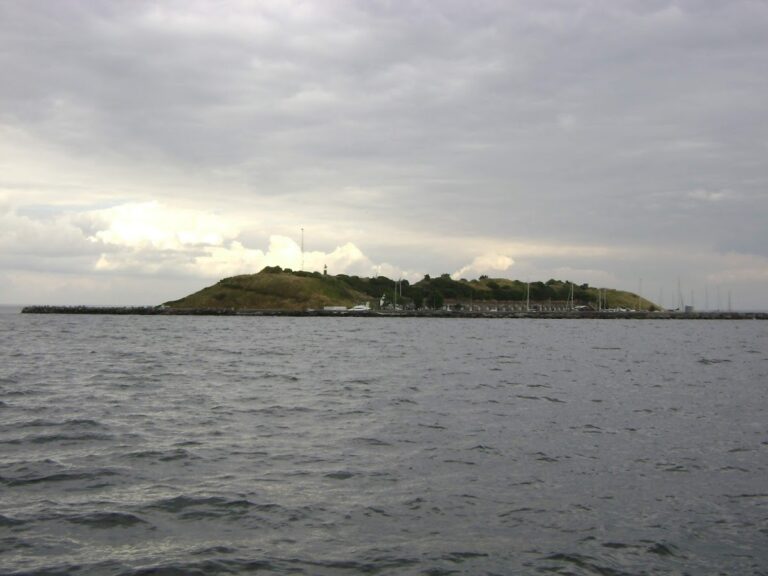
Flakfortet is a Danish sea fort on the artificial island of Saltholmrev in the Øresund, built during the 1910s as part of Copenhagen’s sea fortifications. Its purpose was to defend the capital against attacks from the sea, and its guns covered the Hollænderdybet channel between Middelgrundsfortet and Saltholm as well as the Flinterenden channel between Sweden and Saltholm.
Construction and Coastal Defence
Flakfortet was the last of three artificial islands created by Denmark to protect the entrance to Copenhagen Harbour. The other two were Trekroner Fort and Middelgrundsfortet. The name refers to the Danish word flak, meaning a sand shoal, rather than to the German term for anti-aircraft artillery. Although the island’s original name is now seldom used, both the island and the fort are commonly called Flakfortet.
The fort formed a major position within the coastal defence system. Its two-floor fortifications provided bombproof accommodation for troops, magazines, ammunition stores, and open gun positions. At full occupation, the barracks could house a garrison of 550 men.
Wartime and Post-war Military Use
During the Second World War, the German army used the island. After the war, Flakfortet continued mainly as an anti-aircraft artillery position until 1957. In 1950, Marshall Plan aid, a United States programme of economic assistance to European countries after the war, helped Denmark install new weapons. These included four heavy German 105 mm guns, probably transferred from Hansted, now Hanstholm, six twin 40 mm guns described as American copies of the Bofors M36, and several 20 mm anti-aircraft guns.
Denmark decided in 1965 to establish a permanent HAWK battery on Middelgrundsfortet. HAWK was a ground-based surface-to-air missile system for anti-aircraft defence. Because Middelgrundsfortet required extensive renovation, the battery was temporarily installed at Flakfortet from 1965 to 1968. Military use ended in 1968, when the permanent facility at Middelgrundsfortet was ready.
Change to Civilian Use
In 1975, the Danish Ministry of Defence leased Flakfortet to the Copenhagen Sailing Association and opened the site to the public. Recreational use was accompanied by extensive vandalism and substantial damage to the fort. The ministry retained ownership until 2001. The property had been offered for sale in 1999 through Statens Ejendomssalg, also known as Freja, the Danish Ministry of Finance department responsible for disposing of surplus state property. In June 2001, the Swedish company Malmökranen purchased Flakfortet.
After the sale, the new owners repaired the island and several of its buildings. Flakfortet is now used for recreation, with a restaurant, yacht moorings, and an overnight hostel.
Remains
Artificial Island
Flakfortet occupies an artificially built and enlarged island of approximately 32,000 square metres, or 0.3 square kilometres. It rises to about 23 metres above sea level and measures approximately 0.3 kilometres from end to end and 0.1 kilometres across. The island was formed with reinforced-concrete caissons, large watertight construction units used in marine engineering. They were initially cast at the Lynetten quay on Refshale Island, while the final caisson was cast at Flakfortet itself. A stone perimeter was laid around the island to create a breakwater and hinder landings.
Fortifications and Accommodation
The fortifications extend across two floors and are built primarily of concrete and natural stone. Their protected interior spaces included troop accommodation, magazines, and ammunition stores, while the defensive arrangement also incorporated open gun emplacements. Several buildings and other parts of the site were repaired after the 2001 sale. A former barracks building now contains a restaurant.
Artillery and Searchlights
The original armament consisted of four 29 cm M1910 howitzers, six 21 cm M1913 guns, and four 75 mm quick-firing guns. Later additions included two 47 mm anti-balloon guns, another 75 mm gun, and 8 mm machine guns. The fort was also equipped with one 90 cm searchlight and four 150 mm searchlights. Its later anti-aircraft installations included four heavy 105 mm guns, six twin 40 mm guns, and several 20 mm guns.