Bruce Castle: A Historic Manor House and Museum in London


Site at a Glance
- Rating
- 4.4
- Popularity
- Low
- Country
- United Kingdom
- Primary era
- Early Modern
- External website
- Open
- Eras represented
- Medieval, Early Modern, Modern
- Civilizations
- British, English
- Site type
- Domestic
- Remains
- Manor House
On this page17 sections
History
Bruce Castle is a historic manor house in the United Kingdom, located in Tottenham, London. Built in England as a sixteenth-century country house, it is one of the oldest surviving English houses in which brick is the principal building material. Despite its name, the site never contained a castle. The name refers to the House of Bruce, the Scottish royal family associated with Robert the Bruce, which once held one-third of the manor of Tottenham.
Medieval origins and the Compton estate
The building probably replaced an earlier house, although the date and circumstances of its construction remain uncertain. Parts of the present structure may date from the fifteenth century. Other interpretations place its construction around 1514 or in the late sixteenth century, so no single foundation date can be established.
The Bruce connection arose through medieval landholding rather than residence. After Robert I of Scotland became king in 1306, his English lands, including the Bruce holdings in Tottenham, were forfeited and granted to Richard Spigurnell and Thomas Hethe. The three parts of Tottenham manor were brought together under the Gedeney family in the early fifteenth century and remained united thereafter.
Early records refer to the house as Lordship House. Sir William Compton, a trusted courtier who held the royal office of Groom of the Stool under Henry VIII, acquired the manor of Tottenham in 1514 and is generally regarded as the house’s first owner, although there is no evidence that he lived there. The earliest known reference to the building dates from 1516, when Henry VIII met his sister Margaret Tudor, Queen of Scots, at “Maister Compton’s House” beside Tottenham. The Compton family retained the property throughout the sixteenth century.
The Coleraine family and the name Bruce Castle
In the early seventeenth century, Lordship House belonged to Richard Sackville, 3rd Earl of Dorset, and Lady Anne Clifford. Sackville’s gambling and extravagant spending led him to lease the property to Sir Thomas Peniston. The house was later purchased by Hugh Hare, a wealthy landowner from Norfolk, who acquired the manor of Tottenham, including Lordship House, in 1625. He was soon created 1st Baron Coleraine.
Hugh Hare was closely connected with the court of Charles I, but suffered financial losses during the English Civil War, the conflict that culminated in the trial and execution of Charles I and the establishment of a republican Commonwealth. The ownership and condition of Lordship House during the Commonwealth period are uncertain. Hugh Hare died in 1667, and his son Henry Hare succeeded him.
Henry Hare, 2nd Baron Coleraine, settled at Lordship House and adopted the name Bruce Castle in recognition of Tottenham’s historic association with the House of Bruce. A noted historian, he wrote the first history of Tottenham. By 1680, he and his family were living at the house, although the date of his move from Totteridge is not known.
After marrying the widowed Duchess of Somerset, Henry Hare oversaw a major remodelling in 1684. Much of the present south front dates from this work. His son, Henry Hare, 3rd Baron Coleraine, inherited the estate in 1708. He spent much of his time travelling through Europe, but remodelled the north of the house and added rooms. When he died in 1749, the estate passed to his daughter, Henrietta Rosa Peregrina. Her inheritance was initially rejected because she was French, and after legal challenges the property passed to her husband, James Townsend.
Townsend ownership and later country-house use
James Townsend was a magistrate, Member of Parliament for West Looe, and Lord Mayor of London in 1772. He remodelled the house after 1764. His son, Henry Hare Townsend, showed little interest in the estate, which was leased to successive tenants. In 1792, it was sold to Thomas Smith of Gray’s Inn for use as a country residence.
John Eardley Wilmot moved to Bruce Castle in 1804 after retiring from public life. While living there, he wrote memoirs describing the American Revolution and his part in investigating its causes and consequences. The memoirs were published shortly before his death in 1815. Wilmot had also helped organize relief for Loyalist refugees from the revolution and for French refugees who settled in Tottenham.
After Wilmot’s death, the London merchant John Ede acquired the house and grounds and demolished the west wing. He sold the property in 1827 to the educator Rowland Hill, who established a school there.
The Hill School and the growth of Tottenham
The Hill School operated at Bruce Castle from 1827. Its politically radical educational principles were associated with Thomas Paine, Richard Price, and Joseph Priestley. Corporal punishment was abolished, alleged offences were judged by a court formed by pupils, and the curriculum included foreign languages, science, and engineering. Among its pupils were sons of London-based diplomats and sons of Charles Babbage, the pioneer of mechanical computing.
In 1839, Rowland Hill left the school after becoming head of the General Post Office. There he introduced the world’s first postage stamps as part of a major reform of postal payment and delivery. His brother Arthur Hill succeeded him at the school, and Arthur’s son, George Birkbeck Norman Hill, became headmaster in 1868. Birkbeck Hill’s retirement in 1877 ended the family’s association with the institution.
During the school’s operation, railways changed Tottenham from a rural district of villages, farmland, and marshland into a substantial residential and industrial area. The Northern and Eastern Railway opened in 1840. In 1872, the Great Eastern Railway’s direct line to Liverpool Street opened, including Bruce Grove station near the castle.
Public park, museum, and heritage site
The school closed in 1891, after which Tottenham Council purchased the house and grounds. The grounds opened as Bruce Castle Park in June 1892, becoming Tottenham’s oldest public park. The house opened as Bruce Castle Museum in 1906.
Bruce Castle now houses the museum and the archives of the London Borough of Haringey. Its permanent displays explore Haringey and the districts that preceded it. Other collections and displays concern Rowland Hill and postal history, early photography, historic manorial documents and court rolls, and the history of Tottenham Hotspur. The museum also holds many eighteenth-century engravings of Tottenham by Henrietta Townsend and a substantial collection of paintings by Beatrice Offor.
In 1969, the building also housed the regimental museum of the Middlesex Regiment. That collection was later transferred to the National Army Museum. Bruce Castle and its detached round tower were separately listed at Grade I in 1949, while the park’s seventeenth-century southern and western boundary walls received Grade II listing in 1974.
Remains
Bruce Castle is a brick-built manor house accompanied by a detached cylindrical tower and surviving boundary walls. The complex preserves evidence of successive medieval, Tudor, Renaissance, Georgian, educational, and archaeological phases. Its present asymmetrical form reflects demolition and alteration over several centuries.
The manor house
Brick manor house and principal fronts
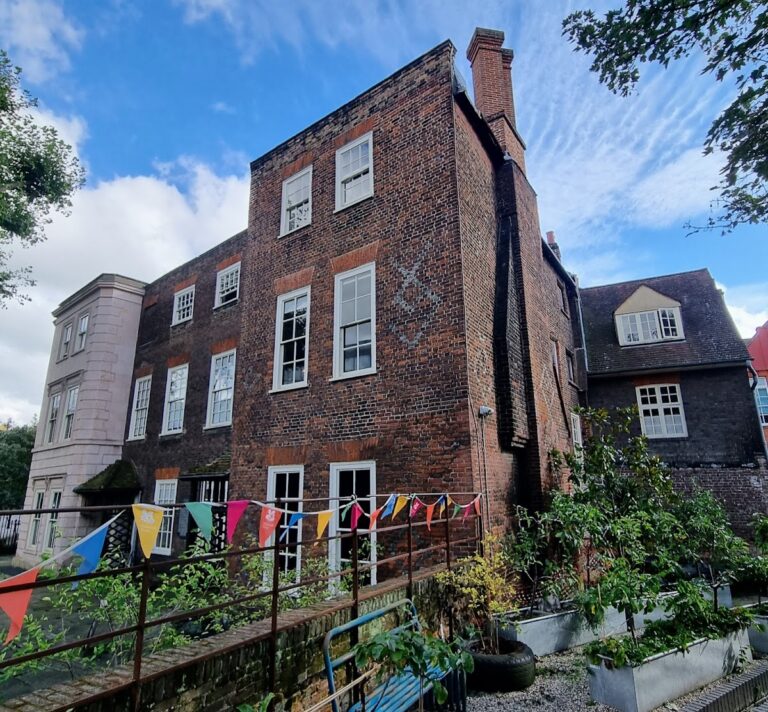
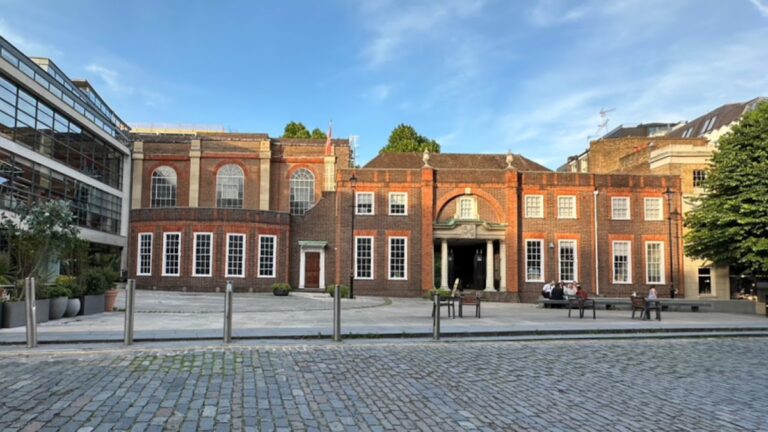
The main house is constructed chiefly of red brick with ashlar quoins, finely dressed stone forming the corners. Its principal facade has symmetrical end bays and tall paned windows. Parts of the structure may belong to a fifteenth-century building, while interpretations of the main house’s construction range from about 1514 to the late sixteenth century. The surviving front may have formed part of an earlier courtyard house whose other buildings have disappeared.
Seventeenth- and eighteenth-century alterations
Henry Hare’s remodelling of 1684 enlarged the end bays and rebuilt the central porch. The porch incorporated stone quoins and pilasters, a balustrade, a small tower, and a cupola. The central tower and belvedere, an elevated feature designed to provide a view, use a form associated with the English Renaissance, the architectural phase influenced by Renaissance ideas from continental Europe.
A plan from 1684 places the hall at the centre of the house, with service rooms to the west and the main parlour to the east. On the first floor, the dining room stood above the hall, the main bedchamber above the kitchen, and a lady’s chamber above the porch. Early in the eighteenth century, a range of rooms was added to the north, with a large Coleraine coat of arms placed on the pediment of the north facade.
After 1764, James Townsend remodelled the narrow east facade as an entrance front in the Georgian style, the architecture associated broadly with the reigns of the first four King Georges. The gabled attics on the south front were removed, giving the south elevation its present appearance. An inventory from 1789 lists a hall, saloon, drawing room, dining room, and breakfast parlour on the ground floor, with a library and billiard room above.
School extension and surviving form
The west wing was demolished in the early nineteenth century and was never rebuilt, leaving the house asymmetrical. When Bruce Castle became a school, a three-storey extension was added to its north-west side in 1870. The extension was built in the Gothic Revival style, which reused forms associated with medieval Gothic architecture.
Detached tower and earlier remains
Cylindrical Tudor tower
A detached cylindrical Tudor tower stands immediately south-west of the house. Built from locally made red brick, it is 6.4 metres high and has walls approximately 0.91 metres thick. It is generally regarded as the earliest part of the complex, although Daniel Lysons considered it a later addition.
Excavations in 2006 showed that the tower continues well below the present ground level. A description from 1829 placed it over a deep well and stated that it was being used as a dairy. Its separate survival and construction distinguish it from the main house, with which it forms the historic core of the complex.
Earlier house and discarded objects
The 2006 community archaeological excavation exposed chalk foundations belonging to an earlier house on the site. The excavation also recovered large quantities of discarded everyday objects, providing material evidence of activity before and during the later phases of the complex.
Moat and park boundaries
Moat evidence
References to repairs to a drawbridge in 1742 indicate that Bruce Castle then had a moat. An archaeological publication from 1911 referred to the recent levelling of the moat, linking the surviving house with an earlier layout that included a water-filled defensive boundary.
Seventeenth-century boundary walls
The grounds include seventeenth-century boundary walls along the southern and western sides of the park. These walls remain part of the historic setting of the house and its grounds, while the detached tower and main house survive as separately listed historic structures within the complex.
John Abraham Heraud’s 1820 poem Tottenham mentions Bruce Castle and gives a romantic account of the life of Robert the Bruce. The poem reflects the enduring association between the house’s name and the medieval Scottish royal family, an association expressed in the building’s later title rather than in evidence that the Bruce family occupied the site.
Nearby sites