Rabeneck Castle: A High-Medieval Aristocratic Castle in Germany


Site at a Glance
- Rating
- 4.4
- Popularity
- Low
- Country
- Germany
- Primary era
- Medieval
- External website
- Open
- Eras represented
- Medieval
- Civilizations
- Holy Roman Empire
- Site type
- Military
- Remains
- Castle
On this page9 sections
History
Rabeneck Castle is a high-medieval aristocratic castle in Germany, probably built around 1250 on a rocky spur above the Wiesent valley near Waischenfeld. It was associated with ministeriales, medieval service nobles who held offices and estates for powerful secular or ecclesiastical lords. Another interpretation places its construction before 1200, when a branch of the Lords of Rabenstein may have established it as an allodial castle, meaning hereditary property rather than a fief, and adopted Rabeneck as its family name. That earlier foundation remains uncertain.
The Rabenecks and the Schlüsselbergs
The Rabeneck name appears from 1217 in connection with Ebertshausen Castle. Ulrich of Munich was associated with the name in 1242, followed by Siboto and Chunrad of Rabeneck in 1257, Nentwich of Rabeneck in 1261 and 1296, and Heinrich of Rabeneck in 1276. The Rabenecks probably descended from the Lords of Rabenstein. The close position of the two castles and the similarity of their names support that relationship.
Unlike Rabenstein Castle, Rabeneck did not form part of the Lordship of Waischenfeld, which was then held by the Lords of Schlüsselberg. The Schlüsselbergs nevertheless possessed shares in Rabeneck, although the origin of those holdings is unknown. After Konrad of Schlüsselberg was killed at Neideck Castle in 1347, his son-in-law Count Günter of Schwarzburg, Günter’s wife Reichza, and Reichza’s sister Agnes, the wife of Heinrich of Plauen, sold their rights in one share to the Bishopric of Bamberg in 1348. Count Johann of Schwarzburg and his son Günther confirmed the agreement in 1376. Countess Sophia of Zollern, who was born a Schlüsselberg, unsuccessfully sought the return of the share in 1360.
Rabenstein and Stiebar ownership
By 1353 Rabeneck was again entirely in the hands of the Rabensteins, who had probably acquired Bamberg’s share after the bishopric suffered financial difficulties. The Rabensteins granted the Nuremberg burgraves an access right to the allodial castle for twelve years. Such an arrangement allowed a political or military partner to enter and use a privately held castle in return for payment or by contract.
By 1388 Rabeneck had become an allodial possession of the Lords of Stiebar, probably through Konrad Stiebar, a steward serving the Bishop of Bamberg. The Stiebars granted the Nuremberg burgraves an access right for 700 guilders. In the same year, Bamberg’s Ulrich of Aufseß and Hans Stiebar captured the castle during the War of the Cities, a conflict in which towns and territorial princes fought over political and economic power in the Holy Roman Empire. Friedrich Stiebar, dean of Bamberg Cathedral, founded a castle chaplaincy in 1415, providing a religious foundation for worship at the castle. Bishop Albrecht later confirmed it.
Destruction, rebuilding, and Bamberg control
Rebellious peasants captured and burned Rabeneck during the Peasants’ War of 1525, a widespread uprising against social, economic, and seigneurial conditions in the German lands. Alexander Stiebar received 485 guilders in compensation, while Christoph Stiebar, who owned the other half of the castle, received 554 guilders. Reconstruction continued until 1535.
The Stiebars retained Rabeneck while the castle was progressively converted into a fief of the Bishopric of Bamberg. Alexander Stiebar enfeoffed his half to Bamberg in 1530, and Christoph Stiebar’s half became a Bamberg fief 29 years later. After Christoph’s death, his share passed to his son Endres, a Pfleger, or appointed administrator of an estate or district, at Pottenstein. Endres died in 1572. Through Wilhelm of Künsberg, who was using the Rabeneck designation by 1570, the purchased half passed to Daniel Rabenstein, who received it as a fief in 1577.
The other half remained with the Stiebars for longer. After Daniel Stiebar, the last member of the Rabeneck line, entered the clergy, that share passed to the Stiebar branches of Buttenheim and Ermreuth. They sold it in 1603 to their brother-in-law Georg Werner of Rabenstein. Following Georg Werner’s death, the Rabensteins sold Rabeneck to the Bishopric of Bamberg in 1620 for 36,000 guilders. Because Bamberg again faced financial difficulties, Bishop Johann Gottfried of Aschhausen advanced the purchase money. The castle remained pledged to him and his heirs until repayment, and the Aschhausen family still held it in 1682.
The Rabenstein and Schönborn disputes
Hans Dietrich and Hans Christoph of Rabenstein sued the bishopric during the second quarter of the seventeenth century because the guilders paid to them were considered poor in value. An agreement reached on 2 March 1716 returned Rabeneck to the Rabensteins’ possession retroactively to 22 February. Bishop Lothar Franz of Schönborn supplied a credit of 12,000 Reichstalers in 1717, increased to 20,000 guilders in 1719, to repair the ruined castle. The Rabensteins apparently renewed the main castle but left the outer bailey abandoned.
Peter Johann Albrecht of Rabenstein, the last Rabenstein at Rabeneck, died on 19 May 1742, and the family became extinct. The estate consequently reverted to the Bishopric of Bamberg. On 10 December 1742, Count Franz Rudolph Erwein of Schönborn, brother of Bishop Friedrich Karl of Schönborn, received Rabeneck as a fief. After the bishop’s death on 26 July 1746, the cathedral chapter refused to recognize the arrangement. The dispute continued before the Reichshofrat, the supreme judicial council of the Holy Roman Empire. The court decided for the Schönborns, and Bishop Adam Friedrich of Seinsheim restored the counts to possession on 1 October 1778.
Norman Schiller acquired Rabeneck Castle in 1975. The castle is listed as a Bavarian architectural heritage monument and forms part of the cultural-heritage complex D-4-6133-0290 in Waischenfeld.
Remains
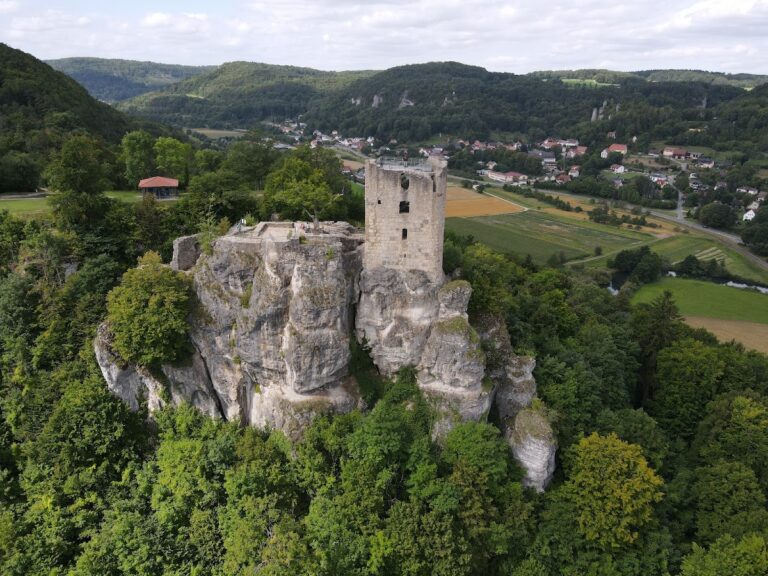
Rabeneck is a hill castle and spur castle on a rocky projection approximately 415 metres above sea level, high above the Wiesent valley in the Franconian Switzerland-Veldenstein Forest Nature Park. The complex lies about three kilometres south-southwest of Waischenfeld, in Upper Franconia, Bavaria. The ruins of Waischenfeld Castle are nearby. Rabenstein Castle stands to the east at a similar elevation above the Ailsbach valley, while Schlüsselberg Castle formerly occupied the Galgenberg farther up the Wiesent valley, above the powder mill.
Castle complex
Main castle and outer bailey
The surviving complex consists of a main castle and an outer bailey, together with a gatehouse and a castle chapel. The main castle retains substantial parts of its historic fabric and was renewed during the repairs financed in the early eighteenth century. The outer bailey was left abandoned during that phase, creating a distinction between the maintained central stronghold and the less-used outer area.
Gatehouse and castle chapel
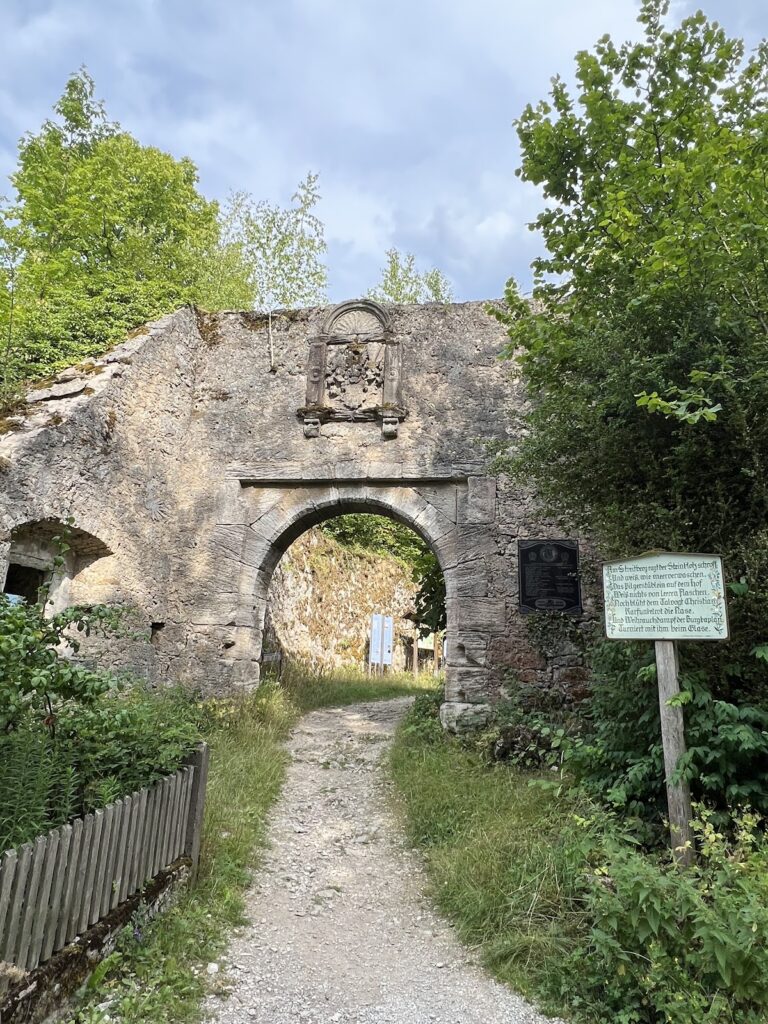
The gatehouse stands at Rabeneck 22, while the castle chapel is at Rabeneck 23. The chapel reflects the religious role established by Friedrich Stiebar’s castle chaplaincy in 1415, which provided a priest or chaplain for worship at Rabeneck. Together with the main castle and outer bailey, these surviving elements form the preserved architectural complex on the rocky spur.
Nearby sites