Palace in Koszęcin: A Neoclassical Cultural Complex in Poland
Site at a Glance
- Rating
- 4.7
- Popularity
- Low
- Country
- Poland
- Primary era
- Modern
- External website
- Open
- Eras represented
- Early Modern, Modern
- Civilizations
- German, Habsburg, Holy Roman Empire
- Site type
- Domestic
- Remains
- Palace
On this page16 sections
History
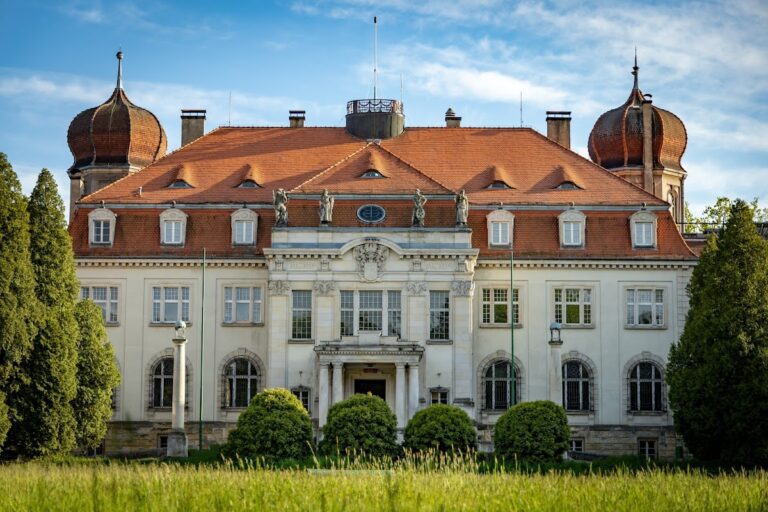
The Palace in Koszęcin is a historic palace complex in Poland, rebuilt in the neoclassical style between 1828 and 1830 for the Hohenlohe-Ingelfingen family. Its history reaches back to a medieval settlement and an early modern castle, while its present cultural role began in 1953, when it became the headquarters of the Śląsk Song and Dance Ensemble.
Medieval settlement and early castle
Koszęcin appears in written records in 1275, when Bishop Paweł of Przemanków granted a tithe to the church in Kamień Śląski. In 1302, the settlement was named Gostonia and was donated by the knight Alexius von Leckensteyn to the Cistercian monastery of Himmelwitz. The name Constantin was used in 1416. A local tradition gives the settlement a pre-Christian origin, associating it with Prince Gosław Koszeński and his daughter Przesława, whose story is connected with the legend of the White Lady.
At the beginning of the sixteenth century, Koszęcin came into the possession of Margrave George of Ansbach-Jägerndorf. It later passed through several owners as pledged property, until Hans von Kochczitz acquired it in 1587. His son, Andreas von Kochczitz, is believed to have established the first castle at the site.
The Kochczitz castle and seventeenth-century owners
The original wooden castle and the village were destroyed by fire in 1603. Andreas von Kochczitz completed a brick castle and a castle chapel by 1605. Around 1630, amid reprisals following an uprising, the Habsburgs confiscated his estate, apparently because of his Protestant faith. He was imprisoned in Vienna, where he died.
Nikolaus Philipp von Rauthen owned the estate from 1647 to 1693. Local tradition holds that King John III Sobieski, the Polish monarch from 1674 to 1696, and his court stayed at the castle in 1683. Sobieski was then leading the relief of Vienna against the Ottoman siege, while his wife, Queen Marie, is said to have remained at Koszęcin during the campaign.
The Sobek estate and imperial possession
After von Rauthen’s death, the Sobek family inherited Koszęcin and retained it until 1784. Count Carl Heinrich von Sobek enlarged his holdings in 1774 by acquiring the Boronów estate, five villages, and the Ollschin manor. After that acquisition, he expanded the Koszęcin residence with a theater that was later converted into a palace wing.
Von Sobek relinquished the estate after declaring bankruptcy in 1784. The imperial crown then took possession and offered the property at auction. In 1804, the estate was acquired by the Prussian general Frederick Louis, Prince of Hohenlohe-Ingelfingen, whose family belonged to a princely branch of the German House of Hohenlohe.
The Hohenlohe-Ingelfingen residence
Frederick Louis’s son, Adolf Karl Friedrich Ludwig, Prince of Hohenlohe-Ingelfingen, commissioned the reconstruction that created the present palace. The cornerstone was laid on 22 August 1828, which was also the birthday of his wife, Princess Louise. The work was designed by the Berlin architect Albert Roch and supervised by Friedrich Wilhelm Degner. It incorporated surviving seventeenth-century elements but demolished most of the early seventeenth-century castle. The southern wing was removed, the central section of the western wing was transformed, and the façades received their classical treatment.
Prince Adolf was succeeded by his son, Prince Frederick William, a general in the Prussian army. Adolf’s other son, Prince Kraft, was born at Koszęcin and later became a Prussian general and influential military theorist. Under the Hohenlohe-Ingelfingen family, the palace served as the center of an estate extending on both sides of the Mała Panew River. It included five knightly manors, 19 villages, and industrial enterprises, and covered approximately 200 square kilometres by 1910.
Political change and the end of the princely estate
In the 1921 Upper Silesian plebiscite, a postwar vote intended to help determine the region’s political affiliation, approximately 65 percent of Koszęcin’s residents voted to remain in Germany. The town and its surrounding area were nevertheless ceded to Poland in 1922, and the name changed from Koschentin to Koszęcin. A dispute in 1925 over a request for a monthly German-language church service reflected the area’s tense linguistic and political conditions.
During the German occupation in the Second World War, the Hohenlohe-Ingelfingen estates were confiscated by the Polish authorities. The last owner, Prince Karl Gottfried, left for Austria in 1945 and later died without heirs in Kraubath an der Mur in Styria. Known locally as “the good prince,” he had supported the socioeconomic welfare of Koszęcin and neighboring municipalities. His activities included support for the parish house built in 1898, the post office built by his father in 1881, and the Sacred Heart Church in Koszęcin.
Cultural use and conservation
Since 1953, the palace has housed the Śląsk Song and Dance Ensemble, a Polish performance institution devoted to regional folk music, song, dance, and costume. The ensemble, named after its founder and longtime director Stanisław Hadyna, uses the complex for artistic work, chamber concerts, special events, exhibitions, educational activities, and administration. The palace and park underwent extensive renovation between 2005 and 2014. The complex is classified as a first-category historical monument and is entered in the heritage register under designation A-81/78, dated 10 January 1997.
Remains
The surviving complex is an irregular neoclassical composition of three wings: the main southern wing, the western wing, and the northern wing, which connects with a tower containing the former chapel. The inner courtyard opens toward the south and leads to the garden. Older fabric remains within the nineteenth-century reconstruction, including seventeenth-century wall paintings, interior decorative elements, and funerary epitaphs in the chapel.
Palace wings and interiors
Western wing
The western façade facing the park has a five-axis central projection, with pilasters and a triangular pediment preceded by a terrace. The ends of the wing have projecting sections that originally carried observation decks. Some ground-floor rooms retain barrel vaults. Inside the western wing are the Ballroom, a terrace overlooking the park, and the Green Hall, where an Empire-style round tiled stove survives. Empire style was an early nineteenth-century decorative form related to neoclassicism and characterized by monumental classical forms.
Northern wing
Radar investigations carried out in 1999 identified the northern wing as the oldest part of the palace complex and revealed stones dating from the sixteenth century. Its ground floor, sometimes described as a connecting section, may preserve part of the earlier castle. This surviving element links the present residence with the site’s pre-nineteenth-century history.
Palace chapel
The chapel is dedicated to the Assumption of the Virgin Mary and Saints Dionysius and Vitalis. A crypt beneath it contains the burials of members of the Hohenlohe-Ingelfingen family, including Prince Adolf. The chapel was inactive from 1945 until its renovation in 2001, after which it became the Śląsk Chamber Concert Hall for the ensemble’s choir and orchestra. It has also been used for chamber concerts, while its earlier religious fabric and funerary epitaphs remain part of the complex.
Park and associated buildings
Riding hall and former farm building
The Elwira Kamińska Pavilion served as the palace riding hall during the princely period. A former late nineteenth-century farm building now houses the Adolf Dygacz Creative Work House and the Śląsk Ensemble Memorial Room. Its permanent display presents Silesian folk costumes and memorabilia from the ensemble’s tours.
Courtyard monument and park structures
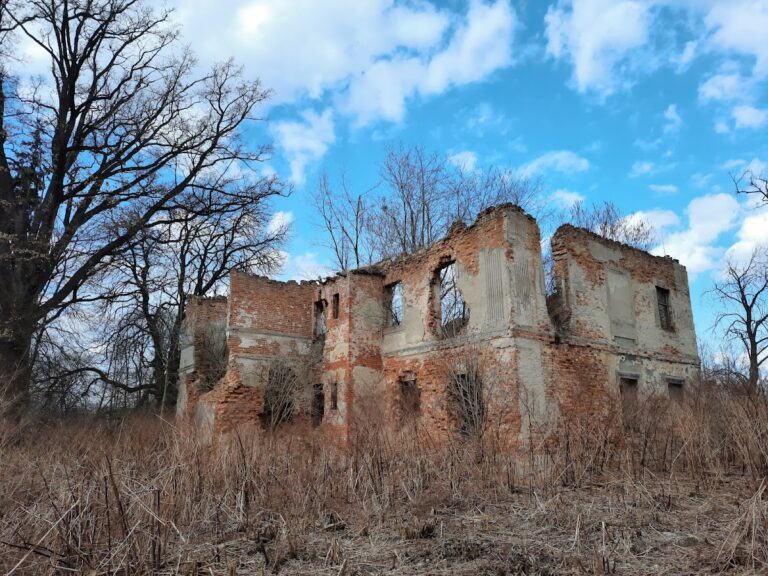
The courtyard includes an entrance gate and the Professor’s Bench, a monument to Stanisław Hadyna. The statue depicts him seated on a bench, smoking a pipe and holding the sheet music for Helokanie. It has stood in the courtyard since 2006. The park also contains the ruins of a nineteenth-century romantic tower.
English landscape park
An extensive English landscape park surrounds the palace. Established in the mid-nineteenth century, it includes a pond in its western section. Its planting consists of small-leaved lindens, horse chestnuts, maples, common beeches, sycamores, tall ash trees, pedunculate oaks, eastern white pines, Canadian and black pines, Canadian hemlocks, London plane trees, and American ashes. Many of these trees are designated as natural monuments.