Forte Jafferau: An Italian Alpine Frontier Battery


Site at a Glance
- Rating
- 4.8
- Popularity
- Low
- Country
- Italy
- Primary era
- Modern
- Eras represented
- Modern
- Civilizations
- Italian
- Site type
- Military
- Remains
- Fort
On this page11 sections
History
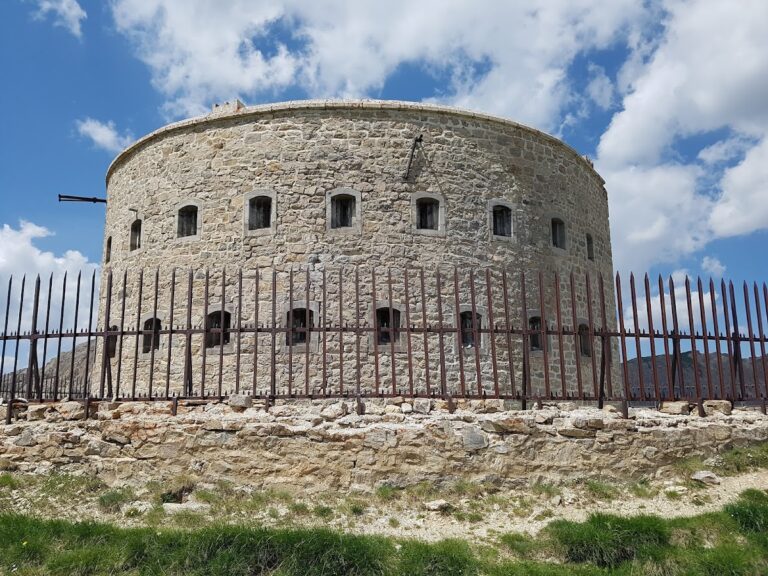
Forte Jafferau is an Italian frontier battery on Mount Jafferau above Bardonecchia, built by Italian military engineers between 1896 and 1898. Constructed during the late nineteenth-century development of Alpine fortifications, it belonged to the 137th Battery of the Guardia alla Frontiera, Italy’s frontier-guard organization, within the Bardonecchia subsector of the Western Alpine Wall, the fortified system along Italy’s western Alpine border.
Construction and military role
The battery was classified as a long-range action work because its artillery could reach deep into French territory. Its strategic duties included blocking movement, protecting the surrounding area, and supporting offensive action. The fort also possessed a degree of logistical independence through the Fenil–Pramand–Föens–Jafferau military road and an aerial cableway that connected Costans with Forte Föens and Jafferau. This cableway transported personnel and supplies across steep mountain terrain.
Forte Jafferau formed part of a defensive network whose weapons were intended to cover the Bardonecchia basin, the Rho Pass, and the Rochemolles Valley. Its position at 2,775 metres above sea level made it the highest military battery in Italy. In the Alps, it ranked below Chaberton Battery, whose position reached 3,130 metres and later fell within French territory near Montgenèvre after the 1947 Treaty of Paris.
Wartime use and destruction
The original artillery was removed in 1915. On the eve of the Second World War, the battery was rearmed with eight 149/35 Model 1901 guns. Between 16 and 17 June 1940, these weapons engaged Forte dell’Olive in the Clarea Valley beyond the Scala Pass. The battle ended in victory after the guns of Chaberton Battery intervened.
Forte Jafferau’s strategic function ended on 25 June 1945. After the Second World War, friendly bombardment destroyed the fort under Article 47 of the Treaty of Paris, the 1947 peace settlement with Italy that required the dismantling or destruction of specified Italian fortifications facing France.
Remains
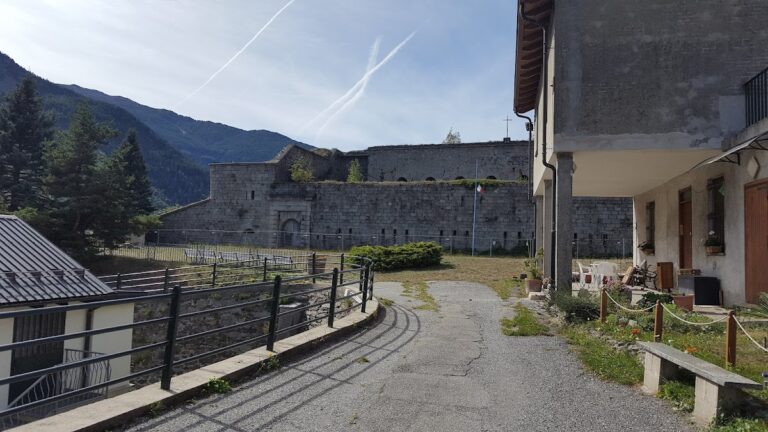
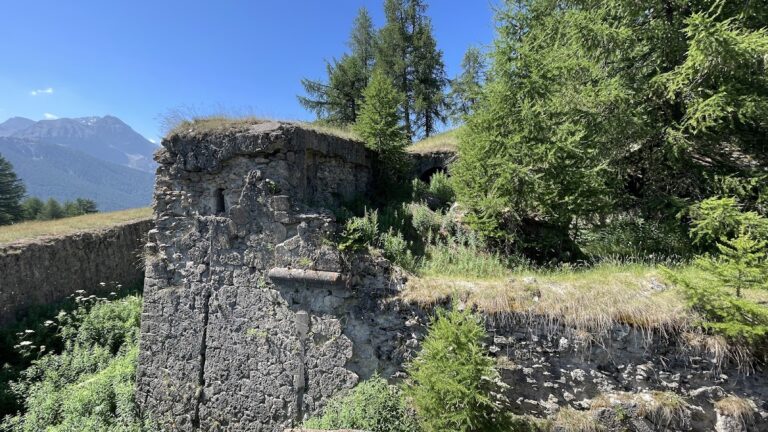
Forte Jafferau stands on the summit of Mount Jafferau in the Susa Valley. The complex was built in concrete and comprised the main fortification, an underground powder magazine, and a fuze-setting facility, where artillery fuzes were prepared. The surviving remains are dispersed between the summit and the end of the military road, while the cableway terminus survives only as ruined fabric.
Summit fortification
Gun positions
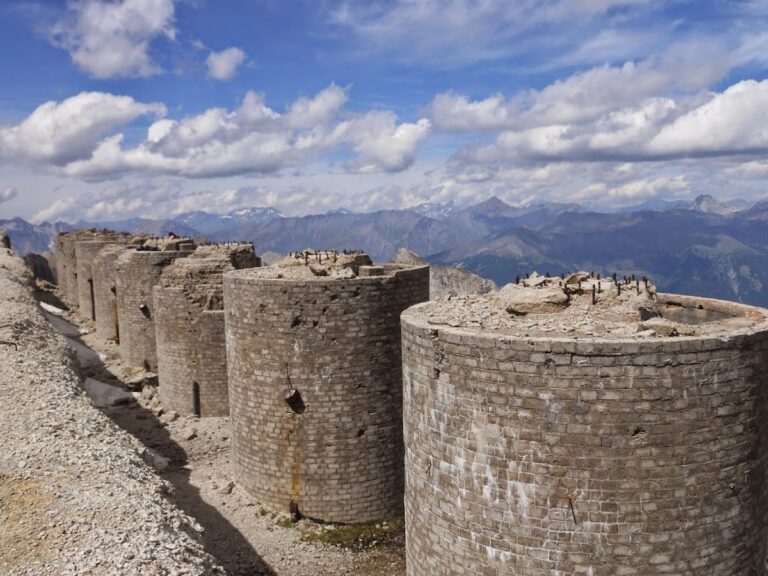
Almost nothing remains of the main fort itself, but all eight gun positions are clearly visible on the summit. Their aiming-angle markings and the ammunition recesses beneath them remain identifiable. The original armament consisted of eight paired 149/23 guns, each set at a different angle in an open barbette position, meaning that the artillery fired over a parapet rather than through a covered opening.
Defensive enclosure and accommodation
A defensive wall once surrounded the entire fort, interrupted only by the entrance portal. The portal carried the emblem of the 137th Battery and was approached across a moat by a drawbridge. The wall has almost entirely disappeared, the portal survives only in part, and the drawbridge is gone. Beneath the gun platforms, rooms for services and accommodation could house as many as 200 men. These spaces faced toward Jafferau Pass, with their backs turned toward the direction of fire.
Underground ammunition facilities
Powder magazine
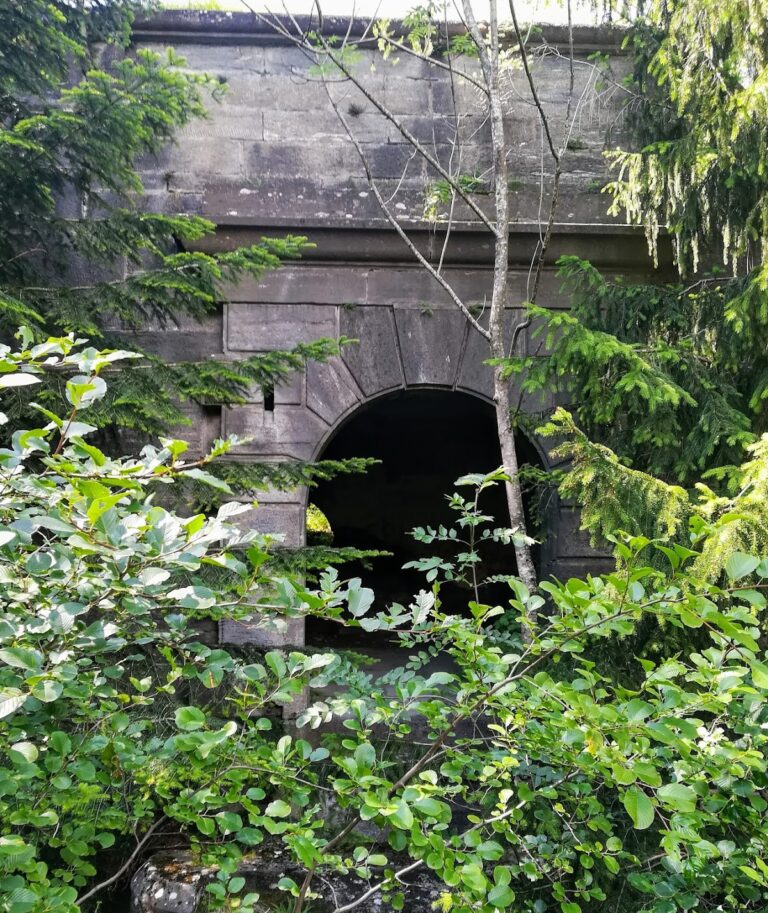
The powder magazine, a protected store for gunpowder and ammunition components, lies substantially below the fort at the end of the military road. It consists of one very long room excavated into the rock and remains in comparatively fair condition.
Fuze-setting facility
Beside the magazine is the fuze-setting facility. Its four rooms have wood-covered walls, and a corridor approximately 50 centimetres wide separates each room from the next. Like the powder magazine, this part of the complex remains in comparatively fair condition.
Military cableway terminus
Very little survives of the terminal station of the military cableway that connected the battery with the lower installations. Its remaining fabric has been reduced to ruins, preserving only a fragment of the transport system that helped support the fort’s high-altitude military autonomy.
Nearby sites