Citadel of Bonifacio: Genoese Fortifications in Corsica, France


Site at a Glance
- Rating
- 4.8
- Popularity
- Low
- Country
- France
- Primary era
- Early Modern
- External website
- Open
- Eras represented
- Medieval, Early Modern, Modern
- Civilizations
- Crown of Aragon, French, Genoese
- Site type
- Military
- Remains
- Citadel
On this page14 sections
History
The Citadel of Bonifacio is a fortified historic complex in France, developed by Pisan and Genoese powers from the twelfth century onward on the southern coast of Corsica. Its origins reach back to 830, when Count Boniface of Lucca established a papal castrum, or fortified settlement, after being drawn to the site during an expedition against the Saracens. Merchants later settled nearby and used the harbor of the Cartola inlet. The fortifications eventually protected an important Genoese stronghold that secured commerce between Genoa, Liguria, and Sardinia while controlling the Strait of Bonifacio.
Pisan and Genoese Bonifacio
The earliest fortifications were built by Pisa. Genoese forces under Falcone Castello captured Bonifacio in 1187, but Pisa recovered it in 1195. Genoa then retook the town and replaced its inhabitants with an exclusively Genoese population. At the end of the twelfth century, Bonifacio became the first Genoese preside established in Corsica. A preside was an inhabited fortified settlement whose residents combined civilian life with responsibility for defense, so Bonifacio was more than a military installation in the strict sense.
During the thirteenth century, Bonifacio stood within the struggle between Pisa and Genoa. Periods of peace lasted from 1217 to 1241 and from 1247 to 1282, but the wider contest ended decisively with the Battle of Meloria in 1284, when Genoa defeated Pisa in a major naval engagement. Pisa consequently lost its possessions in Corsica and Sardinia.
Bonifacio supported the Ghibelline faction and the Doria family in 1321. The Ghibellines generally favored imperial authority in opposition to the papacy and its allied Guelf faction, while the Doria were a powerful Genoese family active in Mediterranean and Corsican politics. Bonifacio resisted a first Catalan attack in 1344 and took part in the war between Genoa and King Peter IV of Aragon from 1352 to 1355. From about 1340, Genoa also pursued a wider defensive network in Corsica rather than relying only on Bonifacio to control coastal commerce. This policy reflected the continuing competition among Genoa, Pisa, and Aragon for the island.
Siege of 1420 and the Office of Saint George
King Alfonso V of Aragon and Sicily besieged Bonifacio in 1420. When the town did not surrender, he returned with Corsican allies and began constructing the King of Aragon’s Staircase to obstruct the delivery of supplies. Genoese naval assistance broke the blockade in December, and Alfonso abandoned the siege on 5 January 1421 after being summoned to Naples. The remaining siege was later abandoned after a dispute involving Vincentello d’Istria and Polo della Rocca.
Genoa regained effective control of Corsica after defeating the Catalans at the Battle of Ponza in 1435. Vincentello d’Istria, who had served as viceroy of Corsica from 1421 to 1434, was later captured by the Genoese and beheaded in Genoa.
In 1453, Genoa transferred the administration of Corsica to the Office of Saint George, a Genoese financial and administrative institution that governed parts of the island during the fifteenth and sixteenth centuries. The office established its first government of Corsica from 1453 to 1463, recovered the island in 1478, and established itself at Bonifacio and Calvi in 1480. Its second government of Corsica began in 1483, while Genoa resumed direct administration in 1562.
Sixteenth-century sieges and defenses
The Office of Saint George progressively built a major line of fortifications across the entrance to the Bonifacio peninsula. The entrance was bastioned around 1550 on the advice of the engineer Giovan Maria Olgiati. A bastion is a projecting section of fortification designed to direct defensive fire along adjoining walls. The work formed part of the continuing effort to secure the peninsula and strengthen Bonifacio’s military role.
A severe plague epidemic in 1528 and 1529 reduced Bonifacio’s population from 5,000 to 700 inhabitants. Later, during the conflict between King Henry II of France and the Habsburg emperor Charles V, French forces, supporters of the Corsican leader Sampiero Corso, and an Ottoman fleet commanded by the admiral Dragut besieged the town. Sampiero Corso supported French intervention in Corsica, while Dragut was an Ottoman admiral and privateer active in the Mediterranean.
After eighteen days and eighteen nights of bombardment, the garrison surrendered. Ottoman forces massacred it despite the terms previously agreed. Dragut soon left Bonifacio, which remained under French control until the Treaty of Cateau-Cambrésis returned French-held Corsican towns to Genoa in 1559. Fortification works continued during the French occupation.
Genoese modernization and later military use
From 1580, Genoa strengthened the defenses by bastioning the town’s towers, adding the Stendardo Bastion beside the Genoese Gate, and constructing low walls along the flanks. The modernization known as the Lavor nuovo, meaning “New Work,” continued through much of the seventeenth century. The older harbor side had been recognized as vulnerable to artillery fire from the Pian di Capello, and the later works altered the defenses over a large part of the seventeenth century.
Barracks and magazines were added in the late seventeenth and eighteenth centuries. A magazine was a military storage building for ammunition and supplies. The Genoese Barracks was built in 1731 for Austrian troops sent by Emperor Charles VI to assist Genoa, then remodeled in 1769 for French military use.
In April 1815, Bonapartist inhabitants forced the military authorities to permit a tricolor flag on the bell tower of Sainte-Marie-Majeure Church. The episode increased military suspicion of the population. A separating wall between the military and civilian sections of Bonifacio was approved in 1840 and built in 1848. Much of it was demolished on 2 July 1984.
Battery No. 6 was built within the citadel between 1888 and 1895 and modernized in 1902 for five 194 mm guns on mountings of the 1875 and 1876 models. The guns were modified in 1939, while the battery itself was altered again between 1932 and 1936 as part of Corsica’s defensive organization associated with the Maginot Line, the system of twentieth-century French fortifications. The citadel entered the register of historic monuments in 1929. A new registration order issued on 16 February 2023 replaced the earlier one, and an order of 20 June 2025 added classified historic-monument status.
Remains
Plateau and defensive front
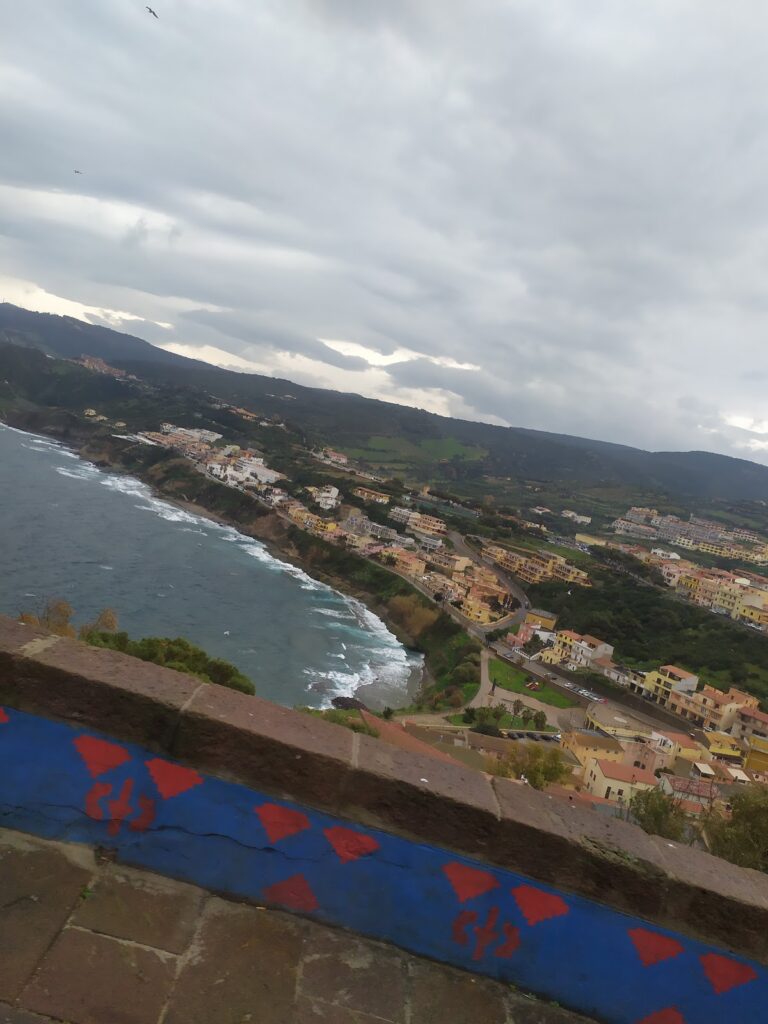
The fortified complex occupies a limestone plateau formed from horizontal strata, with a sea-facing cliff approximately 60 metres high. Its principal defensive feature is a large façade closing access to the Bonifacio peninsula. The façade incorporates the Bastardello, the Orecchione, and a new gate flanked by the Tower of Maestro Abrà.
Genoese Gate and Stendardo Bastion
The new gate received bastioned defenses around 1550. Il Stendardo, also called the Bastion of the Standard, was added to the right of the Genoese Gate, while low ramparts extended along the flanks. These projecting and lateral defenses formed part of the enlarged entrance system that secured access to the peninsula.
Harbor defenses and later works
The harbor side was treated as a defensive weakness because artillery from the Pian di Capello could reach it. The Lavor nuovo modernization consequently reshaped the defenses across much of the seventeenth century. Later construction added barracks and magazines, giving the fortified settlement the military storage and accommodation needed for its continuing defensive function.
Genoese Barracks
The Genoese Barracks dates from 1731, when it housed Austrian troops sent to assist Genoa. It was remodeled in 1769 for French military use, preserving the building as part of the later military fabric of the complex.
Separating wall
A wall 250 metres long and 4 metres high divided the military and civilian sections of Bonifacio. Built in 1848 after approval in 1840, it expressed the nineteenth-century separation between the fortified establishment and the town. Much of the wall was destroyed in 1984.
Battery and siege feature
Battery No. 6
Battery No. 6 lies at Pointe du Timon within the citadel. It was designed for five 194 mm artillery positions. The battery underwent modernization in 1902 and further alterations from 1932 to 1936 within Corsica’s defensive organization associated with the Maginot Line. Its guns were modified in 1939.
King of Aragon’s Staircase
The King of Aragon’s Staircase was constructed during the siege of 1420. Its purpose was to obstruct the delivery of supplies to Bonifacio as Alfonso V attempted to maintain a blockade of the town. The staircase therefore belongs directly to the siege landscape and to the physical defenses created during that effort to force the settlement’s surrender.
Nearby sites