Fort Saint-Nicolas: The Royal Citadel Guarding Marseille’s Harbour


Site at a Glance
- Rating
- 4.5
- Popularity
- Low
- Country
- France
- Primary era
- Early Modern
- External website
- Open
- Eras represented
- Early Modern, Modern
- Civilizations
- French
- Site type
- Military
- Remains
- Citadel
On this page15 sections
History
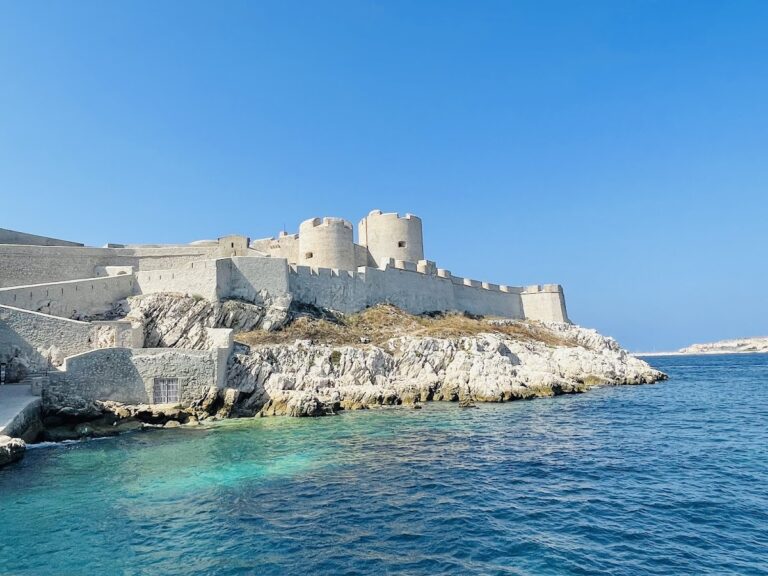
Fort Saint-Nicolas is a seventeenth-century French royal citadel in Marseille, France, built between 1660 and 1664 under Louis XIV. It overlooks the Vieux Port from the opposite side of the harbour entrance to Fort Saint-Jean. The fortress was designed not only to protect Marseille from attack by sea, but also to reinforce royal authority over a city known for its independent political spirit.
Medieval harbour defences
A chapel dedicated to Saint Nicholas stood on the site between 1150 and 1218 under the authority of Saint-Victor Abbey. In 1322, the seneschal of Provence ordered a wooden palisade and a chain across the narrowest passage between Fort Saint-Jean and the future site of Fort Saint-Nicolas. The barrier was intended to close the entrance to the harbour.
The defensive works grew stronger during the fourteenth century. By 1381, the chain was supported by two substantial bridge-like structures. The chapel was also extensively adapted, acquiring a wall-walk and a wall that extended towards the harbour chain.
These defences failed on 20 November 1423, when King Alfonso V of Aragon attacked Marseille. Aragonese troops landed in a nearby cove, took the chapel from the rear, and allowed Catalan galleys to enter the port. The city was looted for three days. The attackers carried away the harbour chain, which is still displayed in Valencia Cathedral in Spain.
Rebuilding and the Marseille disturbances
Four private individuals, Louis Naudet, Gabriel Delassus, Jean Beolan, and Antoine Mascaron, rebuilt the Chapel of Saint Nicholas in 1591. Mascaron was a friend of Charles de Casaulx and became director of the Marseille mint in 1593.
Political conflict later brought the site into a much wider royal confrontation with Marseille. In October 1657, the Duke of Mercœur, governor of Provence, arranged for Lazare de Vento, seigneur de la Baume, to become consul. Opposition grew after officials sought to arm a galley for Mercœur’s son, the Chevalier de Vendôme. Led by Gaspard de Glandevès de Niozelles, the movement developed into riots and the seizure of the town hall in July 1658.
The crisis deepened when the opposition’s electoral victory was cancelled and its leaders were summoned to Paris on 6 January 1659. When Niozelles tore up a royal summons, Louis XIV travelled to Provence with Cardinal Mazarin, the queen mother, and the court. They reached Aix-en-Provence on 18 January 1660.
Construction of the royal citadel
On 19 January 1660, Louis XIV ordered troops into Marseille and instructed the Duke of Mercœur to build a citadel at the most suitable location. Mercœur and Henri de Forbin-Maynier, Baron d’Oppède, had proposed the project. Its political purpose was to control Marseille and suppress its independent civic power, while its military role was to defend the harbour against attack from the sea.
Louis Nicolas de Clerville, a leading French military engineer, rejected Saint-Charles hill because it lay too far from the shore for maritime resupply. He selected the ground behind Saint-Victor Abbey, a broad limestone spur with a freshwater fountain shown on older maps. Marshal du Plessis-Praslin initially favoured a position near the present Palais du Pharo but later accepted Clerville’s choice.
Construction began in 1660 under Clerville. The Duke of Mercœur laid the foundation stone on 11 February, and its inscription presented the citadel as a response to Marseille’s disorders and as protection for both the city’s notables and its people. Three commemorative medals marked the event.
The upper fort was completed in 1663 by the master mason Jean Étienne Chieuse. Work on the lower fort stopped after Mazarin’s death on 9 March 1661 and resumed on 16 July 1663 under a contract involving seven masons, including Pierre Puget. The lower fort was completed in 1664.
Criticism and later military changes
Vauban, France’s best-known seventeenth-century fortification specialist, inspected the citadel in 1679. He had not taken part in its construction and severely criticized the design. After 1664, low-level batteries and a fausse-braye, a low outer defensive platform, were added around the lower fort to provide further positions for fire and protection.
The citadel’s position close to the Lazaret also affected Marseille’s harbour landscape. Its governor asked for the quarantine establishment to be moved, and the city relocated it near Saint-Martin d’Arenc. After the plague of 1720, Catalan fishermen settled in abandoned infirmary buildings near the former Lazaret, giving the surrounding district its name.
Revolution, prison, and wartime use
In 1790, Marseille’s population feared that the commanders of the forts were accumulating ammunition. On 30 April, Major de la Roque, the fort’s commander, agreed to admit as many National Guards each day as there were soldiers in his garrison. On 18 May, a crowd began demolishing the eastern part of the citadel as a symbol of despotism. The National Assembly ordered the demolition stopped on 28 May because it considered the fortress useful to Marseille’s defence.
In January 1794, General Napoleon Bonaparte inspected the coastal fortifications of Provence. He reported that Fort Saint-Nicolas could not resist for even fifteen minutes. The three city-facing fortified circuits had been demolished, leaving the fort accessible from all sides, and its surrounding batteries were in very poor condition.
Prefect Thomas restored the demolished sections in 1833. The repairs used mediocre greyish stone, which contrasted with the surviving masonry of pink Cap Couronne limestone. A municipal decision of 18 April 1860 authorized a road between the Vieux Port and the Palais du Pharo. Boulevard Charles Livon was cut through the site in 1862, dividing the citadel into two independent parts.
The fort became a prison in 1823 after the Duke of Angoulême’s expedition to Spain. It received 569 prisoners, including Valdès, a soldier who had helped organize guerrilla resistance to Napoleonic troops after 1808. The prison also held sailors from the vessel that brought the Duchess of Berry ashore near Carry-le-Rouet on 28 April 1832. The vessel was intercepted two days later near La Ciotat.
Fort Saint-Nicolas remained a prison until the end of the Second World War. Its prisoners included the writer Jean Giono in 1939, Jean Zay in 1940, the Tunisian politicians Habib Bourguiba and Hédi Nouira from 1940 to 1942, and the Resistance member Guy de Combaud-Roquebrune.
During the Battle of Marseille, the fort served as the principal centre of German resistance. French artillery bombarded it, and the garrison surrendered on 27 August. On 29 August, United States Marines accepted the surrender of German forces occupying the fortified harbour islands.
Names and modern preservation
In 1887, the lower fort was renamed Fort Ganteaume after Ganteaume, a former vice-admiral and maritime prefect. The upper fort became Fort d’Entrecasteaux, named after Admiral d’Entrecasteaux, a relative of the Bailli de Suffren.
Fort Saint-Nicolas was classified as a French Monument historique, a legal heritage designation for places of historical or architectural importance, in January 1969. Since 2003, the upper fort has been restored by ACTA VISTA through programs combining heritage work with practical training. Since 2021, the non-profit association La Citadelle de Marseille has held a 40-year emphyteutic administrative lease, a long-term public-law lease that preserves public ownership while granting rights of use and development.
The restoration program combines conservation, professional integration, cultural activities, and the adaptation of the former military site for guided visits, exhibitions, artists’ residencies, performances, and concerts. The upper fort opened to the public in May 2024.
Remains
Fort Saint-Nicolas occupies a limestone spur between Marseille’s harbour, Saint-Victor Abbey, and the Le Pharo district. Its principal sections are separated by Boulevard Charles Livon. The lower fort lies between the boulevard and the sea, extending between Quai Marcel Pagnol and the Port de la Réserve, while the upper fort stands south of the boulevard.
Construction and overall layout
The citadel was built mainly from pink limestone quarried at Cap Couronne. Masonry from the demolished Porte Royale and nearby portions of Marseille’s older walls was also reused. The 1833 restoration introduced contrasting greyish stone, while the retaining walls created during the 1862 boulevard excavation were built from white Urgonian limestone.
Upper fort
Enceintes and entrances
The upper fort consists of two interlocking enceintes, or enclosing fortified circuits. Its eastern entrance passes through a gate. Restoration has included the eastern, northern, and western ramparts, preserving the principal defensive lines of the upper section, which was completed in 1663.
Outworks and memorial windmill
The restored upper fort also includes the Villeroy demi-lune and the Dauphine demi-lune, detached crescent-shaped works placed before a fortress entrance or bastion. The Beringhen bastion forms another part of the surviving defensive arrangement. A former windmill in the upper fort has served as a memorial to the war dead since 1954.
Lower fort and earlier defences
Lower fort batteries
The lower fort was completed in 1664. Low-level batteries and a fausse-braye were added around it after the original construction, extending the defensive positions in front of the main fortification. The lower section now houses a military circle and officers’ mess.
Medieval chapel and harbour chain
The medieval Chapel of Saint Nicholas that preceded the citadel was later demolished. Its earlier defensive installation included a wall-walk, a wall reaching towards the harbour chain, and the structures that supported the chain across the narrow passage between the two harbour forts.