Château d’If: French Royal Fortress and State Prison off Marseille


Site at a Glance
- Rating
- 4.6
- Popularity
- Medium
- Country
- France
- Primary era
- Early Modern
- External website
- Open
- Eras represented
- Early Modern, Modern
- Civilizations
- French
- Site type
- Military
- Remains
- Castle
On this page18 sections
History
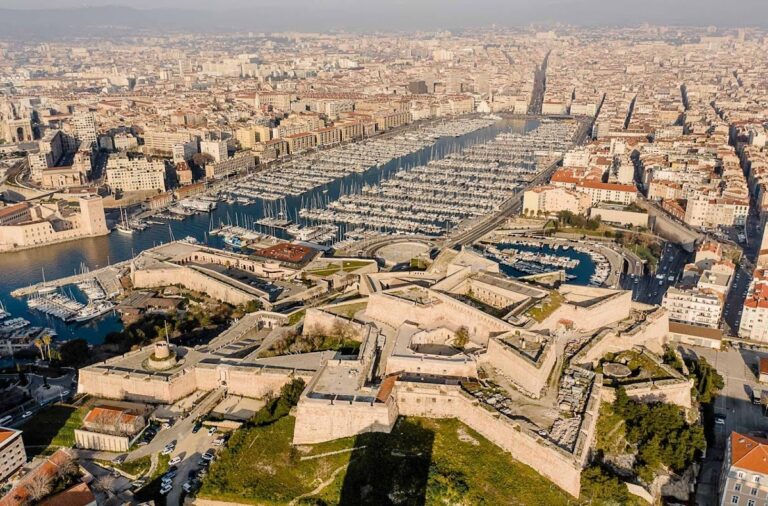
Château d’If is a French royal fortress on the Île d’If off Marseille, France, built under King Francis I during the sixteenth century. Its first defensive walls began in 1524 after the Spanish siege of Marseille, and the main construction campaign started in mid-April 1529. The fortress was completed in 1531, when its first garrison and governor were installed. It formed part of Francis I’s effort to strengthen royal control of the Provençal coast and protect Marseille from foreign fleets and maritime raids.
Foundation and royal defense
Francis I recognized the island’s strategic value during a visit to Marseille in January 1516. He had come to see a rhinoceros being transported from Lisbon to Rome, but the visit also drew attention to Marseille’s weak coastal defenses. The island stood in the northern part of the city’s roadstead, a sheltered anchorage used by ships, beside important maritime routes. Its position allowed the crown to defend Marseille against Spanish fleets, Ottoman vessels, and attacks by Barbary pirates. It also helped protect the royal galleys anchored in the Old Port and the city’s maritime food supply.
The fortress belonged to a wider defensive system covering the Frioul archipelago. Forts, artillery batteries, trenches, and observation posts were established across the islands, which served as an advanced maritime defense for Marseille. Ratonneau contained an important fort dating from the reign of Henry IV, later buried beneath successive reconstructions. Château d’If itself never fought a full-scale attack. Charles V abandoned an invasion plan in 1531, and his offensive against Marseille in 1536 was also abandoned in the context of the fortress’s defenses.
A contested royal presence
Marseille’s inhabitants resisted the new fortress because the city retained traditional autonomy over its own defenses. They regarded Château d’If as an expression of the monarchy’s attempt to impose centralized authority in Provence. Local descriptions such as “the unwelcome neighbor” and “the bad neighbor” conveyed this hostility. The fortress therefore had a political role as well as a military one, asserting the presence of the French crown at the entrance to the city’s harbor.
During the sixteenth century, the fortress was converted into a prison of state. The first documented prisoners were two Marseille fishermen confined there in November 1540. By the 1580s, Château d’If was regarded as one of France’s oldest state prisons. Its isolated position and the currents around the island encouraged its reputation as an almost escape-proof prison island, also described as a “bastille of the seas.” It held state prisoners, religious detainees, political prisoners, and people confined by royal order.
Religious and political imprisonment
French Protestants, often called Huguenots, were held at Château d’If from the late seventeenth into the eighteenth century, particularly after the revocation of the Edict of Nantes, which ended official toleration for French Protestant worship. The often-repeated claim that 3,500 Protestants were imprisoned at If or passed through it before being sent to the galleys is unfounded. A more limited estimate identifies 27 religious prisoners held there between 1696 and 1716. They included nine Camisards captured during the War of the Cévennes, five men arrested while attempting to emigrate, four guides, four participants in clandestine Protestant assemblies, and two Catholic galley prisoners who had converted to Protestantism and refused to recant.
Five prisoners were moved to If in 1696 because of suspected espionage, while five others were transferred in 1700 and 1701 after refusing to remove their hats during compulsory Masses. Nine Camisards were confined there between 1702 and 1707. Some prisoners were transferred from Marseille prisons to limit their religious influence, and officials also feared that they might communicate secretly with Protestants in countries at war with France. Céphas Carrière spent several years at the fortress from 1700. Jean Monnier, a lay preacher condemned to the galleys in 1695, was transferred there in 1696.
Château d’If also received prisoners from privileged social backgrounds. The Chevalier de Lorraine was confined in 1670 at the request of Henriette of England before being exiled to Rome. Honoré Gabriel Riqueti, comte de Mirabeau, was imprisoned from 1774 to 1775 under a lettre de cachet, a royal order that could impose imprisonment or exile without an ordinary judicial trial. His father had requested the confinement because of his debts and libertine conduct. Mirabeau was later transferred to Fort de Joux after seducing the castle’s cantinière. Other detainees included the royalist conspirator Charles d’Hozier, held from 1805 to 1814, General Frédéric Michel de Lajolais, held from 1805 to 1808, and Fanny Dillon, imprisoned in March 1815.
Revolutionary and nineteenth-century prisoners
After the disturbances of June 1848, 120 people were imprisoned at the fortress. Following the coup d’état of 2 December 1851, 304 detainees were held there temporarily while awaiting deportation to the penal colonies of Maison-Carrée in Algeria or Cayenne in French Guiana. Republican prisoners were also confined after the fall of the Second Empire in 1870. Gaston Crémieux was held there before his execution in 1871, and Louis Auguste Blanqui was transferred to Château d’If in 1877. Blanqui was released under a general amnesty on 10 June 1879.
The final prisoners were Alsatian and Lorraine civilians released in September 1914, although the prison’s operation is generally considered to have ended at the close of the nineteenth century. The fortress also briefly housed the embalmed body of General Jean-Baptiste Kléber, who had been assassinated in Cairo on 14 June 1800. French troops brought his body to If in 1801 during their withdrawal from Egypt. First Consul Napoleon Bonaparte ordered that it remain there because Kléber’s tomb might become a republican symbol. Louis XVIII ordered the remains transferred to Strasbourg in 1818, after they had stayed at the fortress for 18 years.
Fiction, legend, and preservation
Alexandre Dumas made Château d’If internationally famous through his 1844 novel The Count of Monte Cristo. The fictional prisoners Edmond Dantès and Abbé Faria are confined in the fortress. Other stories connected with the site are legends rather than established history. The supposed prisoner Anselm, allegedly imprisoned in 1580 for conspiring against the monarchy and later strangled in his cell, cannot be verified as a historical person. The alleged imprisonment of the Man in the Iron Mask is also legendary, and the Marquis de Sade was not held at Château d’If.
The fortress was demilitarized and opened to the public on 23 September 1890. It became a French historic monument on 7 July 1926. The Centre des monuments nationaux, the French public institution responsible for managing and preserving many historic monuments, now maintains the site. Since 2012, the Île d’If has also formed part of Calanques National Park.
Remains
Château d’If occupies almost the entire three-hectare Île d’If, a small limestone island in the Frioul archipelago. White, stratified Urgonian limestone cliffs descend steeply into the sea, while high ramparts and artillery platforms occupy the island’s perimeter. At the center stands a square, three-storey fortress measuring 28 metres on each side. Three cylindrical casemated towers, containing vaulted chambers for troops or artillery, project from the building and are connected by terraces and defensive works.
Central fortress and towers
Central building
The central building contains three principal levels. Living quarters and a kitchen occupied the ground floor, while the first floor held casemates and the upper levels formed part of the defensive and residential arrangement. Broad embrasures, or openings designed for artillery, replaced the arrow slits and crenellations associated with medieval fortifications. The covered towers and the overall arrangement represent a transitional stage between medieval tower defenses and the later bastioned system, a gunpowder-era design using projecting works and overlapping fire.
Materials came from several sources. Limestone was quarried on Île d’If, while “stone of the Midi” from La Couronne was used for the courtyard façades and paving. Stone salvaged from Marseille buildings destroyed during the 1524 siege was also incorporated into the fortress. This mixture of materials contributed to the description of Château d’If as a piece of Marseille transported onto a rock in the gulf.
Tour Saint-Christophe
The northwestern Tour Saint-Christophe is the highest of the three towers, rising 22 metres. It functioned as the donjon, the principal fortified tower, and controlled the main navigation channel and the open sea. The tower itself was built between 1524 and 1527, while its associated residential donjon dates from 1529. Its elevated position formed part of the fortress’s early artillery system.
Tours Saint-Jaume and Maugovert
The northeastern Tour Saint-Jaume and southeastern Tour Maugovert face Marseille. They flank the entrance and connect with a broad artillery platform directed toward the city and maritime traffic. The three towers are linked by a spacious terrace extending across two levels. Each tower projects beyond the curtain walls over approximately three-quarters of its surface, an arrangement that allowed the artillery chambers to cover the surrounding defenses.
Artillery and outer defenses
Early firing positions
The towers contain superimposed firing chambers and broad openings for artillery. The original arrangement included high-level plunging and raking fire, intended to damage the masts of ships with chained or linked shot. The height of the guns made this method comparatively ineffective against ships’ hulls. The defensive design nevertheless reflects the changing requirements of warfare as gunpowder artillery displaced older forms of wall defense.
Coastal batteries and enclosure
Sébastien Le Prestre de Vauban, France’s leading military engineer under Louis XIV, responded by initiating low coastal batteries on the Cap de Croix on Ratonneau and at Cap d’Ouriou on eastern Pomègues. Their flatter fire was directed toward ships’ waterlines. In a critical report dated 11 April 1701, Vauban proposed a fourth sea-facing tower, judged much of the earlier work, apart from the original castle, to have been poorly executed, and ordered or planned improvements to the coastal defenses.
Vauban also had a guardhouse built beside the fortress exit because the soldiers were badly housed. The building later became known as the Caserne Vauban. Around the fortress, a peripheral bastioned enclosure was constructed by Florentine troops between 1591 and 1598 during Charles de Casaulx’s attempt to establish an independent Catholic republic at Marseille. Raymond de Bonnefons raised the enclosure in 1604, and it was heightened again under Louis XIV.
Prison spaces and inscriptions
Cells and social divisions
The surviving prison architecture reflects sharp distinctions between prisoners. Dangerous or undisciplined detainees could be isolated in recesses within the towers, reached only by a small opening in the vault. Impoverished prisoners were crowded into collective ground-floor cells with poor hygiene and straw bedding. Wealthier detainees could rent individual first-floor rooms known as pistoles or chambres passables. These generally had windows, furniture, a bed with bedding, and a fireplace, and some occupants received better food and private visits.
Graffiti and the June 1848 memorial
Prisoners carved or sculpted graffiti into the masonry from the sixteenth century onward. After the June 1848 imprisonment, the former entrance to the main courtyard received the inscription “House of the Sovereign People.” A 25-metre frieze in two or three horizontal bands commemorates the defeated June 1848 prisoners. Ninety-six inscriptions survive on the north, east, and south façades. The prison administration authorized the work and supplied tools, while at least nine of the political prisoners were stonemasons.
Literary and legendary cells
A roughly hewn dungeon is presented in connection with Edmond Dantès, the fictional protagonist of Dumas’s novel. Another sign identifies a “prison of the Man in the Iron Mask,” but this refers to a legend rather than a historically verified occupation of the fortress. These features preserve the relationship between the physical monument and the literary and popular traditions that shaped its modern identity.