Švėkšna Manor: A Historic Estate and Villa in Lithuania


Site at a Glance
- Rating
- 4.7
- Popularity
- Low
- Country
- Lithuania
- Primary era
- Modern
- External website
- Open
- Eras represented
- Modern
- Civilizations
- Russian
- Site type
- Domestic
- Remains
- Elite Residence
On this page11 sections
History
Švėkšna Manor is a historic estate in Švėkšna, Lithuania, first recorded in the fifteenth century in the historical region of Samogitia. Its early owner was Mykolas Kęsgaila, Elder of Samogitia, a senior regional officeholder, and Castellan of Vilnius, a high-ranking official connected with territorial administration and defence. The extensive estate bordered Gardamas, Rietavas, Pajūralis, and the Duchy of Prussia.
Early ownership and industry
The Kęsgaila family held Švėkšna until 1569, when the estate passed through the marriage of a Kęsgaila daughter to Jonas Zaviša. The Zaviša family retained it until 1624. From 1624 to 1644, it belonged to Hieronim Kryszpin-Kirszenstejn, overseer of the Pajūris district. During his ownership, Švėkšna acquired the first factory in Samogitia, with workshops producing glass and paper. Some of that paper was used for Samogitian court documents.
Ownership then passed successively to the Denhof family, who held the estate from 1644 to 1694, the Grotesai family from 1694 to 1721, and the Ogiński family from 1721 to 1766. During these successive changes, the estate entered a period of deterioration. In 1766, the Broël-Plater family acquired Švėkšna from the Ogiński family.
The Broël-Plater estate
The first Broël-Plater owner was Livonian Count Wilhelm Jan Broël-Plater, who lived from 1715 to 1769. He was followed by his son, Count Jerzy Broël-Plater, who lived from about 1760 to 1825. In 1820, Jerzy divided the family properties among his four sons. Švėkšna went to Stefan Broël-Plater, an amateur archaeologist, while Vilkėnas Manor went to Franciszek, Gedminaičiai Manor to Jerzy, and Stemplės Manor to Kazimierz.
Stefan returned to Lithuania after travelling through Europe and the Middle East, bringing back souvenirs and works of art. His son, Count Adam Broël-Plater, born in 1836, later continued the family’s interest in archaeology. Adam investigated sites in Lithuania, including the Kernavė mounds, and joined the Vilnius Archaeological Commission and the Russian Archaeological Society of St. Petersburg, scholarly organizations devoted to archaeological research and the study of historical remains. He was also said to have found seven Egyptian statues in burial mounds in 1852.
During the late nineteenth and early twentieth centuries, the estate was reorganized into two principal zones. The residential area occupied a hill above the Šalna and Švėkšnalė rivers, while agricultural and service buildings stood in the Šalna River valley and along its left bank. The landlords also maintained hunting grounds containing moose, roe deer, and pheasants.
Villa Genowefa and the estate under Adam Plater
Adam Broël-Plater supported the construction of the Church of St. James the Apostle by donating 50,000 rubles and supplying bricks and tiles made at the estate. He later held a senior position at the Tsar’s Palace in St. Petersburg and received high-ranking guests at Švėkšna for hunting.
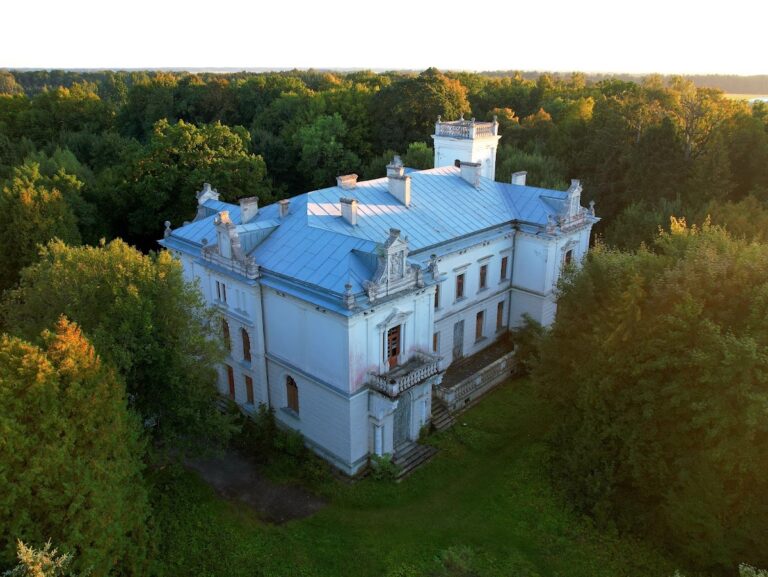
In 1880, Count Adam Alfred Broël-Plater built Villa Genowefa beside the older wooden manor house. This small Empire-style palace used the formal early nineteenth-century style derived from imperial classicism associated with Napoleonic France and adapted across Europe. Named after Adam’s wife, Genowefa, the villa served for family celebrations and receptions.
After Adam’s death in 1909, Genowefa managed the estate, although she usually lived in Paris. From 1912 to 1940, management passed to their son, Count Jerzy Floryan Plater, who was born in 1875. He married his second cousin Janina Plater in 1912. In 1922, Janina inherited Vilkėnas Manor from her father, reuniting the two estates. Their son, Aleksander Adam Plater, was born in 1913.
War, independence, and Sovietization
During the First World War, Jerzy Plater was mobilized. He served as Chief of Staff of the Pskov Reserve Brigade and later as Assistant to the Chief of the Cavalry at Luga. German Baron Weitenhorst lived at Švėkšna and Vilkėnas during the conflict, while German forces damaged buildings at Švėkšna and destroyed the estate’s manor zoo.
Jerzy returned from Russia to Švėkšna in 1918, during the period of Lithuanian independence, and remained there until the estate was Sovietized. He added sculptures of St. Florian and Diane, a name for Diana, the Roman goddess associated especially with hunting, as well as a solar clock. He donated part of the park to the local gymnasium and supported the institution after 1925.
After Genowefa died in 1935, Jerzy inherited works of art from her Paris apartment and transferred them to Švėkšna. In 1940, Soviet authorities nationalized the estate, incorporating the private property into the Soviet state system, and expelled Jerzy Plater. The manor archives and library books were burned, many works of art were destroyed, and a small number of objects and pictures were taken to the Telšiai Museum. Jerzy was deported to Siberia, where he died and was buried in an unknown grave.
During the German occupation, Aleksander Adam Plater returned to the estates and lived at Švėkšna, while Vilkėnas was left to the Germans. From 1941 to 1944, he taught geography, biology, and public science at Švėkšna Gymnasium. He left for Germany in 1944, emigrated to the United States in 1949, and lived there for the rest of his life.
Postwar changes and return
After the Second World War, Villa Genowefa was converted into a cinema, while the other unattended buildings deteriorated. A Soviet soldier was buried in the parterre, a formal ornamental garden area, in front of the villa, and a monument was erected there. After Lithuania regained independence, the soldier’s remains were reburied at Švėkšna Cemetery.
The old wooden manor house was demolished around 1952, leaving its foundations as a surviving trace of the earlier residence. Villa Genowefa remained standing. In 2001, Švėkšna and Vilkėnas Estates were returned to the Plater family, represented by Countess Felicija Laimė Plater, the wife of Aleksander Plater. She repaired Villa Genowefa, renewed the flower beds, restored some park structures and the gates, and established a museum. Countess Felicija Plater died in Washington, DC, on 28 October 2015. Her remains were intended for burial beside her husband in the crypt of the Šventoji Catholic Church.
Remains
Švėkšna Manor’s surviving physical setting combines the foundations of the former wooden residence, Villa Genowefa, and elements of a landscaped park. The estate was arranged across two contrasting areas: the residential zone stood on a hill above the Šalna and Švėkšnalė rivers, while agricultural and service buildings occupied the Šalna River valley and its left bank. Ponds, a mill, avenues, bridges, steps, flower beds, sculptures, gates, and other park structures formed part of this wider arrangement.
Manor buildings
Former wooden manor house
The original manor house was a single-storey wooden building. It stood beside Villa Genowefa until its demolition around 1952. Its foundations remain as the physical trace of the older residential centre and preserve the position of the building within the later estate layout.
Villa Genowefa
Villa Genowefa was built in 1880 beside the wooden manor house. The small palace has a graceful Empire-style design and was created for family celebrations and receptions. Its later use as a cinema altered its function after the Second World War. Following the return of the estate to the Plater family in 2001, the building was repaired and adapted to house a museum.
Park and grounds
A wide avenue connected the mansion with the Church of St. James the Apostle. The park included ponds, steps, footbridges, formal flower beds, sculptures, gates, and other decorative structures. Jerzy Plater added the figures of St. Florian and Diane and installed a solar clock. Some park architecture and the gates were restored after the estate returned to the Plater family.
The parterre in front of Villa Genowefa formed a formal garden space within the residential grounds. It was used temporarily for the burial and commemoration of a Soviet soldier, whose remains were later transferred to Švėkšna Cemetery. Beyond the residential park, a fenced hunting enclosure covered 70 hectares and contained moose, roe deer, and pheasants.
Nearby sites