Fort de Brégançon: A Royal Fortress and Presidential Residence in France


Site at a Glance
- Rating
- 4.3
- Popularity
- Low
- Country
- France
- Primary era
- Early Modern
- External website
- Open
- Eras represented
- Medieval, Early Modern, Modern
- Civilizations
- French
- Site type
- Military
- Remains
- Fort
On this page18 sections
History
Fort de Brégançon is a fortified site and former stronghold in France, located at Bormes-les-Mimosas on the Mediterranean coast. Its origins reach back to a Ligurian fortified settlement established toward the end of the sixth century BC, while the islet also served as a Greek trading post known as Pergantion between the seventh and sixth centuries BC. A first fortress was built during the Merovingian period, and the site later developed into a royal coastal defense before becoming an official residence of the President of the French Republic.
Ancient and medieval origins
The Ligures, ancient communities living in parts of southeastern Gaul and northwestern Italy, probably established an oppidum, a fortified settlement, on the site toward the end of the sixth century BC. The location also functioned as a Greek commercial settlement between the seventh and sixth centuries BC. Its name was recorded as Pergantion during this early phase. A new fortress appeared during the Merovingian period, the era of Frankish rule conventionally dated from the fifth to the eighth century.
The medieval lordship of Brégançon was initially centered on a castle on the mainland rather than on the present islet. This fortified lordship, or castellany, was created at the end of the tenth century for the Viscounts of Marseille after the expulsion of the Saracens from Fraxinet in 972. In 1140 it became a rear fief of Hyères, meaning that it was held indirectly through another lordship, and was granted with Hyères to Pons, Marquis of Fos.
Raimond-Geoffroi de Fos sold the castle and a twelfth of the lordship of Hyères to the Community of Marseille in 1216. Other members of the Fos family confirmed the transaction in 1223. On 6 June 1257, Charles of Anjou acquired Marseille’s possessions. He renovated and rearranged the mainland castle, which remained associated with the Angevin dynasty, a ruling house that controlled Provence and the Kingdom of Naples through different branches.
Angevin rule and contested lordship
Members of the Angevin royal family visited Brégançon. Queen Jeanne of Naples, the fourteenth-century ruler of Naples and Sicily, stayed there in January 1348 while fleeing Naples. After returning to her kingdom, she granted Brégançon on 31 July 1348 to Jacques de Galbert, a Marseille shipowner whom she had appointed Vice-Admiral of Provence. She revoked the grant in 1366.
During the war of succession to the Kingdom of Naples, Marie of Blois granted the lordship and fort of Brégançon in 1387 to Balthazar Spinola, a Genoese condottiero, or military commander leading a contracted force. Spinola had changed sides in favor of the Angevins and used Brégançon as a base for raids along the coasts near Toulon and Hyères. The site returned to Louis II of Anjou in 1405, when Spinola ceded it for 200 florins.
Transformation into a royal fortress
Brégançon became a royal fortress in 1481, when Provence passed to Louis XI. The development of artillery and improvements in navigation had made the mainland castle unsuitable for coastal defense. In 1483, Jean de Baudricourt transferred the fortification to the present islet, beginning the transformation of Brégançon into a maritime stronghold.
Charles III, Duke of Bourbon, besieged the fort in 1524 after entering the service of Emperor Charles V. Brégançon surrendered after only a few days. In 1531 Francis I incorporated it into the newly created Marquisate of the Golden Isles, a sixteenth-century territorial and administrative marquisate associated with the coastal islands of Provence. Bertrand d’Ornézan, General of the Galleys, held responsibility for the new territory and for defending the Toulon coast against Ottoman raids. After several changes of ownership, Brégançon returned permanently to the crown in 1561.
Charles IX stopped at the fort for several hours on 30 October 1564 during his royal tour of France, but no other reigning monarch stayed there during this period. In 1574 Henry III made Brégançon a marquisate for Antoine Escalin des Aimars, General of the Galleys. The fort then became a Protestant stronghold. Catholic forces commanded by the Count of Vins besieged it in 1578, and the castellan and garrison surrendered after two days before being massacred. The lordship returned to the royal domain that same year, while command of the fort was separated from the lordship and assigned to a governor.
Seventeenth- and eighteenth-century administration
Melchior de Gasquy held the governorship from 1582, followed by his son Joseph de Gasquy from 1606 and his younger son Honoré de Gasquy from 1609. The marquisate and governorship were reunited under Honoré de Gasquy in 1619. During the Thirty Years’ War, the major European conflict fought principally between 1618 and 1648, Cardinal Richelieu reorganized the defenses of the Toulon and Hyères coasts and their surrounding islands. The Gasquy family rearmed and strengthened Brégançon, which had been badly damaged during the Wars of Religion, the sixteenth-century civil and religious conflicts in France. The fort acquired its general present form during this seventeenth-century reorganization.
After a disputed sale in 1660, the marquisate returned to the royal domain and remained under royal administration until 1714. It was then granted to Joseph-Paul de Ricard, followed by his son Louis-Hercule de Ricard in 1741, Alexandre Pateron in 1775, and Pierre Rouard in 1786. The marquisate legally ended during the French Revolution. Rouard considered the fort uncomfortable and began converting a farm on the mainland into a residence. Work continued through the Revolution, despite lawsuits involving neighboring landowners and the communes of Hyères and Bormes.
Revolutionary and Napoleonic military use
During the Revolution, the garrison protected possessions retained by the Marquise de Ricard from attacks by peasants in 1789. The Jacobin Club of Hyères seized the garrison’s weapons in 1791. Napoleon Bonaparte became interested in Brégançon after the recapture of Toulon on 18 December 1793. He stayed at the fort during the winter of 1793 to 1794 and later had it repaired and supplied with improved artillery.
After becoming emperor, Napoleon strengthened the garrison in 1805 with a company of Imperial veterans. In 1809 he rejected Pierre Rouard’s claims and expropriated him, definitively separating the mainland estate from the fort. The state has owned Brégançon independently of the former mainland property since the Revolution.
Military decommissioning and private residence
After the Franco-Prussian War of 1870, the Ministry of War modernized the fort’s military installations. It added artillery and a powder magazine, a secure place for storing gunpowder, without changing the exterior. A small garrison remained during the First World War, and the fort was decommissioned in 1919.
The French Republic leased Brégançon to private occupants from 1924 to 1963, except during the Second World War. Robert Bellanger, a former deputy, senator, and Under-Secretary of State for the Navy, restored and modernized it as a private residence. He installed water and electricity, created a Mediterranean garden, and built a wall and the causeway connecting the road to the islet, while preserving the fortress’s exterior appearance.
The islet and fort received protection as a classified natural and picturesque site in 1924 and were again protected as a classified natural site in 1962. The fort and islet were classified as historic monuments on 25 September 1968, under a French legal designation protecting properties recognized as having national importance. The site is also protected as an archaeological site.
Presidential residence
When Bellanger’s lease ended in 1963, the state resumed possession. Charles de Gaulle stayed at Brégançon on 25 August 1964 while attending ceremonies marking the twentieth anniversary of the Liberation of Provence. He disliked the mosquitoes and the small bed, but accepted the fort’s potential as a presidential residence after encouragement from René-Georges Laurin. The state subsequently refurbished the property, and a decree of 5 January 1968 assigned it permanently to the Ministry of Cultural Affairs as an official residence and summer retreat of the president. Pierre-Jean Guth, an architect for the French Navy and a Prix de Rome laureate, adapted the fort in 1968 while retaining its surviving fortress fabric.
Georges and Claude Pompidou were the first presidential couple to use Brégançon regularly as a holiday residence, beginning in August 1969. They introduced modern-art furnishings and decorations, including works associated with Pierre Paulin. Valéry Giscard d’Estaing later changed the interiors, removing much of the Pompidous’ contemporary furniture and adding more traditional pieces. He also had a terrace and a dome constructed in the dining room and installed video surveillance. During his presidency, the fort became nationally prominent as a setting for presidential media appearances.
François Mitterrand used Brégançon relatively rarely, although he received Chancellor Helmut Kohl there in August 1985 and also received Irish Prime Minister Garret FitzGerald. Jacques Chirac began visiting in 1995, held a working weekend there in spring 1997, and received Algerian President Abdelaziz Bouteflika for lunch in 2001. Nicolas Sarkozy also used the residence. François Hollande stayed there with Valérie Trierweiler in summer 2012 and later decided to make the property more accessible to the public.
In 2013 the presidency announced that Brégançon would open to the public while retaining its status as an official presidential residence. The Centre des monuments nationaux managed the site from 2014 until 2018, when management returned to the Élysée, the official Paris residence and administrative seat of the president. Public access continued when the presidential couple was away, while the private apartments remained reserved for presidential use.
Emmanuel Macron first visited Brégançon as president in May 2018 and returned in August of that year. The presidential couple subsequently used the fort for annual summer stays. Macron received British Prime Minister Theresa May on 3 August 2018, Russian President Vladimir Putin on 19 August 2019, German Chancellor Angela Merkel on 20 August 2020, and German Chancellor Friedrich Merz on 28 August 2025. The fort has also hosted presidential and governmental working meetings, including discussions about the state budget in 2010 and negotiations concerning Brexit in 2018.
Brégançon remains state property and an active presidential residence. Gendarmes and Republican Guards regularly occupy the site, with permanent security personnel and maritime protection when the president is present. A restricted airspace zone, LF-P 48, was established around the fort in 2005.
Remains
The islet and approach
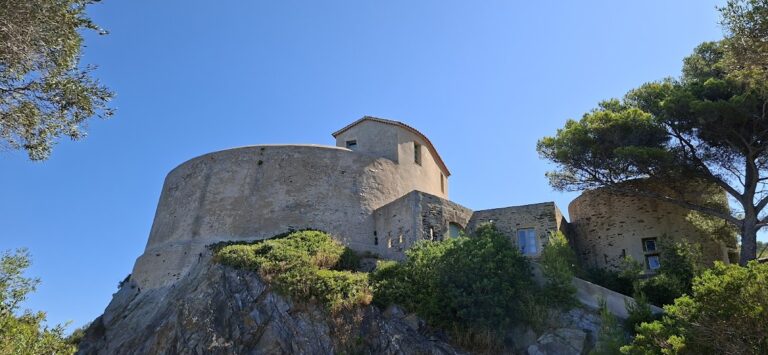
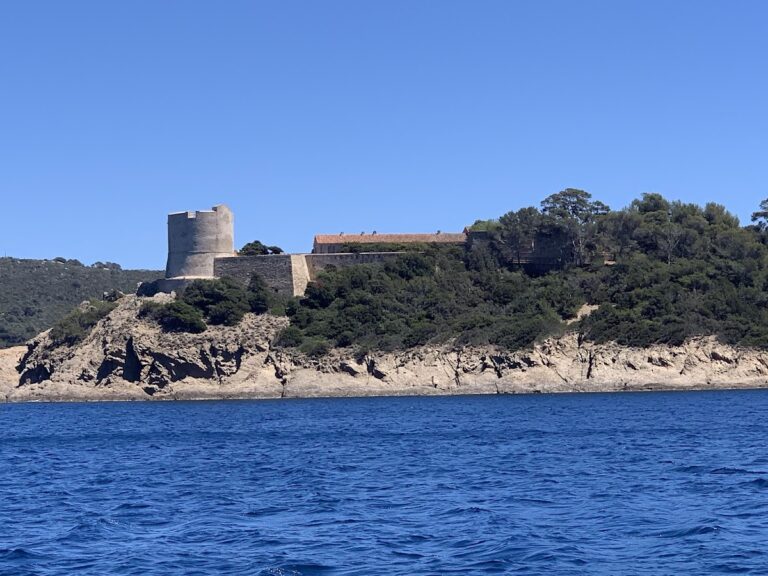
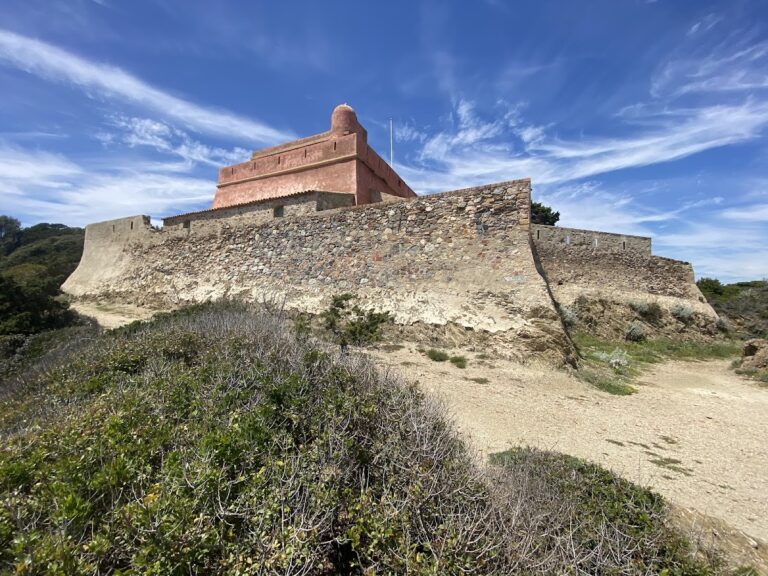
Fort de Brégançon occupies a rocky islet of approximately 2,000 square metres off the Cap Bénat coast. The rock rises roughly 35 metres above sea level and is connected to the mainland by an artificial causeway and jetty. A filled area within the causeway provides parking for staff and can serve as a helipad. The medieval castral settlement included a village and a church, while other historic buildings are incorporated beneath or within the modern construction.
Defensive structures
Drawbridge and gatehouse
Entry to the fortress crosses a ditch cut into the rock by means of a drawbridge. The bridge reaches an entrance gatehouse, or châtelet, flanked by two round towers. One surviving section of the original outer defensive wall contains long, narrow slit loopholes designed for shooting missiles or firearms through the masonry.
Towers and main building
The principal surviving arrangement consists of an eastern tower, identified as the keep, and a western tower joined by a main building. A belvedere, an elevated feature designed to provide a view, overlooks the rock face and the private beach. The eastern tower contains the presidential office. The western tower contains the presidential suite and is reserved as a private part of the residence.
Presidential and guest accommodation
The building facing the Giens peninsula contains guest and service rooms, salons, dining rooms, and accommodation for a visiting prime minister or head of state. Pierre-Jean Guth’s adaptation of 1964 to 1968 created a white, angular residence divided into a presidential wing and a guest and security wing. The guest wing contains five bedrooms on the first floor and additional staff rooms on the ground floor. The military origin of the structure remains visible in its small windows.
Interior arrangement
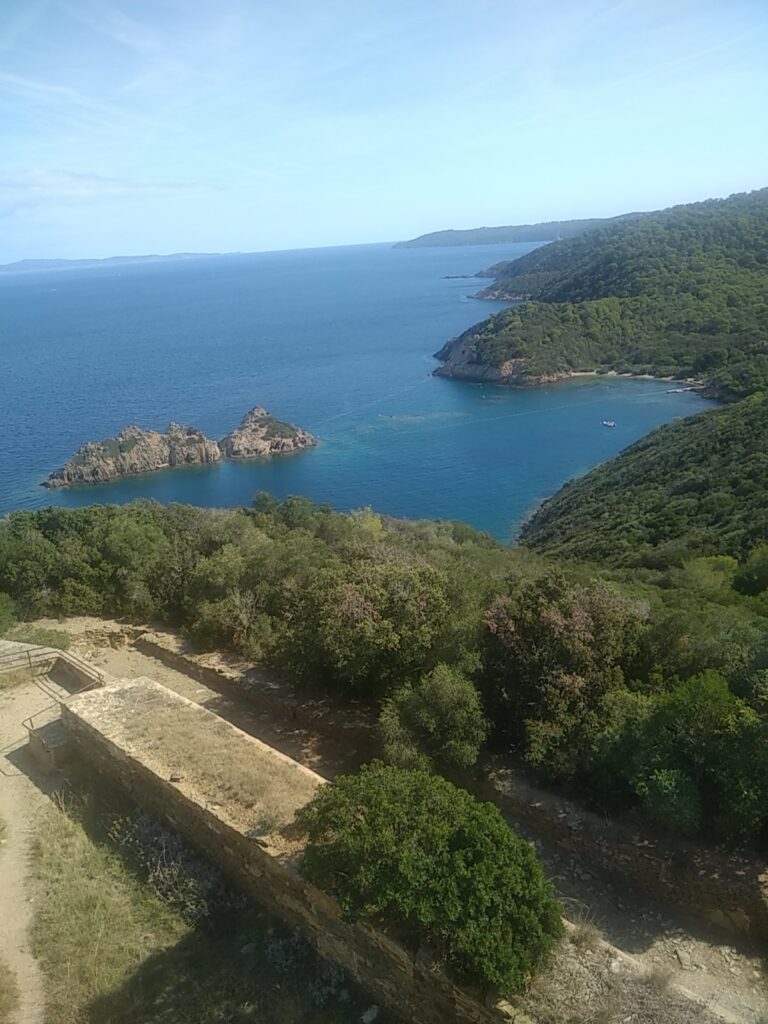
The ground floor contains an honor hall with terracotta tiles, two salons, a dining room, and kitchens. The upper floor includes the presidential office and medium-sized bedrooms. The presidential apartment occupies the upper floor and includes a tower office, an antechamber between the two towers, a bathroom, and a bedroom with a balcony in the western tower. The bed faces the sea and the island of Porquerolles.
Furnishings and decorations
The interiors are arranged as a comfortable, functional house rather than as a sumptuous palace. Surviving furnishings include contemporary seats associated with Pierre Paulin, floral sofas with matching small chairs, and large two-colored Aubusson or Cogolin carpets. A mosaic in the entrance was presented by Tunisian President Habib Bourguiba to Valéry Giscard d’Estaing. Other decorations installed during Giscard d’Estaing’s presidency include a bouquet painting by Pierre-Joseph Redouté in the entrance, a Joan Miró lithograph in the staircase, and two Sonia Delaunay lithographs in the office.
Garden and shoreline features
A maintained lawn lies in front of the presidential bedroom and overlooks the sea. An irregular garden surrounds the residence with bougainvilleas, mimosas, umbrella pines, Aleppo pines, laurels, agaves, and olive trees. The islet also has a very small artificial private beach reached by a steep descent, protected by a rock breakwater. An above-ground pool was installed in 2018.
Public presentation
Parts of the fort were rearranged for public presentation after 2013. The honor hall in the presidential pavilion displays official gifts presented to François Hollande, including a miniature gold oasis from Saudi Arabia, a blown-glass vase from Joe Biden, three tea services from Chinese President Xi Jinping, and a desk set from Moroccan King Mohammed VI.
The official dining room contains a large walnut table laid with Haviland china and a smaller table with Moustier china made specifically for Brégançon. A gallery of presidential portraits was created, and books were added to the presidential office in the eastern tower.
Nearby sites