Akrai Archaeological Park: A Greek and Roman Settlement in Sicily

Site at a Glance
- Rating
- 3.9
- Popularity
- Very Low
- Country
- Italy
- Primary era
- Classical
- Eras represented
- Classical
- Civilizations
- Ancient Greek, Roman
- Site type
- City
On this page13 sections
History
Akrai Archaeological Park in Italy preserves the remains of Akrai, a Greek colony founded by the Syracusans in Sicily in 663 BC. Established within the ancient Greek colonial world of southern Italy and Sicily, known as Magna Graecia, Akrai occupied the Acremonte plateau in the Hyblaean Mountains and became one of Syracuse’s earliest settlements.
A Syracusan colony
Akrai stood in a strategically important position overlooking the surrounding territory. Its elevated location helped Syracuse protect its borders, while the settlement retained political, administrative, and military autonomy despite its loyalty to the Syracusan state. It belonged to a wider chain of Syracusan settlements in southeastern Sicily, including Kasmene, Akrillai, and Kamarina, and lay along the route toward Gela.
The settlement also played a part in regional military affairs. In 421 BC, its army intercepted the invasion force of Nicias, an Athenian general and statesman, in the Val di Noto or Anapo Valley, contributing to the force’s defeat. In 357 BC, Dion of Syracuse, a Greek political and military leader, halted at Akrai while marching against Syracuse so that he could observe the effects of his actions.
Urban growth and Roman rule
Until the third century BC, Akrai remained a small community dominated by Syracuse. Its growth probably accelerated in the mid-third century BC after a treaty between Rome and Hieron II, the Hellenistic king of Syracuse, placed Akrai within Hieron’s dominions. The Greek theatre and the adjacent council house, known as a bouleuterion, belong to this period of urban development.
During the Second Punic War, the conflict between Rome and Carthage from 218 to 201 BC, Akrai followed the fortunes of Syracuse. The town provided refuge for Hippocrates of Syracuse, a Syracusan military commander, after his defeat by the Roman general Marcus Claudius Marcellus at Acrillae in 214 BC.
After Syracuse fell in 211 BC, Akrai became part of the Roman province and was known in Latin as Acrae or Acre. It retained a separate municipal existence under Roman rule and continued into the Byzantine period. The city was destroyed by the Arabs in 827 AD and then abandoned. Soil and spontaneous vegetation gradually covered the remains, leaving the settlement largely forgotten for almost eight centuries.
Rediscovery and archaeological research
The lost city was identified in the sixteenth century by Tommaso Fazello, a Sicilian scholar and monk. Baron Gabriele Judica began the first archaeological excavations in the early nineteenth century. He published his findings in Le antichità di Acre in 1819, discovered the bouleuterion in 1820, and announced the theatre’s discovery in 1824.
Further investigations were carried out by Julius Schubring and, during the twentieth century, by Paolo Orsi, Luigi Bernabò Brea, Giuseppe Voza, Maria Musumeci, and Lorenzo Guzzardi. This work brought much of Akrai’s public architecture to light, while later research examined the residential quarters. In 2009, a Polish archaeological mission from the University of Warsaw identified the residential area through non-invasive research and conducted regular excavations there from 2010 to 2017. The investigations uncovered Greco-Roman houses and numerous artefacts. Akrai is administered within Sicily’s regional archaeological park system.
Remains
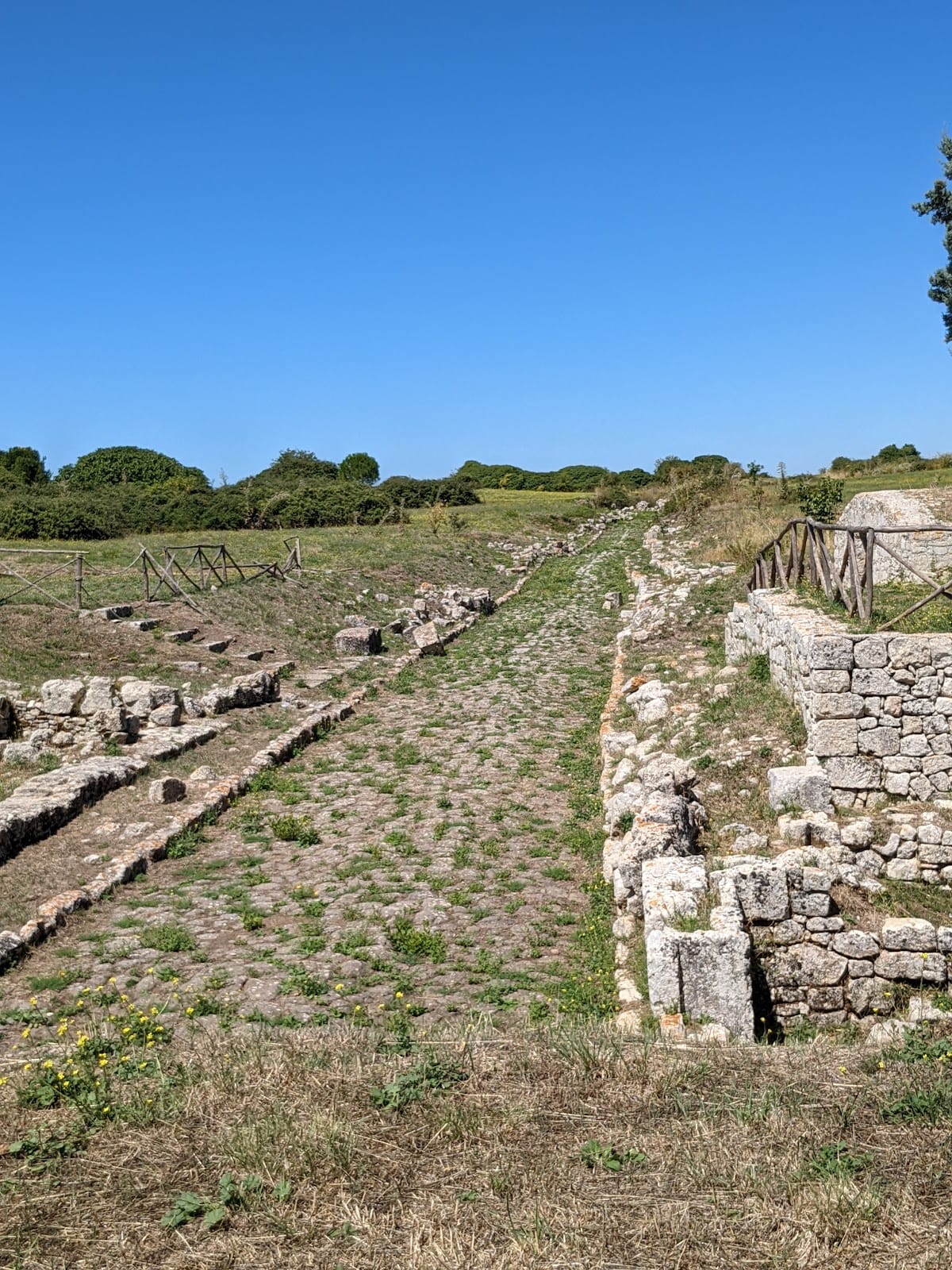
The archaeological area covers approximately 238,000 square metres on the Acremonte plateau, at an elevation of about 770 metres. The elevated position was difficult to attack and offered wide views over the surrounding territory. Its southeastern high point later served as the acropolis, the elevated fortified or religious centre of an ancient Greek settlement. The surviving remains combine civic buildings, sacred and funerary features, rock-cut spaces, and residential quarters.
Civic buildings
Greek theatre
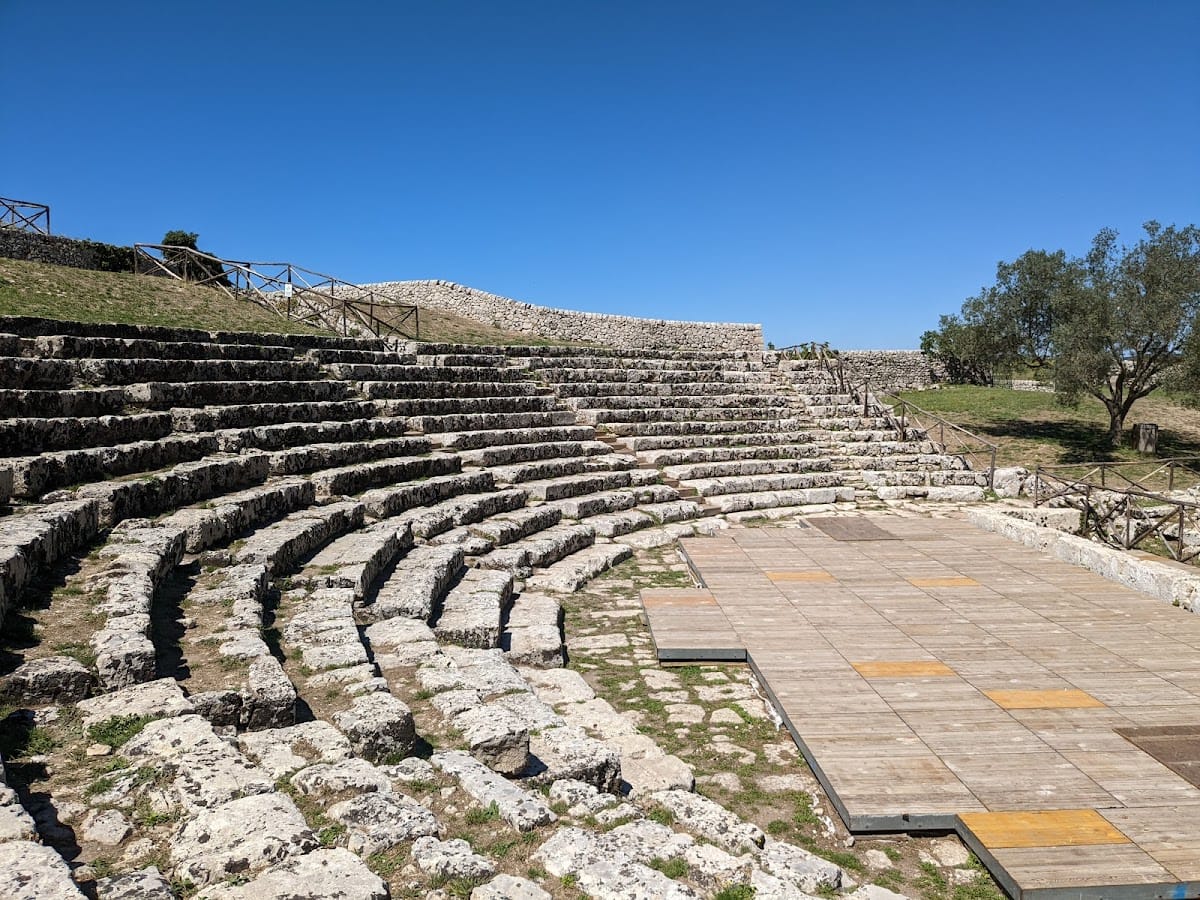
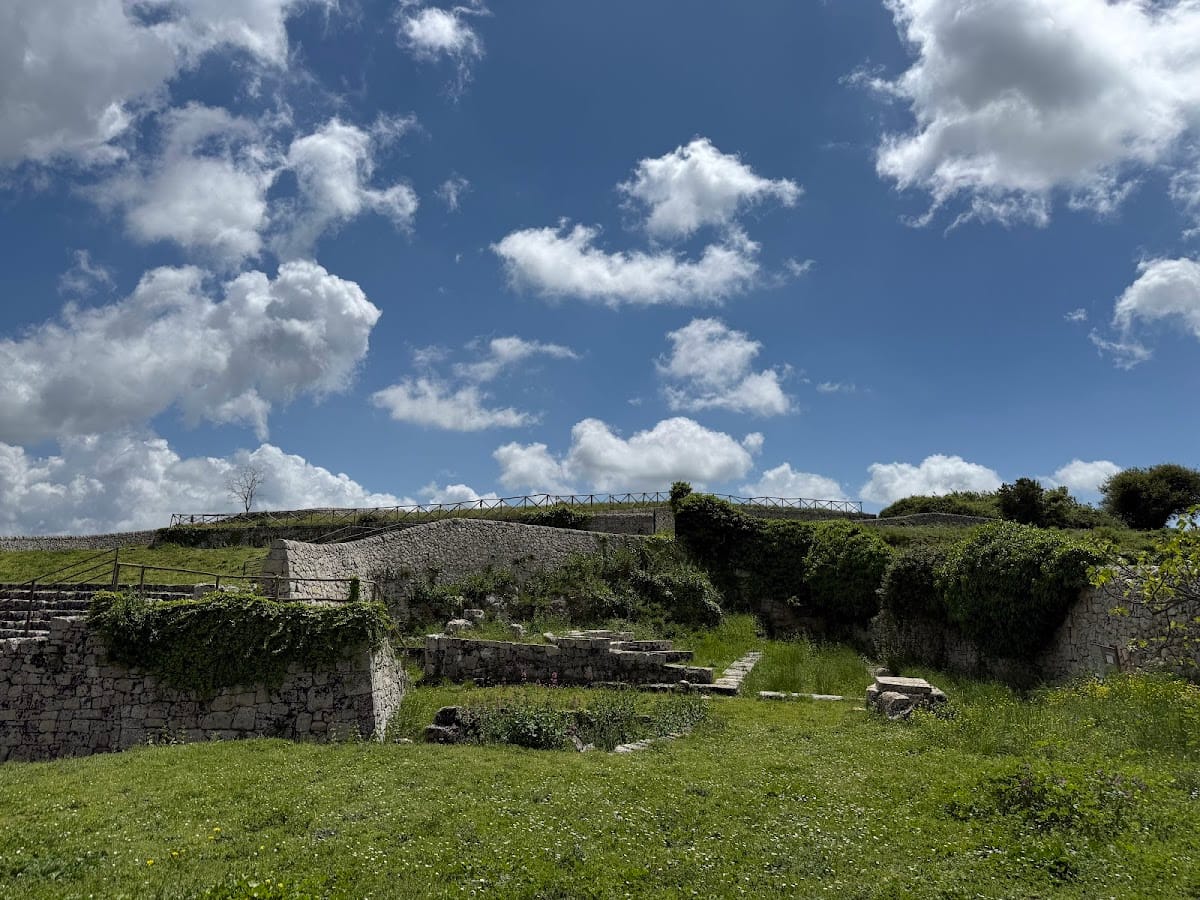
The Greek theatre is relatively small and has been reconstructed to a high degree. Its auditorium was architecturally combined with the adjacent bouleuterion, linking the performance building with the civic centre of the settlement.
Bouleuterion
The bouleuterion stands at the western end of the archaeological area. This building served as the meeting place of the city council and formed part of the urban development associated with Akrai’s expansion during the third century BC.
Sacred and funerary features
Aphrodision
On the flat ground above the Intagliata latomia are the surviving foundation blocks of the Aphrodision, a sanctuary dedicated to Aphrodite, the Greek goddess associated with love and beauty. The temple was erected in the sixth century BC, probably during its second half, when Akrai was developing as an urban centre.
Latomies
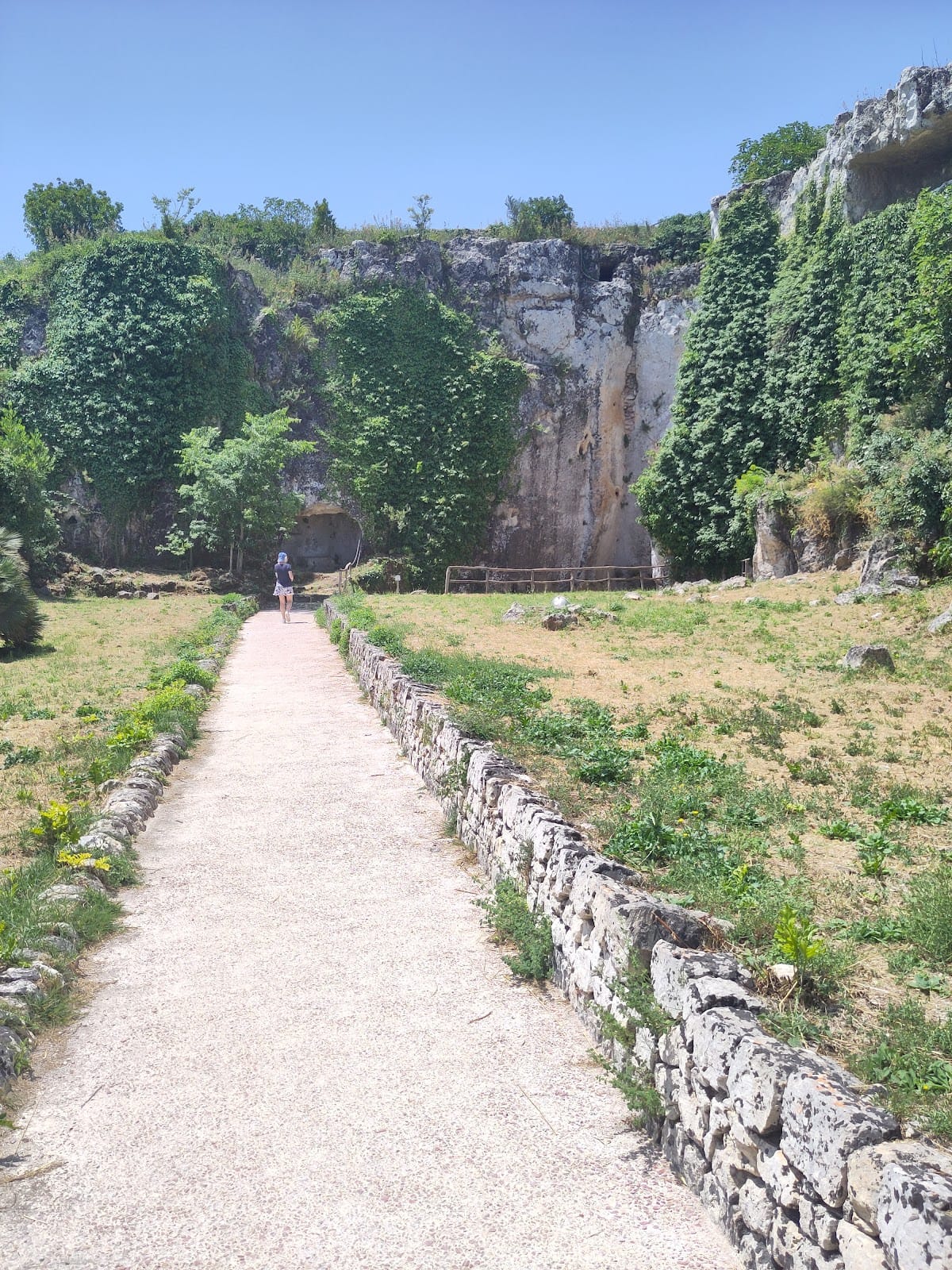
Two rock-cut quarries, called Intagliata and Intagliatella, occupy part of the site. These latomies were used both for extracting stone and for imprisonment, although the date of their initial excavation is uncertain. From the third century BC, they were adapted for elaborate tomb monuments. In late antiquity, the cut spaces were used again as catacombs and as dwellings for poor residents.
Funerary Temples
The Funerary Temples stand east of the hill. They were dedicated to the cult of the dead and form part of the funerary landscape associated with the ancient settlement.
Residential quarter
Excavations in the residential area have revealed Greco-Roman houses and numerous archaeological artefacts. These domestic remains add evidence of household life and settlement organization to the public architecture identified elsewhere at Akrai.