Netum: The Ancient and Medieval Predecessor of Noto
Site at a Glance
- Popularity
- Medium
- Country
- Italy
- Primary era
- Medieval
- Eras represented
- Bronze Age, Iron Age, Classical, Medieval, Early Modern
- Civilizations
- Ancient Greek, Byzantine, Crown of Aragon, Habsburg, Kingdom of Sicily, Norman, Spanish
- Site type
- City
On this page30 sections
History
Netum, later called Noto Antica, was the distinct predecessor settlement of modern Noto on Mount Alveria in Sicily, Italy. Occupied from prehistoric times, it developed as a Greek and Roman town and later became a leading medieval center in southern Sicily. An earthquake in 1693 almost completely destroyed it, after which residents established the new city farther downstream.
Prehistoric and Greek beginnings
Settlement in the area reaches back to the Castelluccio culture of the Early Bronze Age, around the eighteenth to fifteenth centuries BCE. Finds associated with the Finocchito culture belong to the eighth and seventh centuries BCE. Alveria was inhabited in prehistoric times and was home to Sicel communities by at least the ninth century BCE. The Sicels were an ancient people of Sicily.
Tradition holds that in the fifth century BCE the Sicel ruler Ducetius moved Neai, said to be his birthplace, from the hill of Mendola to Alveria as he prepared to resist Greek expansion. The location of Neai is uncertain, and later studies have questioned both Ducetius’s connection with Noto and whether this transfer occurred. A Greek-period settlement probably grew on a lower part of Alveria. Greek influence brought religious practices and customs to the town.
Roman rule
In 263 BCE, Rome assigned Neaiton to Hieron II, the ruler of Syracuse, under a treaty. The town retained some autonomy and had probably become an allied city of Rome by the Second Punic War, Rome’s conflict with Carthage. In Cicero’s time it held the status of a treaty-bound ally; Pliny later described it as a Latin town, a community with a distinct legal status under Rome. In the imperial period Netum became a municipium, a community incorporated into the Roman civic system, and was exempt from the tribute usually called the stipendium.
The town’s residents entered Roman political history in 70 BCE, when Cicero named the Netines among the leading accusers of Gaius Verres, Rome’s governor of Sicily. Verres had improperly demanded their tithe. Roman-period remains at Netum are scarce. The settlement continued into the Middle Ages, although the surviving historical record becomes limited between late antiquity and the ninth century.
Arab and Norman rule
In 864, Netum surrendered to Arab besiegers led by Cafagh Ibn Sofian. It briefly recovered its independence before falling again in 866. From the tenth century, it served as the principal town of one of Sicily’s three administrative valleys. Under Arab rule, agriculture and trade developed, including extensive citrus growing and silk production, while leather tanning also became an important craft.
Under Norman rule the settlement became a strongly fortified center and took the name Noto. Its commerce expanded, and it rose to prominence as the capital of southern Sicily, giving its name to the Val di Noto. In 1091 Roger I of Sicily granted Noto to his son Jordan as a duchy. Jordan began building the castle on the isthmus and founded churches to encourage the revival of Christianity. The geographer Idrisi later praised Noto’s beauty, wealth, and strategic value.
After Jordan’s death, Noto was granted as a fief to Count Goffredo of Montescaglioso during the reign of William I, known as William the Bad, and was later confiscated. In the early thirteenth century Isimbardo Morengia governed the town. In 1212 he founded the Cistercian monastery of Santa Maria dell’Arco, belonging to a Catholic monastic order, and endowed it with four fiefs.
Aragonese rule and medieval prominence
An uncertain tradition says that on 2 April 1282 Noto joined other Sicilian towns in killing the French garrison of Faramondo d’Artois. Under Aragonese rule, Guglielmo Calcerando governed as vicar of King Peter II. Noto remained loyal to the Aragonese during conflicts with their Angevin rivals, despite its castellan, Ugolino Callari, handing the town to Robert II of Artois in 1300. King Frederick III visited in 1335, the town’s customary laws were approved in 1341, and King Ludovico granted it privileges and immunities in 1353.
Around 1330 the nobleman Corrado Confalonieri came to Noto. After a hunting accident he became a hermit and withdrew to a cave in a valley several kilometres from the town. He died there in 1351, regarded as holy, and later became Noto’s patron saint.
Fourteenth-century civil conflict involved the Alagona and Landolina families, supporters of the Aragonese, and the Chiaramonte family, which supported the French. The arrival of the Martin dynasty, especially the rule of Alfonso the Magnanimous, brought periods of relative calm and prosperity. Noto’s political influence was reflected in Nicolò Speciale’s service as viceroy, a governor acting on behalf of a monarch.
Alfonso revoked the perpetual royal-domain status granted by Martin the Younger and gave Noto to his brother Pietro as a duchy. The inhabitants rebelled against this lordship, and a compromise restricted succession to Pietro’s male descendants. When Pietro died without children, Noto returned to the royal domain. Efforts to establish a diocese and to turn the convent of San Domenico into a university did not succeed.
Early modern prosperity and decline
Noto prospered in the fifteenth century, gaining political and commercial privileges. In 1503 Ferdinand the Catholic granted it the title “Ingenious City,” in recognition of the distinction of its people. The sixteenth century brought further cultural and political prestige, but also famine, conflict among noble factions, the severe plague of 1522, and the threat of raids by corsairs operating from the North African coast. In 1542 Viceroy Gonzaga ordered the town’s defenses strengthened.
During the seventeenth century Noto declined gradually. Its agricultural territory, which comprised 80 fiefs, no longer produced the resources it once had, though crafts remained active along the Asinaro valley on Alveria’s western side. The town retained military importance and housed a large troop contingent during the Franco-Spanish War of 1675, a conflict between France and Spain. The philosophical and theological Academy of the Transformed came to represent the wider decline of the period.
Earthquake and the new city
On 11 January 1693, at about 1:30 p.m., an earthquake almost completely destroyed Noto. The earthquake caused more than 60,000 deaths across the Val di Noto. Before the disaster, the town had about 14,400 inhabitants and roughly 3,000 houses. Its medieval street pattern and the geology of the site made rebuilding according to late-seventeenth-century planning standards exceptionally difficult.
Residents established a new city farther downstream and closer to the sea; its rebuilding began in 1703. The old settlement was not wholly abandoned. In 1723 the hermitage and church of Santa Maria della Provvidenza were built there over the ruins of an earlier hermitage destroyed in the earthquake. Carmelite nuns occupied and managed the complex until it was abandoned in 1800. Archaeological investigation has examined only a small part of the site.
Remains
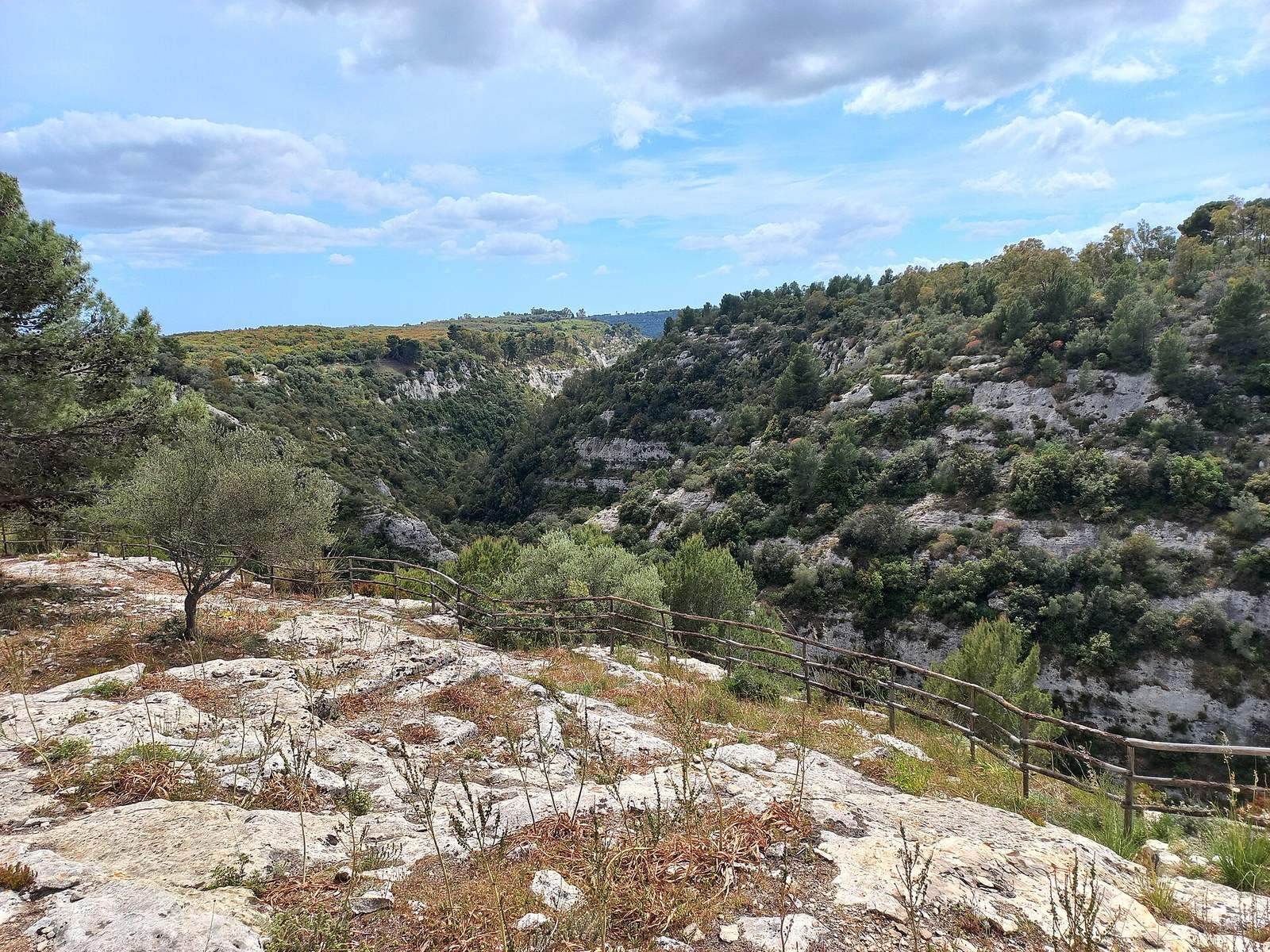
The remains spread across several levels of Mount Alveria, a heart-shaped hill about 409 metres high and enclosed by deep ravines. The site lies near the sources of the Asinaro River, around 14 kilometres from modern Noto and 20 kilometres from the coast. Its physical fabric includes rock-cut features and stone-built structures. Prehistoric habitation consisted of separate hut clusters, while a Greek-period urban nucleus probably occupied a lower terrace above the Durbo valley. In the medieval town, three principal squares, the Crucifix, Main, and Santa Venera squares, were connected by the winding main street, Via Piana, also called the Cassaro. The southern lobes of the hill were used for cultivation and were uninhabited before the 1693 earthquake.
Greek civic and religious remains
Agora, temples, and hero shrine
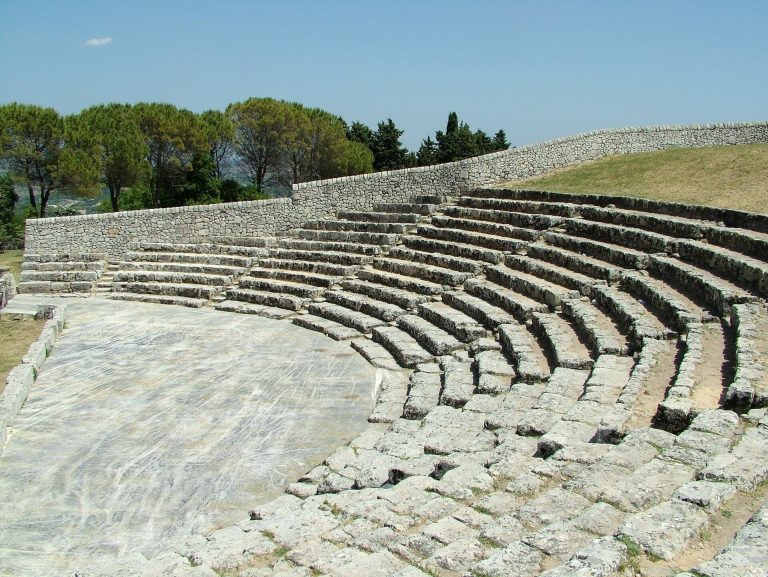
The Greek-period city included an agora, or public gathering place, temples, and theaters. Its third-century-BCE hero shrine was a monument associated with the worship of a hero. Niches in the structure held pinakes, decorated tablets used as votive offerings.
Gymnasium and theaters
The third-century-BCE gymnasium is partly cut into the rock and partly built of stone. A Greek inscription honoring Hieron helped identify the building; German scholar Georg Kaibel found it in 1894. The original inscription is preserved in Noto’s Civic Museum, while a copy is displayed at the site. Remains of the ancient amphitheater are also recorded alongside those of the theaters.
Fortifications and castle
Defensive walls and gates
Visible sections of Greek megalithic defensive walls belong to the ancient city. Later fortifications enclosed both Noto and the mountain. Although damaged in the earthquake, several stretches of these walls still stand. Their two principal gates were the Porta della Montagna to the north and a southern gate; seven smaller entrances also served the enclosure.
Royal Castle
The Royal Castle was joined to the fortifications and contained a large Hall of Arms and stables. Its surviving remains include towers, a main tower dated to 1431, and the former prison. Prisoners left names, images of contemporary ships, and repeated depictions of a board game on the prison walls, along with bas-reliefs. Cannon openings remain visible near the Porta della Montagna. The earthquake destroyed much of the castle, though parts remain in good condition. Its gate bears the Latin motto Numquam vi capta, meaning “Never captured by force.”
Tombs and catacombs
Prehistoric and Sicel tombs
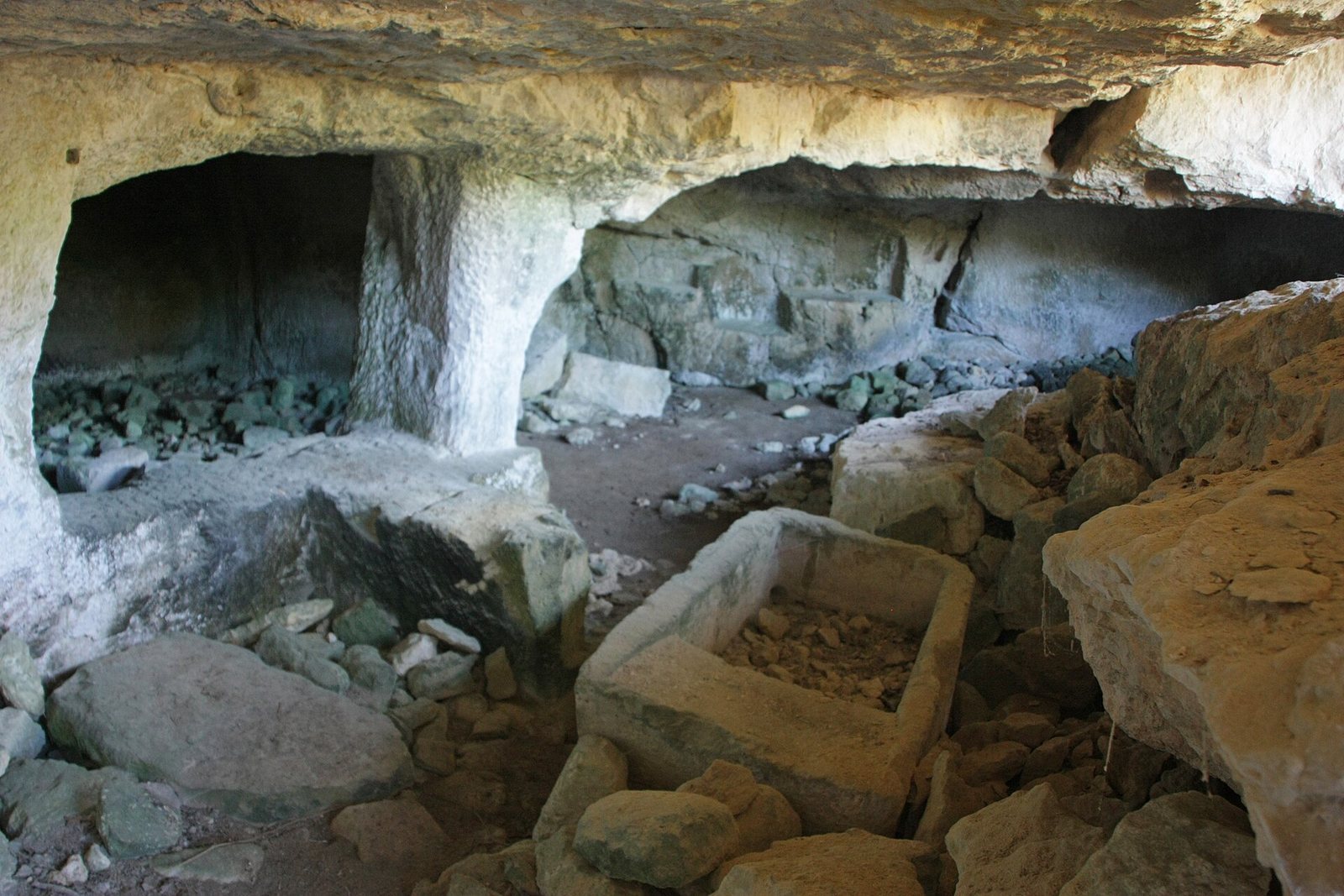
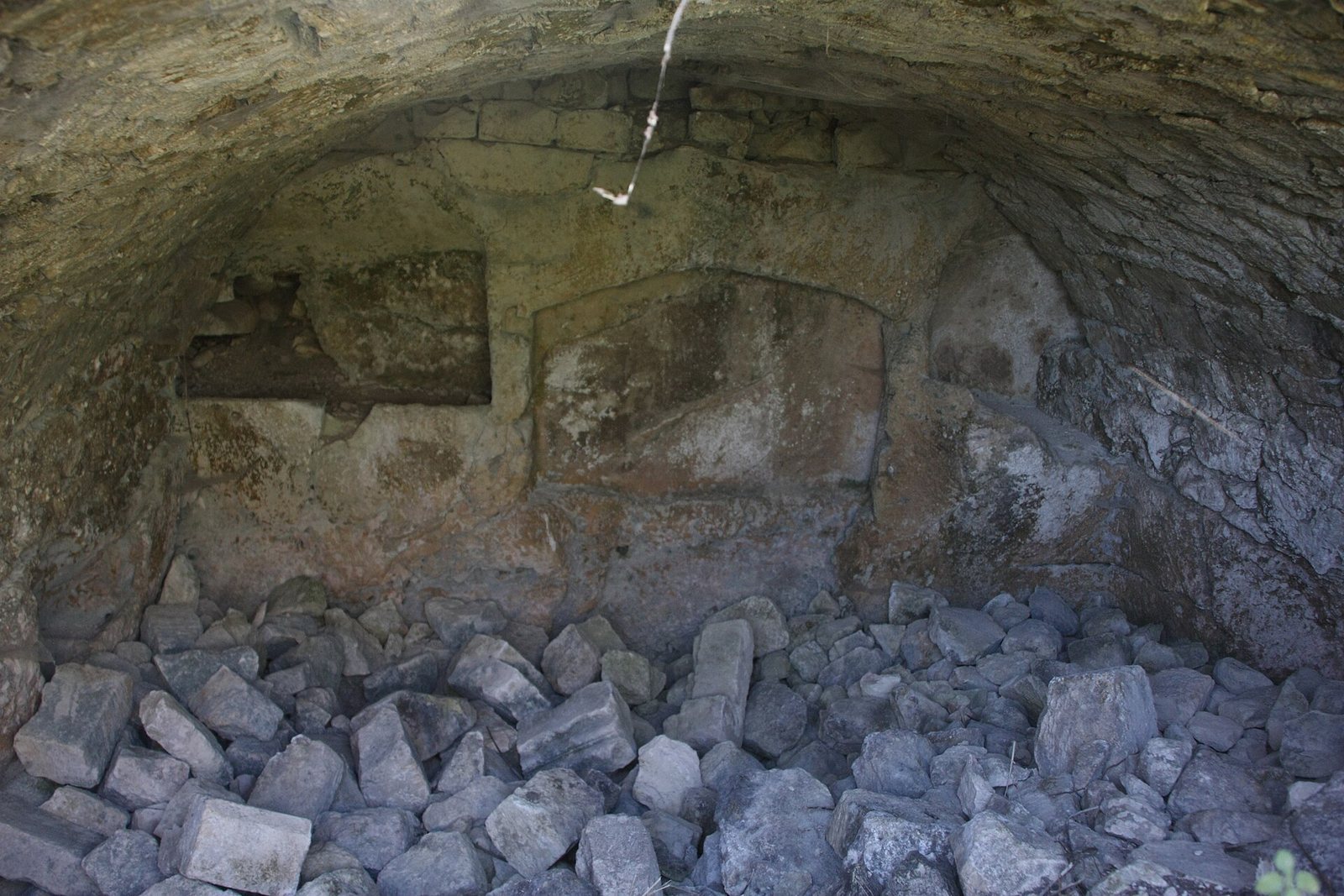
Numerous prehistoric rock-cut tombs occupy the surrounding ravines. Beside the Salitello stream, a Sicel necropolis dated to 730–650 BCE contains chamber tombs cut into the rock. Other Sicel burial grounds at the site date to the ninth and eighth centuries BCE.
Grotta delle Cento Bocche
Near the northern entrance, the small Byzantine catacomb of Grotta delle Cento Bocche contains remains of canopy tombs. Ceiling projections resembling throats gave the cave its name. It later served as a sheepfold and, during the Second World War, as a bunker because of its position overlooking the Salitello valley.
Grotta del Carciofo
Grotta del Carciofo is a Jewish catacomb or tomb. Its name reflects two images of a Jewish menorah, a religious lampstand, which local farmers mistook for artichokes. The menorah images provide evidence of a Jewish community at Noto.
Waterworks and tanneries
West of Mount Alveria, the Asinaro rises in the Carosello valley. There, rock-cut tanneries associated with the Arab period remain alongside water channels, sluice gates, and mills. The water system served leather processing, and the tanning tanks are still intact.
Churches and religious houses
Church of Saint Nicholas
The town’s principal church, known as the Chiesa Maggiore, was dedicated to Saint Nicholas. It was believed to have been founded around the time Count Roger I expelled the Saracens and became a collegiate church, served by a body of clergy, in the early seventeenth century. The church held the urn of Corrado Confalonieri, which is now kept in the cathedral of modern Noto.
Church of the Most Holy Crucifix
The parish church of the Most Holy Crucifix was first dedicated to Our Lady of the Castle, after its location. The Landolina family financed its restoration, and their coat of arms was painted on the ceiling. A painting of the Crucifix, traditionally attributed to Saint Luke, was placed beneath the dome and moved to a dedicated chapel on 27 March 1514. A bell tower stood above the chapel, which was over a bridge; a plaque praised Noto’s ability to astonish the Sicilians.
Only the face of Christ survives from the painting. It is kept in modern Noto on a gilded cross made by Rosario Gagliardi. The church also venerated a gold reliquary of the Holy Thorn and a white Madonna statue by Francesco Laurana. The statue is now held in a church in the new city.
Church and hermitage of Santa Maria della Provvidenza
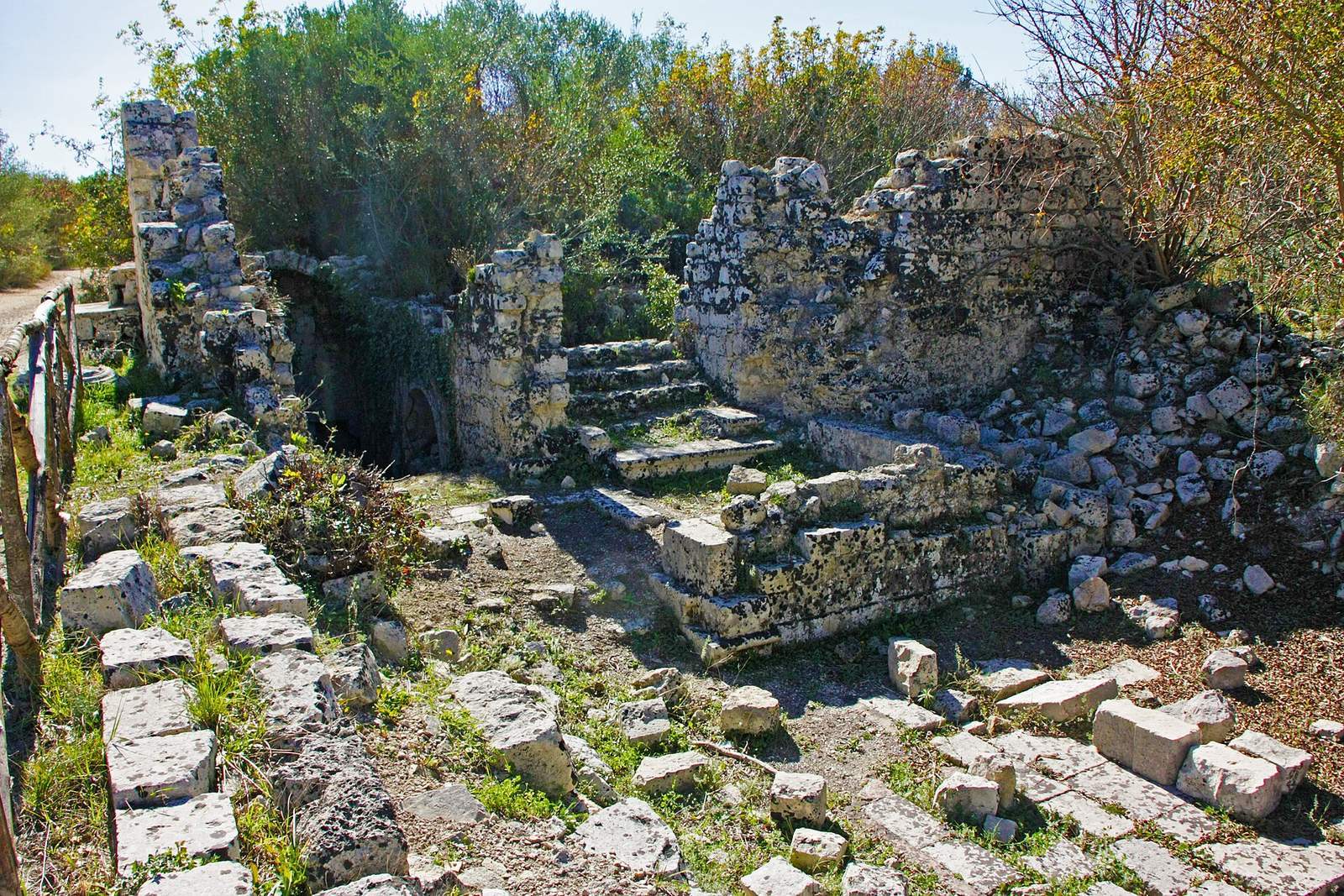
The church and hermitage of Santa Maria della Provvidenza stand in the southern outer part of ancient Noto. Built in 1723 over an earlier hermitage destroyed by the earthquake, the complex survives in a degraded condition, though its convent and church remain. The church has a Baroque façade, stucco decoration, and paintings on its ceilings. Time and vandalism have damaged its interior.
Church of Saint Elijah
The small church of Saint Elijah was built over a much older structure thought to have been a watchtower monitoring the coast near Pachino. Its façade consists of large squared stones laid without mortar and was described as unique in Sicily. An inscription recalled the transformation of a laborious work of giants into a church dedicated to Elijah. The church was dedicated to Elijah of Noto, a hermit who may have died around 1100. It had been closed for a long time before the earthquake of 1693.
Carmelite church
Built in the early seventeenth century over an earlier church, the Carmelite church had three aisles and two rows of columns. Surviving features include sections of walls, column bases, and tombs of Carmelite friars. Reliefs of crossed bones mark the outlines of the tombs.
Monastery of Santa Maria dell’Arco
The Cistercian monastery of Santa Maria dell’Arco stood about six miles north of the town. It was a daughter house of Ferraria in the Clairvaux branch of the Cistercian order. Its church venerated relics of Blessed Nicolò of Noto, some of which were held in silver reliquaries.
Jesuit convent and church
The Jesuit convent and its adjoining church, opposite the ruins of Palazzo Belludia, were completed in 1606. Baron Carlo Giavanti of the fief of Bussello financed the complex. Its remains include a side wall of the convent and column bases from a church probably built with three aisles.
Palaces and hospital
Palazzo Landolina and Palazzo Impellizzeri
Palazzo Landolina was among Noto’s principal palaces. Its Baroque decoration included two limestone eagles supporting the central balcony, probably representing the strength of the Landolina family. Palazzo Impellizzeri is also identified among the town’s palaces.
Hospital of San Martino and Palazzo Belludia
The Hospital of San Martino, also called the Hospital of Santa Maria di Loreto, is connected to a structure cut into the rock that may have served as an ancient oratory. At the palace of the barons of Belludia, the surviving arrangement of rooms can still be made out.