Arenenberg Castle with Chapel and Park: A Beauharnais and Bonaparte Estate in Switzerland


Site at a Glance
- Rating
- 4.6
- Popularity
- Medium
- Country
- Switzerland
- Primary era
- Early Modern
- External website
- Open
- Eras represented
- Early Modern, Modern
- Civilizations
- Holy Roman Empire, Swiss
- Site type
- Domestic
- Remains
- Castle
On this page12 sections
History
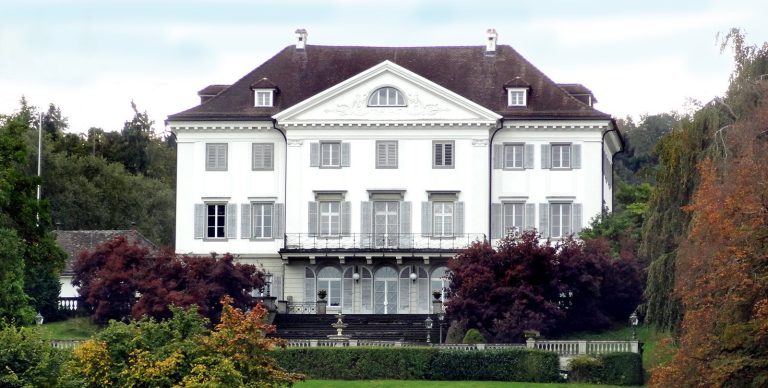
Arenenberg Castle with Chapel and Park is an estate in Salenstein, Switzerland, on the Untersee of Lake Constance. Its present appearance largely reflects the nineteenth-century transformation of an earlier late-Gothic residence, while its historical importance comes chiefly from its association with Queen Hortense de Beauharnais and her son, Louis Napoleon, the future Emperor Napoleon III.
From Narrenberg to Arenenberg
A farmhouse called Narrenberg stood on the site before the castle was built in the early sixteenth century by Sebastian Geissberg, who served as mayor of Constance from 1546 to 1548. In 1585, when the estate belonged to Hans Konrad von Schwarach, it received the status of a Freisitz, a privileged estate exempt from ordinary taxes and dues. Ownership changed several times before Arenenberg passed to the von Streng family in the eighteenth century.
The name Narrenberg gradually gave way to Arenenberg, perhaps through association with the nearby slope called Arnhalde. Arenenberg, and sometimes Arenberg, became established forms during the eighteenth or nineteenth century.
Hortense de Beauharnais and the transformation of the estate
Johann Baptist von Streng sold Arenenberg in 1817 to Hortense de Beauharnais, who was living in exile in Constance. Hortense was the daughter of Empress Joséphine, Napoleon I’s first wife, and the estranged wife of Louis Bonaparte, who had been King of Holland from 1806 to 1810.
Before Hortense began living at Arenenberg intermittently in 1818, the residence underwent extensive remodelling under the direction of the Constance builder Johann Baptist Wehrle. The alterations replaced its earlier fortified character with a French country residence furnished in the Empire style, the formal French decorative style associated with Napoleon I and imagery recalling ancient imperial models.
Hortense made Arenenberg her principal home and remained there until her death on 5 October 1837. She turned the estate into an important centre of aristocratic and social life around Lake Constance. Her guests included Alexandre Dumas, Julie Récamier, François-René de Chateaubriand, Casimir Delavigne, and Count Francesco Arese.
Family members also established residences nearby. In 1819, Hortense’s brother Eugène de Beauharnais acquired the former Sandegg estate and built Schloss Eugensberg above the medieval Sandegg castle. This allowed him to remain close to Hortense during the summer.
Louis Napoleon at Arenenberg
Hortense’s son Louis Napoleon spent periods at Arenenberg from 1818 to 1836 and again in 1837 and 1838. After studying in Augsburg, he continued his education at the estate with professors from Constance. They taught him natural sciences, art, philosophy, and military subjects, and he also learned Swiss German.
In 1832, the Canton of Thurgau granted Louis Napoleon honorary citizenship even though he was not Swiss. At Arenenberg he wrote military and political works and planned his unsuccessful coup attempt in Strasbourg in 1836. He returned to the estate in 1837 while his mother was dying. After her death, political pressure forced him to leave Switzerland.
Imperial ownership and later history
Louis Napoleon sold Arenenberg in 1843 to Karl Keller, a former music teacher who had acquired wealth through marriage. In April 1855, Empress Eugénie, the wife of Napoleon III, bought the estate back as a birthday present for her husband. Arenenberg was renovated and partly remodelled in 1855 and again in 1874.
Napoleon III visited Arenenberg in August 1865 and delivered a speech in the Thurgau dialect. After his death in 1873, Eugénie continued to visit the estate. She donated Arenenberg to the Canton of Thurgau in 1906.
The castle now houses the Napoleonmuseum. The wider estate also contains the canton-operated Arenenberg Education and Advisory Centre, with vocational schools for agriculture and domestic studies and for musical-instrument making, together with agricultural further-education facilities. The castle and park form a cultural monument of European importance.
Remains
Arenenberg consists of a principal castle, a chapel facing the lake, and an approximately 12-hectare park laid out in the English landscape-garden style. This approach uses apparently naturalistic lawns, plantings, paths, and views rather than the strict geometric symmetry of a formal garden. The surviving buildings and designed landscape combine the remains of the earlier residence with the changes made for Hortense and her family.
Castle and chapel
The principal castle
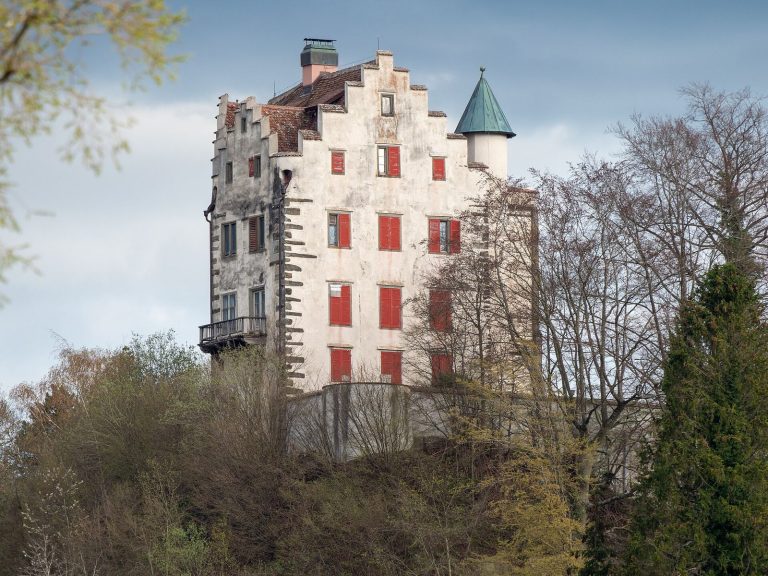
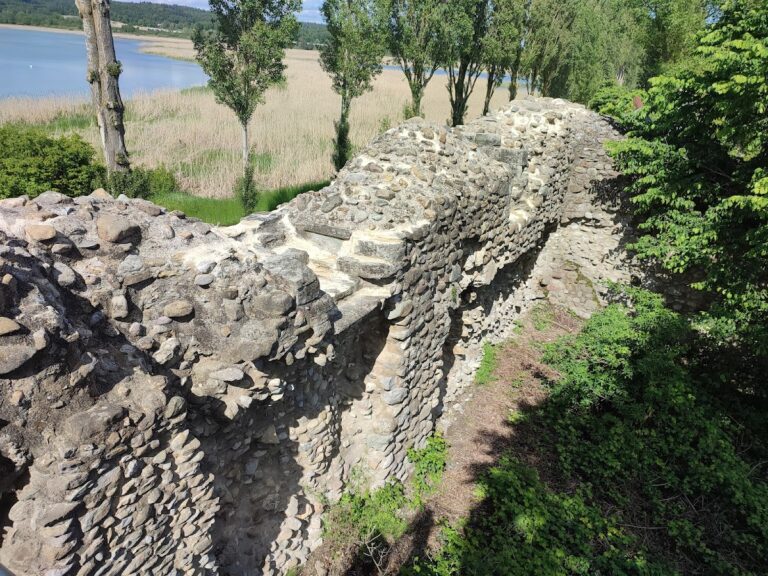
The castle is a well-preserved building whose current form derives largely from the nineteenth-century remodelling of the earlier late-Gothic residence. The former structure had stepped gables, windows with raised central bays, an enclosing wall, a tower, and a drawbridge. During the alterations before 1818, the enclosing wall was demolished, the battlements were removed, the tower above the main building was dismantled, and all but one of the service buildings were taken away.
Inside, the rooms were redecorated in the Empire style with textiles, furniture, statuettes, and paintings recalling Napoleon I. The building now contains the Napoleonmuseum, and most of its furnishings are original. Empress Eugénie removed valuable objects before donating the estate, so some rooms were later refurnished. The ground floor includes a vestibule, winter garden, Queen Hortense’s salon, lower lakeside salon, library, dining salon, and bell system. The first floor contains Queen Hortense’s bedroom and death room, her boudoir and study, the study of the son of Empress Eugénie and Napoleon III, Empress Eugénie’s salon, an upper lakeside salon, Napoleon III’s bedroom, Empress Eugénie’s bedroom, and a toilet. Paintings and other works of art from the Empire period are displayed in the museum rooms, while periodic exhibitions have also occupied the third floor.
The Neo-Gothic chapel
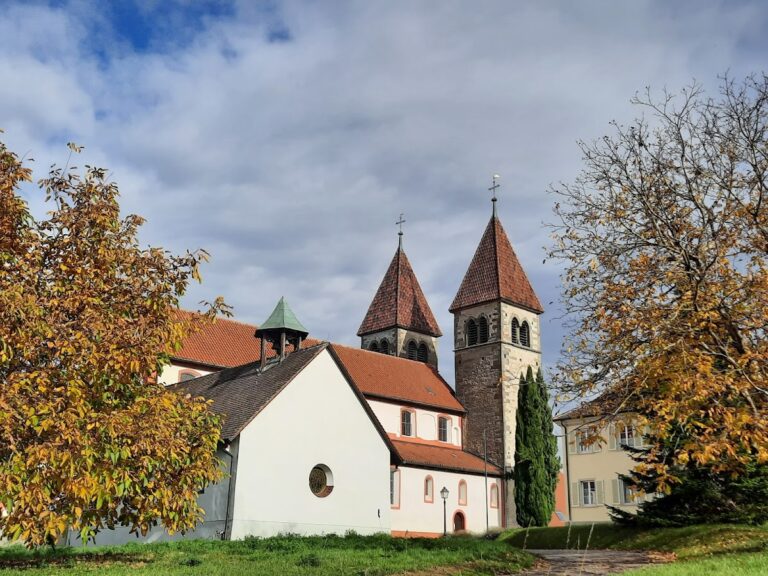
A small Neo-Gothic chapel stands in front of the castle entrance, oriented toward the lake. Hortense built it in 1832. Its simple exterior includes a hipped roof, a roof form with slopes on all sides.
Park and surviving garden structures
The English landscape park
Hortense established the landscape park as an approximately 12-hectare English landscape garden, continuing a tradition associated with her family. Hermann von Pückler-Muskau redesigned it from 1834 and gave it much of its present appearance. The original design may have been created by the landscape architect Louis-Martin Berthault.
The park includes a small hermitage and a viewing pavilion flanked by two satyrs. A circular path follows the slope between vineyards and garden areas and provides views over Lake Constance. The park landscape was largely restored in 2008 for the bicentenary of Napoleon III’s birth, and the restored park reopened later that year.
Ice cellar and vaulted space
Set into the sandstone embankment along the southern side of the park are the entrance to a small, well-preserved historic ice cellar and the entrance to a vaulted space that probably formed part of the former privy. These structures preserve elements of the estate’s service and sanitary arrangements within the designed landscape.